
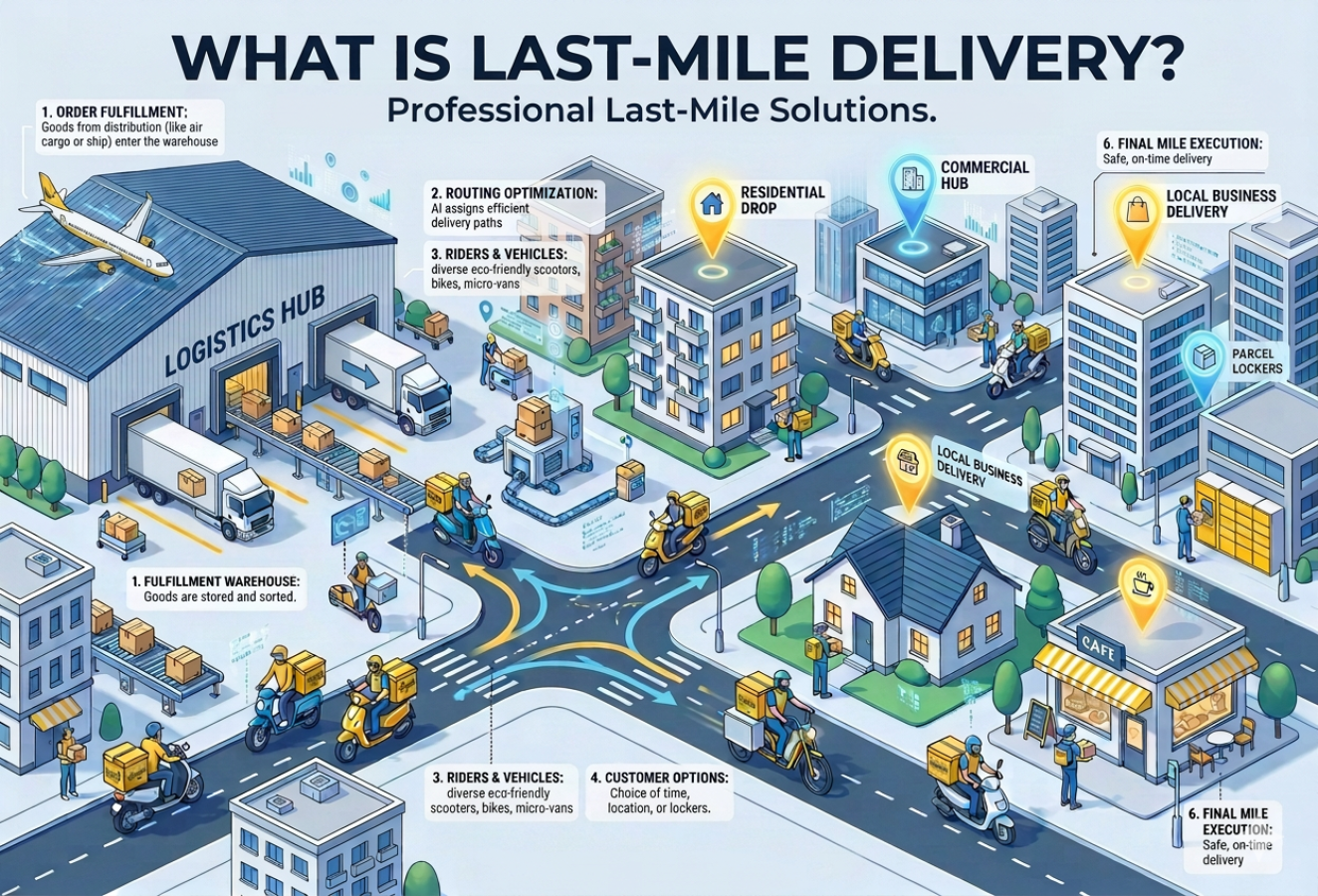
The final stretch of delivery is also the most expensive, most complex, and most critical to your business. Here’s everything you need to know about last mile delivery – and how to master it.
The package has traveled hundreds – maybe thousands of miles by ship, rail, or truck. It has passed through distribution centers, sorting facilities, and regional hubs. Now it sits in a warehouse just a few miles from the customer’s front door. And yet, this short remaining journey is about to become the hardest, costliest, and most consequential leg of the entire trip.
Welcome to the world of last mile delivery.
Whether you run an e-commerce store, manage logistics for a retail chain, or simply want to understand why your online orders sometimes arrive late, understanding last mile delivery is essential. This guide breaks down what it means, why it matters, the challenges it presents, and the innovative solutions including platforms like Maponomy that are reshaping how goods reach your doorstep.
What Is Last Mile Delivery: A Clear Definition
Last mile delivery refers to the final stage of the supply chain the movement of goods from a local distribution center, fulfillment hub, or warehouse to the customer’s doorstep. The term was originally borrowed from the telecommunications industry, where connecting individual homes to the main network proved disproportionately difficult. In logistics, the parallel is strikingly similar: getting a single package across the last few miles to a residential address is far more complex than shipping a container across an ocean.
Despite covering the shortest physical distance in the entire supply chain, this final leg is widely regarded as the most operationally intensive. It involves navigating residential streets, managing individual delivery windows, coordinating with customers, and handling the unpredictability of urban and suburban environments.
In practical terms, last mile delivery is the only part of the supply chain that your customer actually sees. It is the handshake between your brand and the buyer and when it goes wrong, the consequences are felt immediately.
Why Does Last Mile Delivery Matter So Much
The significance of last mile delivery has grown enormously in the age of e-commerce. Here’s why it deserves your close attention.
It dominates delivery costs. Research consistently shows that last mile delivery accounts for approximately 53% of total shipping expenses. The reasons are clear: delivering individual packages to scattered residential locations is inherently less efficient than moving consolidated freight between warehouses. Fuel, labor, vehicle maintenance, and the sheer unpredictability of urban routes all contribute to this outsized cost burden.
It shapes customer loyalty. Studies indicate that nearly 98% of consumers say the delivery experience directly impacts their loyalty to a brand. In a marketplace where competitors are one click away, a late, damaged, or mishandled delivery can send a customer straight to a rival. Conversely, a smooth and transparent delivery experience builds trust, drives repeat purchases, and generates positive word of mouth.
It’s a massive and growing market. The global last mile delivery market was valued at approximately $184 billion in 2025 and is projected to reach nearly $278 billion by 2030, growing at a compound annual rate of over 8%. This expansion is driven by surging e-commerce volumes, rising consumer expectations for speed, and increasing investments in delivery technology.
Speed expectations are accelerating. Same-day delivery is no longer a premium luxury – it is rapidly becoming the baseline expectation. Roughly 30% of online shoppers now expect their orders to arrive the same day, and anything longer than two to three days feels unacceptably slow to a growing share of consumers.
How Does the Last Mile Delivery Process Work?
While the specific workflow varies by company, the last mile delivery process generally follows a consistent pattern involving three key stakeholders: the warehouse manager, the dispatch planner, and the driver.
It starts when the warehouse manager prepares order details, load information, and delivery priorities, then notifies the dispatch planner that new orders are ready. The dispatch planner receives this information, creates an optimized route plan, assigns vehicles, and monitors trip progress in real time handling issues as they arise. Finally, the driver receives their route assignment, confirms it, and starts the trip using navigation tools, sending real-time updates on delays, uploading proof of delivery, and marking each stop complete.
Throughout this workflow, customers receive real-time tracking updates via SMS, email, or mobile apps. This kind of seamless coordination between warehouse operations, dispatch planning, and on-the-ground execution is exactly what modern platforms like Maponomy’s Delivery Planner Suite are designed to automate and streamline connecting every stakeholder in a single, intelligent system.
This sounds straightforward on paper, but in practice, each step is rife with variables that can derail the entire process.
The Biggest Challenges in Last Mile Delivery
Understanding the obstacles is the first step toward overcoming them. The following challenges represent the most persistent pain points for logistics operators worldwide.
High Operational Costs
The per-package cost of last mile delivery is significantly higher than any other stage in the supply chain. Individual residential stops, tight delivery windows, urban congestion, and rising fuel prices all push costs upward. Failed deliveries – when a customer isn’t home or an address is incorrect – add further expense, with each failed attempt costing retailers an estimated $17 or more on average.
Inaccurate Addresses and Failed Deliveries
In emerging markets especially, incorrect or incomplete addresses are a major source of failed deliveries and costly returns. Drivers waste time searching for destinations, packages get returned to origin, and every failed attempt compounds operational costs. Approximately 5% of last mile deliveries fail on the first attempt – and bad address data is one of the leading causes.
Urban Congestion and Traffic Delays
Dense city environments create a perfect storm for delivery delays. Heavy traffic, limited parking, pedestrian zones, and restricted delivery hours all slow drivers down. What looks like a short distance on a map can translate into significant time lost navigating congested streets, particularly during peak hours.
Rising Customer Expectations
Today’s consumers expect fast, free, and perfectly transparent delivery. They want real-time tracking, flexible scheduling, multiple delivery options, and instant communication if anything changes. Meeting these expectations at scale while keeping costs manageable is one of the defining tensions in modern logistics.
Inefficient Route Planning
Many businesses still rely on manual or outdated systems for route planning. Without intelligent optimization, drivers cover unnecessary miles, waste fuel, and miss delivery windows. Ineffective routing doesn’t just inflate costs – it also reduces the number of deliveries a driver can complete in a single shift, directly impacting productivity and customer satisfaction.
Lack of Real-Time Visibility
Without real-time data on driver locations, delivery statuses, and potential disruptions, operations managers cannot proactively resolve problems. Customers are left in the dark, wondering when their packages will arrive and the lack of transparency erodes trust in the brand.
Sustainability Pressures
Consumers and regulators alike are demanding greener delivery practices. The environmental footprint of thousands of delivery vehicles crisscrossing cities every day is substantial, and companies face growing pressure to reduce emissions, minimize packaging waste, and adopt more sustainable delivery methods.
Proven Solutions for Last Mile Delivery Challenges
The good news is that the industry is responding to these challenges with a wave of innovation. Platforms like Maponomy exemplify how AI-powered logistics technology is addressing these pain points end-to-end.
AI-Powered Route Optimization
Artificial intelligence and machine learning are transforming how delivery routes are planned and executed. Modern route optimization engines analyze real-time traffic data, weather conditions, delivery windows, vehicle capacity, driver working hours, and dozens of other constraints to calculate the most efficient paths.
Maponomy’s Intelligent Route Optimization takes this further by combining automated route generation with manual flexibility – allowing dispatch planners to fine-tune routes based on ground-level realities. The system also determines the optimal number and type of vehicles to deploy, plans sortation at the warehouse, and accounts for service and unloading times. Businesses using this kind of optimization typically achieve a 10-15% reduction in logistics costs through shorter routes, fewer vehicles, and better fleet utilization.
Automated Dispatch Planning
Manual dispatching is slow, error-prone, and incapable of handling the complexity of modern delivery operations. Automated dispatch planners optimize delivery assignments in real time, using dynamic route adjustments and real-time data to ensure that the right driver is assigned to the right delivery at the right time.
Maponomy’s Automated Dispatch Planner calculates the ideal number of vehicles, reduces delivery times through dynamic routing, and empowers transportation managers to plan daily operations with precision – all from a single SaaS dashboard.
Address Parsing and Geocoding
One of the most overlooked causes of delivery failure is inaccurate address data. In many markets, customers enter partial, misspelled, or incomplete addresses – and traditional systems simply cannot resolve them. This leads to wasted driver time, failed deliveries, and expensive returns.
Maponomy’s Address Parsing and Geocoding solution tackles this problem directly. The system retrieves accurate latitude and longitude coordinates even from partially completed or semi-structured addresses, helping delivery personnel navigate as close as possible to the actual destination. For both B2B and B2C operations, this dramatically reduces return-to-origin rates and improves first-attempt delivery success.
Real-Time Live Tracking
Providing customers and operations teams with live visibility into delivery status has become a baseline expectation. Modern live tracking dashboards offer real-time vehicle location monitoring, GPS pings from third-party mobile apps and devices, historical track data for performance analysis, and automated notifications at every stage of the delivery journey.
Maponomy’s Live Tracking Suite integrates seamlessly with third-party apps and GPS devices, giving both dispatch teams and end customers full transparency from dispatch to doorstep.
Courier Navigation and Driver Mobile Apps
The driver is the most critical link in the last mile chain, and equipping them with the right tools makes all the difference. Mobile-first courier navigation apps provide turn-by-turn directions along optimized routes, smart delivery sequencing, proof-of-delivery capture through signatures and photos, automated delivery status logging, and support for multiple travel modes with toll and highway avoidance.
Maponomy’s Courier Navigation app is purpose-built for last mile operations, offering multi-language support and seamless integration with the broader delivery management ecosystem. It empowers drivers to work more efficiently while ensuring that operations teams maintain full oversight.
Real-Time Customer Notifications
Keeping customers informed at every stage of the delivery journey reduces missed deliveries, decreases inbound support queries, and builds brand trust. Multi-channel notification systems deliver shipment tracking links, proactive delivery alerts, and key performance metrics to customers through their preferred communication channels.
Dashcam and Streetview Integration
An emerging innovation in delivery management is the combination of real-time dashcam footage with interactive streetview navigation. This capability helps logistics teams verify delivery points before drivers arrive, monitor driver behavior and accountability, and make better-informed route planning decisions based on actual road and location conditions.
Network Optimization
Beyond individual route planning, businesses need to optimize their entire transportation network – determining the best sourcing warehouses, the most efficient loading locations, and the shortest transit paths across their full operation. Network optimization tools analyze these variables at scale, reducing systemic inefficiencies and lowering overall supply chain costs.
The Role of Technology in Shaping the Future
Technology is the single greatest force reshaping last mile delivery. AI and machine learning are already embedded in route planning, demand forecasting, and customer communication. Predictive analytics enable businesses to anticipate demand spikes before they occur, pre-position inventory, and allocate resources proactively rather than reactively.
Autonomous vehicles and drone delivery are moving beyond pilot programs. The delivery drone market is projected to grow from roughly $1 billion in 2025 to over $4 billion by 2030, and robotic sidewalk couriers are already operating in multiple cities. Electric vehicle fleets are expanding rapidly as well, driven by both environmental regulations and the economic advantages of lower fuel and maintenance costs.
The Internet of Things is connecting delivery vehicles, packages, and infrastructure into a single data ecosystem, providing unprecedented visibility and control. Platforms that combine route optimization, live tracking, dispatch automation, driver navigation, and customer notifications into a unified system as Maponomy does with its modular, customizable SaaS suite represent the direction the entire industry is heading.
As these technologies mature and converge, the last mile will become faster, cheaper, more transparent, and more sustainable. Businesses that invest now in building a technology-driven delivery infrastructure will be positioned to lead; those that cling to legacy systems risk falling behind in a market that shows no signs of slowing down.
Key Takeaways for Businesses
Mastering last mile delivery is no longer optional for any business that ships products to consumers. The companies that thrive in this space will be those that treat the final mile not as a cost center to be minimized, but as a strategic asset to be optimized. This means investing in intelligent routing technology, building flexible fulfillment networks, embracing sustainable practices, and above all, keeping the customer experience at the center of every decision.
Whether you’re a courier company looking to reduce driver mileage, an e-commerce business aiming to eliminate failed deliveries, or a logistics provider seeking end-to-end visibility, the right technology platform makes the difference between struggling with the last mile and mastering it.
The last mile is where logistics meets loyalty. Get it right, and you earn customers for life. Get it wrong, and they will remember and they will tell others.
Ready to optimize your last mile operations? Explore Maponomy’s Delivery Planner Suite and discover how AI-powered route optimization, live tracking, and intelligent dispatch planning can transform your delivery performance.