
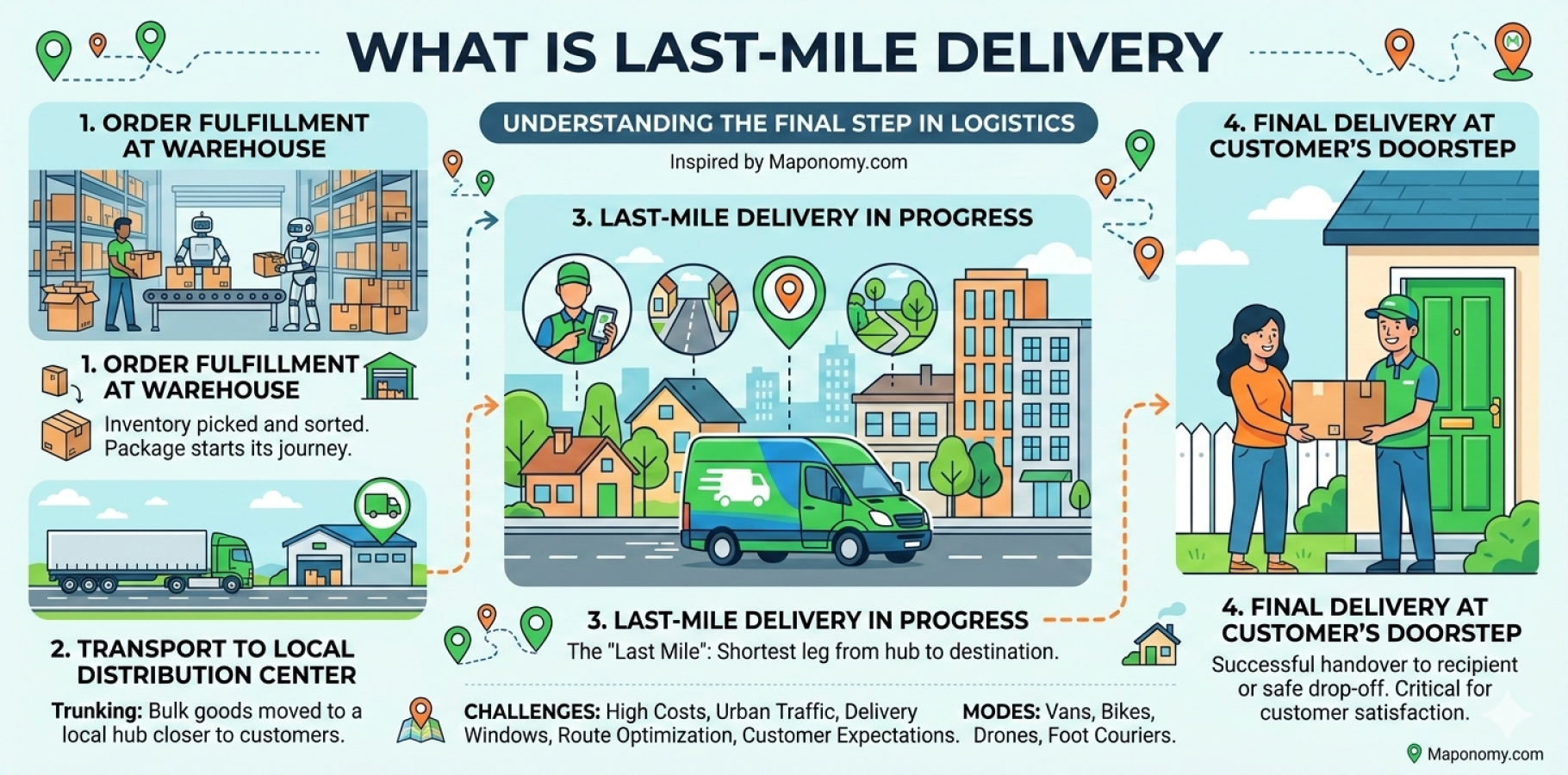
Last-mile delivery planning is the strategic backbone behind every successful delivery operation. Here’s how intelligent planning – powered by the right APIs and SaaS tools – turns the most expensive mile into your biggest competitive advantage.
Every package that arrives at your customer’s doorstep started as a planning decision. Which vehicle should carry it? What route should the driver take? How many stops can be completed before the delivery window closes? What happens when an address is incomplete or traffic reroutes the entire schedule?
These are the questions that last-mile delivery planning exists to answer – and in an industry where the final mile accounts for over 53% of total shipping costs, the quality of those answers determines whether your operation thrives or bleeds margin.
This article explains what last-mile delivery planning actually means and involves, why it matters more than ever, the core components that make it work, and how platforms like Maponomy provide the APIs, SaaS tools, and delivery suites that make intelligent planning possible at scale.
What Is Last-Mile Delivery Planning
Last-mile delivery planning is the strategic process of organizing, optimizing, and coordinating every element involved in moving goods from a distribution hub or warehouse to the customer’s final destination. It encompasses far more than simply choosing a route on a map. Effective planning involves determining how many vehicles to deploy, what type of vehicles to use, how to sequence stops for maximum efficiency, how to handle delivery windows and customer constraints, how to utilize vehicle load capacities and how to adapt when conditions change mid-shift on the way to delivery destination.
At its core, delivery planning solves two of the most complex problems in logistics: the Vehicle Routing Problem (VRP) and the Traveling Salesman Problem (TSP). These are mathematically intensive optimization challenges that grow exponentially in complexity as the number of stops, vehicles, and constraints increases. A delivery operation with 50 stops and 5 vehicles, for example, has billions of possible route combinations – and only a handful of them are genuinely optimal.
This is precisely why modern delivery planning has moved from clipboards and intuition to AI-powered algorithms and cloud-based platforms. Manual planning simply cannot process the volume of variables involved in today’s logistics environment at the speed the market demands.
Why Does Last-Mile Delivery Planning Matter
The impact of good or poor delivery planning ripples across every aspect of your operation.
Cost control. With last-mile delivery representing more than half of total shipping expenses, planning directly determines how much money you spend per delivery. Optimized routes reduce fuel consumption, minimize vehicle wear, and enable each driver to complete more stops per shift. Businesses that implement intelligent planning typically see a 10–30% reduction in logistics costs.
On-time performance. Customers have little tolerance for late deliveries. Planning that accounts for realistic travel times, traffic conditions, service durations, and delivery windows is essential for consistently meeting customer expectations. AI-powered route optimization can push ETA accuracy from 70–80% to above 95%.
Fleet utilization. Poor planning leaves vehicles underloaded and drivers underutilized. Effective planning maximizes truck capacity by weight, volume, and monetary value, ensuring you move the most goods with the fewest vehicles – directly reducing your cost per delivery.
Customer experience. Planning determines when customers receive their packages and how accurately they’re informed about delivery times. Transparent, reliable delivery builds loyalty – and studies show that 98% of consumers say the delivery experience impacts their willingness to purchase again.
Sustainability. Shorter, smarter routes mean fewer miles driven, less fuel burned, and lower carbon emissions. For businesses facing regulatory pressure and consumer demand for greener operations, delivery planning is a direct lever for environmental impact.
The Core Components of Last-Mile Delivery Planning
Effective delivery planning isn’t a single activity – it’s a system of interconnected capabilities working together. Here are the essential components that every planning operation needs to get right.
Route Optimization
Route optimization is the engine of delivery planning. It uses algorithms and real-time data to determine the most efficient sequence of stops and paths for each vehicle, balancing distance, time, traffic conditions, delivery windows, and vehicle constraints simultaneously.
Modern optimization goes well beyond shortest-distance calculations. It factors in driver working hours, maximum tasks per shift, service and unloading times, customer delivery windows, and truck-specific constraints like height restrictions and road limitations.
Maponomy’s Route Planner API is designed specifically for this level of complexity. It handles B2B and B2C last-mile route planning with support for vehicle deployment optimization, warehouse sortation planning, customer delivery windows, service and unloading time calculations, and truck utilization by weight, volume, and monetary value. The API integrates directly into existing TMS or OMS platforms as a plug-and-play solution, meaning businesses can gain advanced optimization capabilities without replacing their current systems.
Vehicle and Load Planning
Before a single vehicle leaves the depot, planners need to determine how many vehicles are required, which type of vehicle suits each route, and how to load each vehicle for maximum efficiency. Load planning ensures that packages are organized based on delivery sequence, pallet size, height restrictions, and stop order – minimizing handling time and ensuring drivers aren’t digging through a van to find the next package.
Maponomy’s Load Builder capability addresses this directly, maximizing loading capacity while minimizing costs through intelligent load and unload sequencing that aligns with the planned delivery route.
Dispatch Automation
Once routes and loads are planned, deliveries need to be assigned to drivers and dispatched efficiently. Manual dispatching is slow and error-prone – especially during peak volumes when hundreds of orders need to be distributed across a fleet within minutes.
Automated dispatch systems use real-time data and rule-based engines to assign deliveries dynamically, matching drivers to routes based on location, availability, vehicle type, and capacity. When conditions change – a cancellation, a priority order, a traffic delay – the system recalculates and adjusts automatically.
Maponomy’s Automated Dispatch Planner handles this entire workflow. It optimizes delivery routes while automating dispatch management, calculates the ideal number of vehicles needed, and makes dynamic route adjustments using real-time data. The result is faster dispatch cycles, fewer errors, and deliveries that stay on schedule even when plans change.
Accurate Address Resolution
One of the most overlooked elements of delivery planning is address quality. In many markets – particularly emerging economies – customers enter partial, misspelled, or unstructured addresses that traditional geocoding systems cannot resolve. The result is drivers circling neighborhoods, failed first-attempt deliveries, and expensive return-to-origin cycles. Every failed delivery costs an estimated $17 or more.
Solving this problem requires address intelligence built directly into the planning workflow – catching and correcting address issues before packages ever leave the warehouse.
Maponomy offers a full suite of Search and Place APIs designed for exactly this purpose. The Geocoding API converts addresses to precise latitude and longitude coordinates, ensuring every delivery location is accurately mapped before route planning begins. The Address Parsing API cleans up scrambled or erroneous addresses entered by customers, standardizing them into structured formats that geocoding engines can process accurately. The Reverse Geocoding API converts coordinates back into human-readable addresses, helping drivers navigate to exact locations. Together, these APIs form an address intelligence layer that eliminates one of the most costly sources of delivery failure.
Directions and Distance Calculation
Accurate route planning depends on accurate travel time and distance data. Planners need to know not just the distance between two points, but the realistic travel time considering road type, traffic conditions, vehicle restrictions, and tolls or highway avoidance preferences.
Maponomy’s Directions API provides exactly this. It builds routes for automobiles, delivery trucks, cargo vans, bicycles, motor scooters, and walking — returning turn-by-turn directions, exact travel times, distances, and detailed route information including elevation profiles and road properties. It supports multiple output formats (JSON, GeoJSON, XML) for seamless integration, and allows planners to customize routes by avoiding tolls, ferries, and highways, and to plan routes based on specific truck sizes.
For operations that need to calculate travel times between many locations simultaneously, the Distance Matrix API computes distances and travel times for up to 1,000 location pairs in a single request. This is essential for solving routing and logistics problems at scale, analyzing reachability for business locations, building store locators with estimated travel times, and optimizing crew routes for delivery, maintenance, or field service operations. The API supports multiple travel modes and includes approximated traffic data to simulate rush-hour conditions.
Real-Time Tracking and Execution Monitoring
Planning doesn’t end when the driver leaves the depot. The best delivery plans require real-time monitoring to ensure execution stays on track – and to enable rapid intervention when it doesn’t.
Maponomy’s Live Tracking Suite provides real-time vehicle location monitoring, GPS integration with third-party mobile apps and devices, historical track data for performance analysis, and automated notifications at every delivery milestone. This gives operations managers the visibility to compare planned versus actual performance and make adjustments in real time.
Driver Navigation and Execution
The driver is where planning meets reality. Even perfectly optimized routes need to be executed accurately on the ground, which requires purpose-built navigation tools.
Maponomy’s Courier Navigation app is a mobile-first solution that provides drivers with optimized turn-by-turn navigation, smart delivery sequencing, proof-of-delivery capture through signatures and photos, automated delivery status logging, and support for multiple travel modes with toll and highway avoidance. Multi-language support makes it suitable for diverse workforces operating across regions.
Customer Communication
Modern customers expect to be informed throughout the delivery process. Planning systems that integrate customer notifications – with live tracking links, ETA updates, and delivery confirmations – reduce missed deliveries and improve satisfaction scores.
Maponomy’s Real-Time Customer Notification system delivers multi-channel alerts at every key milestone, keeping customers informed from dispatch through doorstep delivery.
Analytics and Continuous Improvement
The final component of delivery planning is learning from every delivery to improve the next one. Comprehensive analytics on delivery completion rates, route efficiency, on-time performance, driver productivity, and cost per delivery enable planners to identify patterns, diagnose inefficiencies, and refine their approach over time.
Maponomy’s Reports and Analytics dashboard tracks real-time metrics including route statuses, event logs, and driver activity – providing the data foundation for continuous operational improvement.
How APIs Power Modern Delivery Planning
One of the most significant shifts in last-mile delivery planning is the move from monolithic software systems to API-first architectures. Rather than forcing businesses to replace their entire technology stack, modern delivery planning APIs plug directly into existing order management, warehouse management, and enterprise resource planning systems – adding intelligent optimization capabilities without disruption.
This is the philosophy behind Maponomy’s product architecture. Every core planning capability – route optimization, geocoding, address parsing, directions, distance matrices, and live tracking – is available as both a standalone API and as part of the integrated Delivery Planner Suite. Businesses can adopt individual APIs to enhance specific capabilities, or deploy the full SaaS suite for end-to-end delivery management including a web -based dispatch dashboard, mobile driver app, live tracking, and customer notifications.
This modular approach means a business can start with the Geocoding API to fix address accuracy problems, add the Route Planner API when they’re ready to automate route optimization, layer in the Live Tracking Suite for operational visibility, and scale to the full Delivery Planner Suite as their operation grows – all without ripping out existing systems.