
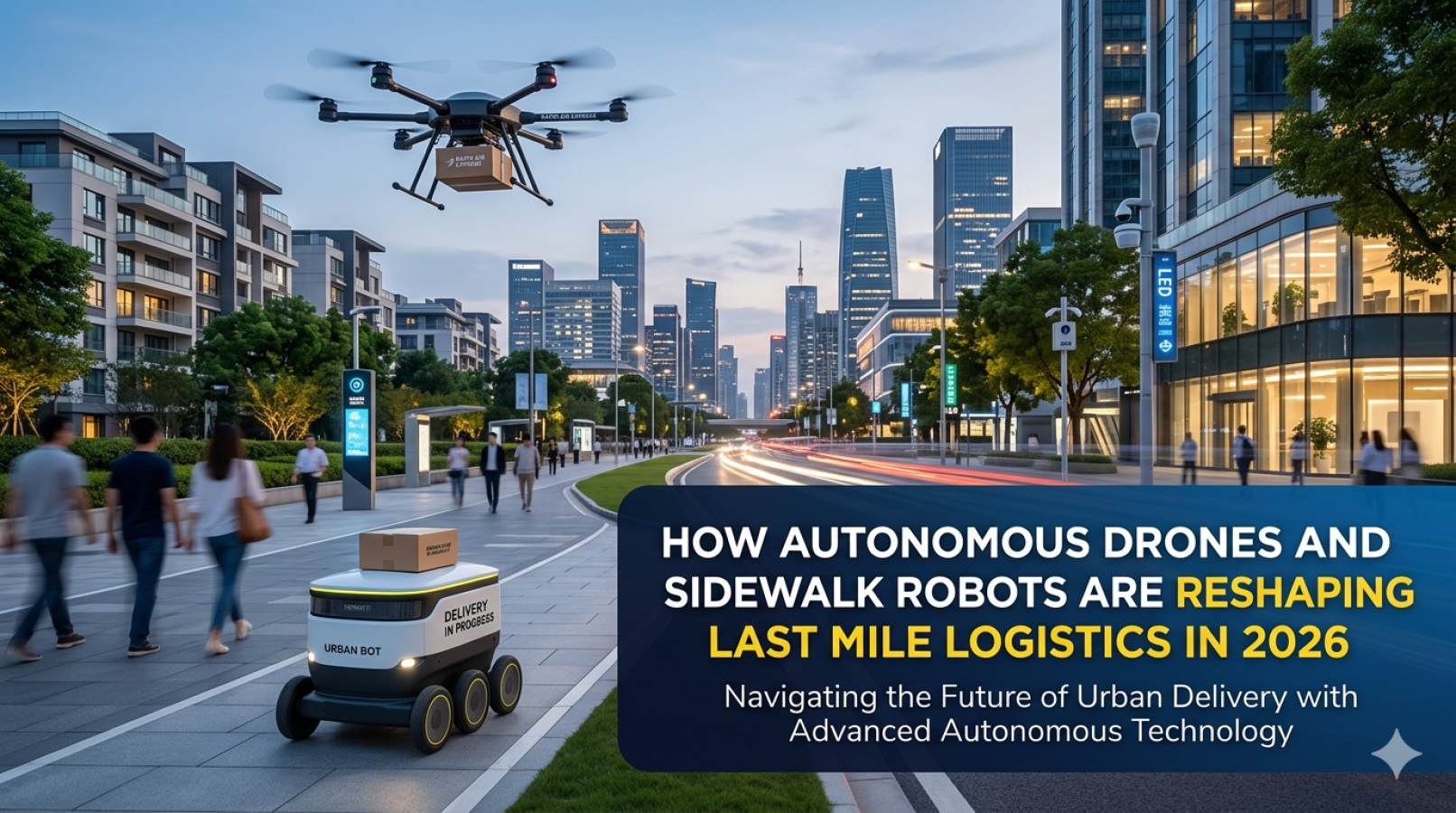
A small white robot rolls quietly along a university sidewalk in Texas, carrying a bag of tacos to a student who ordered them four minutes ago. Three thousand kilometres away, a fixed-wing drone descends over a suburban home in Arizona, lowering a pharmacy package on a tether before climbing back into the sky and returning to its launch pad. Neither delivery involved a human driver. Neither generated a gram of tailpipe emissions. Neither cost more than a dollar to complete.
These are not conceptual prototypes or trade show demonstrations. They are commercial delivery operations happening today, at scale, across hundreds of locations in multiple countries. The autonomous last mile delivery market was valued at approximately USD 1.3 billion in 2025 and is projected to reach USD 11.5 billion by 2035, growing at a compound annual rate of nearly 25 percent. Delivery robots have already surpassed 10 million completed deliveries globally. More than one million drones are expected to be carrying out retail deliveries by the end of 2026. And experts now predict that by 2030, over 80 percent of last mile deliveries could be automated in some form.
The technology is no longer the bottleneck. Regulatory frameworks, public acceptance, and operational economics are the variables that will determine how fast the transition happens. Understanding where things stand today, what is working, what is not, and what comes next is essential for any business that depends on getting products to customers efficiently.
What Is Autonomous Last Mile Delivery and Why Does It Matter?
The last mile is the final leg of a delivery journey, the stretch from a local distribution centre or fulfilment hub to the customer’s door. It is also the most expensive part of the entire supply chain. Industry estimates consistently place last mile costs at more than 50 percent of total delivery expenses. The combination of low drop density in residential areas, traffic congestion in urban centres, failed first-attempt deliveries, and the sheer labour intensity of loading, driving, parking, walking, and confirming hundreds of individual stops makes the last mile a persistent drag on profitability.
Autonomous delivery addresses this by replacing the human driver with machines, either aerial drones that fly over congestion entirely or ground-based robots that navigate sidewalks, bike lanes, and pedestrian paths. The economic logic is straightforward: machines do not take breaks, do not require benefits, do not get stuck in traffic in the same way, and can operate around the clock with consistent performance. Research has demonstrated that drone deliveries can cost as little as a fifth of what an equivalent trip in an electric van costs. Sidewalk robots achieve attractive unit economics once utilisation rates cross a threshold of roughly 15 to 30 deliveries per robot per day.
But the value proposition extends beyond cost. Autonomous delivery systems produce 84 percent fewer greenhouse gas emissions per parcel than diesel trucks. They consume up to 94 percent less energy. They can reach remote or underserved areas where traditional delivery economics make service unprofitable. And they offer a genuinely contactless experience that a significant portion of consumers now prefer.
Delivery Drones: From Pilot Programmes to Commercial Scale
Drones currently dominate the autonomous delivery landscape, holding approximately 49 percent of the market share by platform type as of 2025. The technology has matured rapidly, driven by advances in battery density, sensor miniaturisation, AI-powered navigation, and the gradual relaxation of airspace regulations in key markets.
How Drone Delivery Works in Practice
A typical drone delivery operation begins at a micro-fulfilment centre or retail store where packages are loaded onto the aircraft, either manually or through automated loading systems. The drone lifts off vertically, transitions to horizontal flight, and travels to the customer’s location using GPS-guided navigation supplemented by onboard sensors that detect and avoid obstacles. Upon arrival, the drone lowers the package using a tether or winch mechanism, placing it precisely on the customer’s lawn, driveway, or designated landing zone. The entire process, from order placement to delivery, can be completed in under 30 minutes for distances of up to 10 miles.
The payload limitations are real but well-matched to the most common delivery use cases. Most current platforms handle packages under 5 pounds, with some newer designs pushing toward 8 pounds. This covers the vast majority of pharmacy orders, fast food deliveries, convenience store items, and small e-commerce parcels. For the lightweight, time-sensitive deliveries that consumers value most, drones are not just competitive with van-based delivery. They are superior.
Where Drone Delivery Is Already Operational
The geographic spread of commercial drone delivery has expanded significantly. In the United States, major retailers have scaled their drone programmes from a handful of test locations to hundreds of stores, with some partnerships now covering roughly 10 percent of the national population. Australia was among the earliest markets to reach commercial scale, with tens of thousands of deliveries completed in suburban communities. In Africa, drone networks have become critical infrastructure for delivering medical supplies, blood products, and vaccines to remote health facilities that are hours away by road. Japan conducted milestone Level 4 fully autonomous drone delivery demonstrations in early 2026, validating the technology for pharmaceutical logistics in urban environments. Across Europe, regulatory frameworks are opening up, with the United Kingdom investing over 125 million pounds in drone infrastructure and targeting widespread delivery operations by 2027.
The Regulatory Landscape for Delivery Drones
Regulation remains the single largest constraint on drone delivery expansion. In the United States, the Federal Aviation Administration’s Part 107 rules originally limited commercial drone flights to within the pilot’s visual line of sight, effectively capping the range and scalability of delivery operations. Beyond Visual Line of Sight (BVLOS) operations, which are essential for point-to-point delivery at any meaningful distance, have been granted on a case-by-case basis through waivers and exemptions rather than through a universal regulatory framework.
Progress is accelerating. The FAA has issued over 1.7 million drone registrations and certified more than 30,000 remote pilots. The United Kingdom’s Civil Aviation Authority has launched BVLOS trial corridors specifically for delivery and medical logistics, with a roadmap that envisions multiple operators sharing urban airspace by 2028. The European Union is developing harmonised rules under its U-Space framework. And in Asia, countries like Japan, South Korea, and Singapore are among the most permissive environments for autonomous aerial operations.
The direction is clear: regulators are moving toward enabling drone delivery, not restricting it. But the pace varies enormously by jurisdiction, and operators must navigate a patchwork of national, regional, and sometimes municipal rules that can differ dramatically within a single country.
Sidewalk Delivery Robots: The Ground-Level Revolution
While drones capture headlines, sidewalk delivery robots have been quietly building the most extensive track record in autonomous delivery. The category leader has completed over 10 million deliveries, operates a fleet of more than 3,000 robots across 300 locations in eight countries, and performs approximately 125,000 autonomous road crossings per day, roughly two per second, at Level 4 autonomy without active human supervision.
How Sidewalk Robots Navigate Urban Environments
Sidewalk delivery robots are typically the size of a large cooler, weighing between 20 and 50 kilograms, and travel at pedestrian speeds of around 4 to 6 kilometres per hour. They navigate using a combination of cameras, LiDAR, ultrasonic sensors, and GPS, processed through AI models that handle obstacle detection, path planning, and real-time decision-making. Visual Simultaneous Localisation and Mapping (Visual SLAM) allows robots to build and update detailed maps of their environment without relying on fixed infrastructure, enabling deployment in new areas with relatively minimal setup.
The robots share pedestrian infrastructure, using sidewalks, crosswalks, and bike lanes rather than roads. This gives them a significant regulatory advantage over larger autonomous vehicles, as most jurisdictions classify them as personal delivery devices rather than motor vehicles, subjecting them to lighter-touch regulation. Their low speed and light weight also mean that the consequences of any malfunction are far less severe than those involving a multi-tonne autonomous car, which has helped accelerate public acceptance.
Where Sidewalk Robots Are Operating Today
University campuses have emerged as the primary proving ground, with robots now delivering food and convenience items across more than 65 campuses in the United States alone. The controlled environment, predictable pedestrian patterns, and high density of potential customers make campuses ideal for demonstrating and refining the technology. From this base, operators have expanded into residential neighbourhoods, corporate campuses, hospitals, airports, and mixed-use urban districts.
Partnerships with major delivery platforms and food service companies have been critical to scaling. Robots now fulfil orders placed through mainstream food delivery apps and serve as delivery vehicles for grocery chains, convenience stores, and restaurant brands. One major operator secured USD 80 million in funding in early 2025 specifically to expand its fleet from 100 to 2,000 units, targeting operational profitability through increased utilisation and geographic reach.
Europe has seen parallel growth, with robots operating in cities across the United Kingdom, Germany, the Netherlands, Estonia, and Finland. Nordic countries have been particularly receptive, viewing delivery robots as a natural complement to their existing micro-mobility infrastructure.
Unit Economics and the Path to Profitability
The economics of sidewalk delivery robots hinge on four variables: orders per robot per day, remote-assist minutes per trip, service radius, and battery logistics. Early deployments required significant human oversight, with remote operators intervening frequently to handle edge cases. As AI navigation systems have improved, the ratio of autonomous to human-assisted operation has shifted dramatically, with leading operators now reporting near-full autonomy in familiar environments.
Battery life has reached 18 hours for the latest models, with wireless charging infrastructure further reducing downtime. The combination of longer operational hours and higher utilisation rates is pushing unit economics toward viability, and at least one major operator has publicly claimed profitability at current scale. The industry consensus is that sidewalk robots will achieve broadly competitive unit economics with human couriers within the next two to three years across a wide range of urban and suburban environments.
The Challenges That Remain: Regulation, Infrastructure, and Public Trust
For all the progress, autonomous delivery faces obstacles that technology alone cannot solve.
Regulatory Fragmentation Across Jurisdictions
The regulatory environment is fragmented to a degree that creates genuine operational complexity. In the United States, delivery robot regulation is handled at the state level, with more than half of states having passed some form of enabling legislation but with significant variation in speed limits, weight restrictions, operating zones, and insurance requirements. Municipal authorities often add additional layers. The result is a patchwork that forces operators to customise their deployments city by city, slowing the pace of expansion.
For drones, the challenge is even more pronounced because airspace regulation is inherently a national-level concern that intersects with aviation safety, national security, and privacy law. The transition from case-by-case BVLOS waivers to a scalable, rules-based framework is the single most important regulatory milestone the industry is waiting for.
Sidewalk Accessibility and Public Space Conflicts
Sidewalk robots share space with pedestrians, wheelchair users, parents with pushchairs, and visually impaired individuals. Accessibility advocates have raised legitimate concerns about robots obstructing narrow pavements, creating trip hazards, and complicating navigation for people who rely on predictable pedestrian environments. Compliance with disability access requirements remains a flashpoint, and operators who fail to address these concerns risk both regulatory backlash and community opposition.
Weather, Terrain, and Edge Cases
Autonomous delivery systems perform well in controlled conditions but face degraded performance in heavy rain, snow, fog, and extreme temperatures. Sidewalk robots struggle with uneven surfaces, construction zones, and areas where pedestrian infrastructure is poorly maintained. Drones face wind limitations and must avoid operating near airports, stadiums, and other restricted airspace. These edge cases do not make the technology unviable, but they do limit the percentage of deliveries that can be fully automated in any given geography.
Public Perception and Trust
Consumer surveys show growing acceptance of delivery robots and drones, particularly among younger demographics. However, viral videos of malfunctioning robots and occasional drone incidents generate disproportionate attention. Building trust requires not just technological reliability but also transparent communication about safety records, responsive customer support when things go wrong, and genuine engagement with the communities where these systems operate.
The Road to 2030: Will 80 Percent of Last Mile Deliveries Be Automated?
The prediction that over 80 percent of last mile deliveries could be automated by 2030 is ambitious but not unreasonable given current trajectories. Several conditions must be met for it to materialise.
First, BVLOS drone regulations must move from exception-based to rules-based in the major markets. The United States, European Union, and key Asian markets all have regulatory roadmaps that target this transition within the next two to four years. If those timelines hold, drone delivery capacity will scale rapidly.
Second, sidewalk robot fleets must expand from thousands to tens of thousands of units, with manufacturing partnerships that can produce vehicles at automotive scale and cost. Several operators have announced manufacturing deals designed to achieve exactly this.
Third, the integration layer between autonomous delivery systems and existing logistics infrastructure must mature. Robots and drones do not operate in isolation. They must be connected to order management systems, inventory platforms, customer notification systems, and dynamic dispatch engines that assign the right delivery mode, whether human, drone, or robot, to each order based on weight, distance, urgency, and environmental conditions.
Fourth, the public must continue to experience these systems as reliable, safe, and unobtrusive. Every successful delivery builds the case for the next one. Every failure erodes it.
The most realistic scenario for 2030 is not one where human drivers have disappeared. It is one where the last mile has become a hybrid system in which drones handle lightweight, time-sensitive parcels in suburban and rural areas, sidewalk robots serve dense urban neighbourhoods and campus environments, and human drivers handle heavy, bulky, or complex deliveries that autonomous systems cannot yet manage. The 80 percent figure likely includes partial automation, where a human loads or supervises but the transit itself is autonomous, alongside fully autonomous operations.
What is certain is that the direction is irreversible. The economics, the environmental case, the consumer demand, and the technology trajectory all point the same way. The last mile is being automated, and the only remaining questions are how fast, in what sequence, and who will lead.