
Same-day delivery is becoming the baseline expectation. To meet it profitably, companies are deploying small, automated urban warehouses that shrink the last mile to just a few blocks. Here’s how micro-fulfillment centres and dark stores work – and how intelligent delivery planning technology makes them viable.
The customer places an order on their phone at 11:14 AM. By 11:47 AM, it’s at their front door. Not from a warehouse on the outskirts of the city, but from a compact, technology-driven fulfillment hub three kilometres away – a facility the customer has never seen and will never visit.
This is the world of micro-fulfillment centres and dark stores: purpose-built urban facilities that exist for one reason alone – to get products to customers faster, cheaper, and more reliably than traditional warehouse-to-doorstep delivery models ever could.
The global dark store market is expected to reach $32.91 billion in 2025, growing at a staggering 41% compound annual rate. Micro-fulfillment centres are projected to expand from roughly 250 facilities in 2020 to over 6,600 by 2030. This isn’t a niche experiment – it’s a structural transformation in how goods reach consumers. And the technology that orchestrates delivery from these hyperlocal hubs is just as important as the facilities themselves.
What Are Micro-Fulfillment Centres?
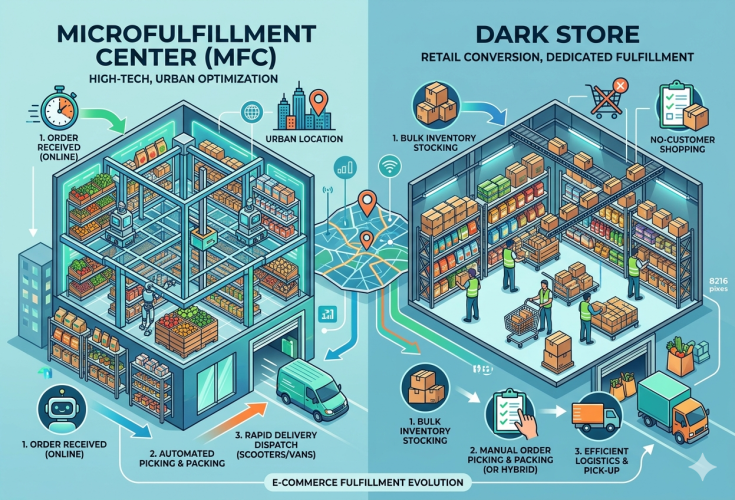
A micro-fulfillment centre (MFC) is a small, often highly automated warehouse facility positioned within or very near urban population centres. Unlike traditional distribution centres – which can span hundreds of thousands of square feet and sit on the outskirts of cities – MFCs are compact facilities, typically between 3,000 and 10,000 square feet, designed to store high-demand products and fulfill online orders at exceptional speed.
MFCs rely heavily on automation, robotics, and AI-driven inventory management to compensate for their smaller footprint. Automated storage and retrieval systems, intelligent picking algorithms, and real-time inventory tracking allow these facilities to process orders at rates of 60 to 80 orders per hour – three to four times faster than traditional warehouse operations.
The fundamental logic is simple: by positioning inventory within a few kilometres of the customer rather than 30 or 50 kilometres away, you dramatically reduce the physical distance, time, and cost of the last-mile delivery leg. Research across major Indian cities found that MFCs shortened delivery times by more than 40% compared to centralized warehouses – from an average of 95 minutes down to 55 minutes in Delhi, with similar improvements in Mumbai, Bengaluru, and Chennai.
What Are Dark Stores?
A dark store is a retail-format facility that looks like a traditional store from the outside – with stocked shelves, organized aisles, and sometimes even refrigeration units – but is entirely closed to the public. No shoppers browse the aisles. No checkout lines form. Instead, the entire operation is dedicated to picking, packing, and dispatching online orders for delivery.
The term “dark” refers to the absence of customer-facing retail activity. Dark stores function as hyperlocal fulfillment hubs, strategically located in high-demand urban areas to enable delivery times as short as 10 to 30 minutes. Companies like Gopuff, Zepto, Blinkit, and major grocery retailers have built extensive dark store networks to power the quick-commerce revolution.
While MFCs and dark stores are often discussed interchangeably, they serve distinct purposes. MFCs are typically more automated and may be attached to existing retail stores. Dark stores tend to be standalone converted retail spaces with more manual picking operations but larger product assortments. In practice, many businesses now deploy hybrid models that combine elements of both – using automation where it delivers the highest return and manual processes where flexibility is needed.
Why Are MFCs and Dark Stores Reshaping Last-Mile Delivery?
The rise of micro-fulfillment is driven by a convergence of consumer expectations, economic pressures, and technological capability.
Consumer demand for speed has become non-negotiable. Approximately 41% of global consumers expect delivery within 24 hours, and 24% want their orders in under two hours. Same-day delivery is no longer a premium perk – it’s the baseline against which every retailer is measured. Traditional centralized warehouses, located far from urban centres, simply cannot meet these timelines cost-effectively.
Last-mile costs demand proximity. The last mile accounts for up to 53% of total shipping costs, and those costs escalate with distance. By positioning fulfillment operations within the delivery zone rather than outside it, MFCs and dark stores can reduce last-mile delivery costs by 30 to 35%. A hybrid MFC-plus-dark-store model has been shown to lower overall cost per order by approximately 33% compared to centralized fulfillment.
Urban density creates opportunity. In densely populated cities, a single MFC can serve thousands of households within a 3 to 5 kilometre radius. This concentration of demand within a small geographic area makes hyperlocal fulfillment economically viable – provided the delivery planning technology can orchestrate high-frequency, multi-stop routes efficiently within that zone.
Technology has caught up. AI-powered inventory management, automated picking systems, real-time order routing, and intelligent last-mile delivery planning have matured to the point where operating a network of small urban fulfillment hubs is not just feasible but profitable. The missing piece was never the warehouse – it was the software that connects the warehouse to the customer’s door.
The Critical Role of Delivery Planning Technology
A micro-fulfillment centre is only as effective as the delivery system that serves it. The facility itself reduces the distance between inventory and customer, but it’s the delivery planning technology that determines whether that proximity translates into faster deliveries, lower costs, and better customer experiences.
This is where intelligent logistics platforms become essential – and where Maponomy’s suite of APIs and SaaS tools directly enables the MFC model.
Optimizing Hyperlocal Routes
MFC-based delivery operates in a fundamentally different pattern than traditional warehouse distribution. Instead of long-haul routes with widely dispersed stops, MFC delivery involves high-frequency, short-radius routes with dense stop clusters. A single courier might make 15 to 25 deliveries within a 3-kilometre radius in a single shift – and every minute saved per stop compounds across the entire route.
Maponomy’s Route Planner API is built for this kind of dense, constraint-heavy optimization. It generates routes that account for delivery windows, vehicle capacity, driver working hours, service times, and real-time traffic conditions – producing sequences that minimize total distance and time even when stops are clustered tightly together. The API integrates directly into existing OMS and TMS systems as a plug-and-play solution, meaning MFC operators can add intelligent routing to their workflows without rebuilding their technology stack.
For businesses operating multiple MFCs across a city, the Route Planner also determines the optimal number and type of vehicles to deploy from each location, plans warehouse-level sortation, and balances workloads across the fleet.
Multi-Modal Delivery from Urban Hubs
The compact delivery radius of an MFC opens up delivery modes that aren’t practical for traditional warehouse operations. Cargo e-bikes, electric scooters, and walking couriers become viable – and often preferable alternatives to vans in congested urban centres. A cargo e-bike can navigate narrow streets, bypass traffic, and access pedestrian zones that are off-limits to motor vehicles.
Maponomy’s Directions API supports this multi-modal reality by building optimized routes for automobiles, delivery trucks, cargo vans, bicycles, motor scooters, and pedestrians. Each route is tailored to the specific travel mode with appropriate speed profiles, road access rules, and avoidance parameters for tolls, highways, and ferries. Results include turn-by-turn directions, exact travel times, distances, and route details including elevation and road restrictions, delivered in JSON, GeoJSON, or XML for seamless integration.
This means an MFC operator running a mixed fleet of electric vans and cargo e-bikes can assign each delivery to the optimal vehicle type with a route specifically optimized for that mode – maximizing speed while minimizing cost and emissions.
Precise Geocoding for Hyperlocal Accuracy
When deliveries are measured in minutes rather than hours, address accuracy becomes critical. A driver circling a block looking for an ambiguous address doesn’t just waste a minute in a hyperlocal model, that minute represents 5 to 10% of the total delivery time. At scale, address inaccuracies can destroy the efficiency advantage that MFCs are designed to create.
Maponomy’s Geocoding API converts raw addresses into precise latitude and longitude coordinates, while the Address Parsing API validates and structures incomplete or poorly formatted customer-entered addresses into clean, deliverable formats. For MFC operations processing hundreds of orders per hour, this automated address intelligence layer ensures that every order enters the routing system with accurate location data – preventing failed deliveries before they happen.
Distance Matrix for Hub-to-Customer Assignment
When a business operates multiple MFCs across a metropolitan area, every incoming order must be assigned to the optimal fulfillment hub. This decision depends on which hub has the product in stock, how far each hub is from the customer, current traffic conditions, and the capacity of each hub’s delivery fleet.
Maponomy’s Distance Matrix API provides the data foundation for these assignment decisions. It calculates travel times and distances between up to 1,000 locations in a single request, supporting multiple travel modes and incorporating traffic data to reflect real-world conditions. For a quick-commerce operator running 15 dark stores across a city, the Distance Matrix enables real-time order routing – assigning each order to the nearest hub with available inventory and delivery capacity, minimizing both delivery time and cost.
Real-Time Tracking Across a Distributed Network
Operating a network of MFCs is inherently more complex than managing a single centralized warehouse. Multiple hubs mean multiple dispatch points, multiple courier fleets, and multiple sets of deliveries in progress simultaneously. Without centralized visibility, this complexity quickly becomes unmanageable.
Maponomy’s Live Tracking Suite provides real-time vehicle and courier location monitoring across the entire network, with GPS integration from third-party mobile apps and devices, historical track data for performance analysis, and automated notifications to operations teams and customers. This centralized visibility layer is what allows distributed MFC networks to operate with the coordination and accountability of a single, unified delivery system.
Courier Execution on the Ground
The courier is the final link in the MFC delivery chain. Maponomy’s Courier Navigation app equips each courier with optimized turn-by-turn navigation, smart delivery sequencing, proof-of-delivery capture through signatures and photos, and automated delivery status logging. Multi-language support ensures the app works for diverse workforces, and multi-mode routing means the same app serves van drivers, e-bike riders, and scooter couriers equally well.
Network-Level Optimization
Beyond individual route and hub optimization, businesses operating MFC networks need to continuously evaluate and refine their overall fulfillment topology. Which hubs should serve which zones? Where should new hubs be located? How should inventory be distributed across the network to minimize total delivery distance?
Maponomy’s Network Optimizer addresses these strategic questions by optimizing routes, sourcing locations, and transit times across the full transportation network – helping businesses design MFC networks that minimize both cost and delivery time at the system level.t as important as the facilities themselves.
MFCs and Dark Stores: Challenges to Consider
Despite their advantages, micro-fulfillment centres and dark stores present real operational challenges. Urban real estate costs are significantly higher per square foot than suburban warehouse space – although the dramatically smaller footprint and higher throughput per square metre often offset this premium. Limited storage capacity means MFCs must carry carefully curated product assortments, requiring sophisticated demand forecasting and inventory management. Scaling from a single hub to a citywide network introduces complexity in order routing, fleet management, and inventory synchronization across locations. And in congested urban areas, even short-radius delivery routes can face traffic delays that erode the speed advantage.
These challenges reinforce why technology is not optional in the MFC model – it’s foundational. The operational margins are tight, the delivery windows are short, and the volume is high. Without intelligent routing, automated dispatch, precise geocoding, and real-time tracking, the model simply doesn’t work at scale.
The future of last-mile delivery isn’t a bigger warehouse further away – it’s a smarter hub closer to the customer, powered by technology that makes every delivery faster, cheaper, and more reliable than the last.