
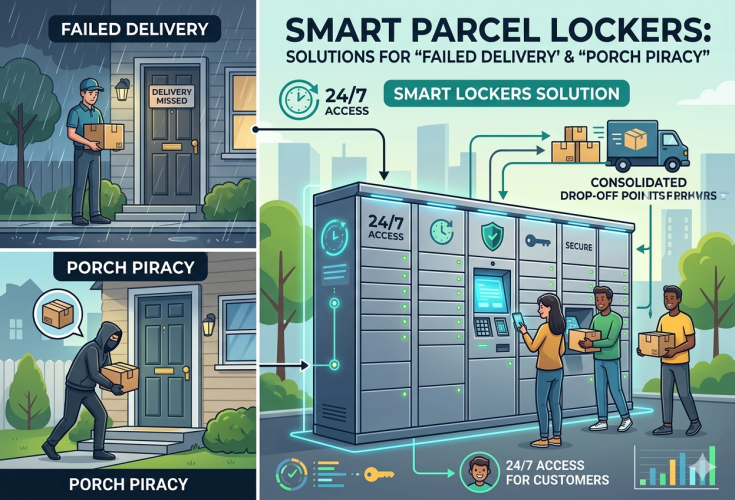
Every failed delivery costs money, wastes fuel, and frustrates customers. Smart parcel lockers are turning high-traffic urban locations into 24/7 delivery endpoints that eliminate missed deliveries, prevent package theft, and make drivers dramatically more productive. Here’s how they work – and the delivery planning technology that makes locker networks viable at scale.
The driver pulls up to the apartment complex at 2:17 PM. The customer isn’t home. The building has no doorman, no secure lobby, and no safe place to leave a package. The driver takes the parcel back to the depot. Tomorrow, they’ll try again – burning fuel, consuming a delivery slot, and hoping the customer is home this time.
This scenario plays out millions of times every day. Approximately 5% of all last-mile deliveries fail on the first attempt, each failure costing retailers an average of $17. Beyond the direct cost, failed deliveries generate unnecessary vehicle miles, increase carbon emissions, clog up depot operations, and erode customer trust in the brand. And when deliveries do succeed but are left unattended, the problem shifts from failed delivery to porch piracy – with packages stolen from doorsteps, lobbies, and porches at an alarming rate.
Smart parcel lockers are designed to solve both problems simultaneously. By providing secure, automated, 24/7 accessible pickup points in high-traffic urban locations, they guarantee successful delivery on the first attempt and eliminate the risk of theft entirely. The global smart parcel locker market was valued at approximately $751 million in 2025 and is projected to reach $1.36 billion by 2032, growing at a compound annual rate of nearly 9%. The broader smart locker market, which includes corporate and institutional applications, is expected to reach $9.1 billion by 2032.
This isn’t a niche convenience play. Smart parcel lockers are becoming structural infrastructure for last-mile delivery – and the planning technology that routes parcels to these lockers is what determines whether the model scales efficiently.
What Are Smart Parcel Lockers
A smart parcel locker is an automated, electronically controlled storage system consisting of multiple compartments of varying sizes, installed in accessible public or semi-public locations. Delivery drivers deposit packages into individual compartments, and customers retrieve them at their convenience using a one-time access code, QR scan, mobile app authentication, or in newer systems – biometric verification.
Modern smart lockers are far more sophisticated than simple storage boxes. They integrate IoT connectivity for real-time status monitoring, cloud-based management platforms for network-wide oversight, mobile app interfaces for customer notifications and access, and temperature-controlled compartments for groceries, pharmaceuticals, and meal kits. Approximately three-quarters of all smart locker units now support QR code or OTP-based access, and temperature-controlled compartments grew by 34% year-over-year as the technology expanded beyond traditional parcel delivery.
Smart lockers are typically deployed in high-traffic, high-convenience locations: apartment building lobbies, office complexes, university campuses, metro and train stations, shopping centres, grocery stores, petrol stations, and dedicated sidewalk installations. InPost, one of the largest operators, runs over 20,000 smart lockers across Poland alone, capturing roughly 40% of the country’s last-mile delivery volume. Amazon’s Hub Locker programme covers over 2,800 locations across North America. DHL’s Packstation network in Germany includes solar-powered and modular units integrated into multimodal transportation hubs.
The Problems Smart Lockers Solve
Smart parcel lockers address several of the most persistent and expensive pain points in last-mile delivery.
Failed Deliveries
A failed delivery triggers a costly chain reaction: the driver returns the package to the depot, a redelivery is scheduled, the vehicle makes the same trip again, and the customer waits another day. Each failure doubles the delivery cost and emissions for that package. With locker delivery, success is guaranteed on the first attempt – the driver deposits the parcel regardless of whether the customer is home, at work, or travelling.
Automated locker networks have been shown to reduce last-mile delivery costs by approximately 35% compared to door-to-door courier delivery, largely by eliminating the redelivery cycle.
Porch Piracy and Package Theft
Package theft from doorsteps has become a pervasive problem in residential delivery, particularly in markets like the United States where unattended front-door delivery is standard practice. Smart lockers eliminate this risk entirely — parcels are stored in individually locked compartments until the authenticated recipient retrieves them.
Driver Productivity and Route Efficiency
This is where smart lockers deliver their most transformative operational impact. A delivery driver making individual door-to-door drops averages 2 to 3 minutes per stop – navigating to the building, finding the entrance, waiting for access, and completing the handoff. At a smart locker hub, the same driver can deposit up to 40 parcels in under 8 minutes. This efficiency improvement of roughly 60% in courier productivity fundamentally changes the economics of last-mile delivery.
But this efficiency gain is only realized if the delivery planning system routes parcels to the right lockers, on the right routes, at the right time.
The Delivery Planning Challenge Behind Smart Lockers
Deploying a network of smart lockers doesn’t automatically make last-mile delivery more efficient. The lockers are endpoints – what happens between the depot and the locker determines whether the network delivers on its promise. This is the delivery planning layer, and it must answer several interconnected questions simultaneously.
Which parcels should be routed to lockers versus delivered to the door? Which locker location is optimal for each customer? What’s the most efficient route for a driver servicing a mix of locker drops and door-to-door deliveries? How should the fleet be sized and dispatched to serve both delivery types? How do you ensure address accuracy for customers who opt for door delivery while routing locker-bound parcels to precise geographic coordinates?
This is where intelligent delivery planning technology becomes essential – and where Maponomy’s suite of APIs and SaaS tools directly enables the smart locker model.
Route Optimization for Mixed Delivery Networks
A smart locker delivery network rarely operates in isolation. Most logistics operations run hybrid models where some parcels go to lockers and others go to individual addresses – and both types of stops need to be sequenced into a single, optimized route.
Maponomy’s Route Planner API handles this complexity natively. It generates optimized routes that incorporate both locker hub stops (where the driver drops multiple parcels in a single visit) and individual door-to-door delivery stops — accounting for delivery windows, vehicle capacity, driver working hours, and service times at each stop type. For locker stops, the service time is compressed because multiple parcels are deposited at once, and the planner exploits this efficiency by clustering locker-bound parcels together.
The API integrates directly into existing TMS and OMS systems as a plug-and-play solution, meaning logistics operators can add locker routing to their existing workflows without rebuilding their technology stack. The system also calculates the optimal number and type of vehicles to deploy and plans warehouse-level sortation – ensuring that locker-bound parcels are grouped and loaded for efficient sequential drop-off.
Geocoding Locker Locations and Customer Addresses
Smart locker networks operate on precise geographic coordinates. Each locker station has a fixed location, and the routing system must know that location exactly – not an approximate street address, but a precise latitude-longitude pair that places the driver at the correct entrance.
Maponomy’s Geocoding API provides this precision, converting addresses into exact geographic coordinates for both locker locations and customer delivery addresses. For customers who opt for door delivery instead of locker pickup, the Address Parsing API validates and structures their address data – preventing the failed deliveries that lockers were designed to solve for the locker-routed parcels. Together, these APIs ensure that every stop in the route plan — whether a locker hub or a residential doorstep – is accurately located.
Distance Matrix for Optimal Locker Assignment
When a customer opts for locker delivery, the system must assign them to the most convenient locker – typically the one closest to their home or workplace with available compartment capacity. This assignment decision requires calculating distances and travel times between the customer’s location and every nearby locker station, factoring in the customer’s typical travel patterns and the locker’s current utilisation.
Maponomy’s Distance Matrix API provides the data layer for these decisions. It calculates travel times and distances between up to 1,000 locations in a single request, supporting multiple travel modes – driving, walking, cycling, and public transit. For a customer who walks to their locker, the nearest locker by walking distance matters more than the nearest by driving distance. The Distance Matrix supports this level of precision, enabling smarter locker assignment that increases customer adoption and satisfaction.
Multi-Modal Courier Routing
Locker networks in dense urban areas are often serviced by a mix of vehicle types: vans for high-volume trunk routes, cargo e-bikes for congested city centres, and walking couriers for pedestrian-zone locations. Each vehicle type requires routes optimized for its specific capabilities – speed, capacity, road access, and parking constraints.
Maponomy’s Directions API builds optimized routes for automobiles, delivery trucks, cargo vans, bicycles, motor scooters, and pedestrians, with mode-specific parameters including toll avoidance, highway preferences, and truck size restrictions. This multi-modal capability ensures that every locker station is serviced by the right vehicle type, on the right route, at the right time.
Real-Time Tracking Across the Locker Network
Operating a dispersed locker network requires centralized visibility into every vehicle, every route, and every delivery status. Maponomy’s Live Tracking Suite provides real-time vehicle and courier location monitoring, GPS integration from third-party devices and apps, historical track data for route analysis, and automated notifications to both operations teams and customers. When a driver deposits parcels at a locker, the system can automatically trigger customer notifications — informing them that their package is ready for pickup and providing access instructions.
Courier Execution and Proof of Delivery
At the locker station, the driver needs a mobile tool that confirms which parcels go into which compartments and logs the deposit as a completed delivery. Maponomy’s Courier Navigation app provides turn-by-turn navigation to each stop, smart delivery sequencing, proof-of-delivery capture through photos and digital signatures, and automated status logging – ensuring that every locker deposit is recorded, timestamped, and traceable.
The Sustainability Dimension
Smart lockers also contribute meaningfully to sustainability goals. By consolidating multiple deliveries into a single locker stop, they reduce the total number of vehicle stops, the total miles driven, and the associated carbon emissions. A driver depositing 40 parcels at one locker station replaces up to 40 individual door-to-door stops – each of which would involve navigation, parking, building access, and handoff time.
When combined with route optimization that minimizes total distance as Maponomy’s Route Planner provides the emissions reduction compounds further. Fewer stops, shorter routes, and higher vehicle utilization translate directly into a smaller carbon footprint per parcel delivered. Several operators, including DHL, have deployed solar-powered locker units, further reducing the infrastructure’s environmental impact.
Where Smart Lockers Are Heading
The smart locker market is evolving rapidly. Temperature-controlled compartments are expanding the model into grocery, pharmaceutical, and food delivery. Biometric authentication – fingerprint and facial recognition with sub-3-second verification – is replacing codes and QR scans. Solar-powered outdoor units are reducing energy dependence. Modular designs allow operators to scale locker stations seasonally. And integration with returns logistics is turning lockers into bidirectional nodes – customers can drop off returns at the same locker where they collect purchases.
Critically, the market is also moving from standalone locker deployments to connected delivery ecosystems, where locker networks are integrated with logistics management software, route optimization engines, and real-time tracking platforms. This integration – the kind that Maponomy’s API-first product suite is designed to enable – is what transforms a collection of individual locker stations into a coordinated, network-wide delivery infrastructure.
The future of last-mile delivery isn’t about reaching every doorstep – it’s about reaching the right endpoint, at the right time, with zero failures. Smart parcel lockers, powered by intelligent delivery planning, are making that future a reality.