
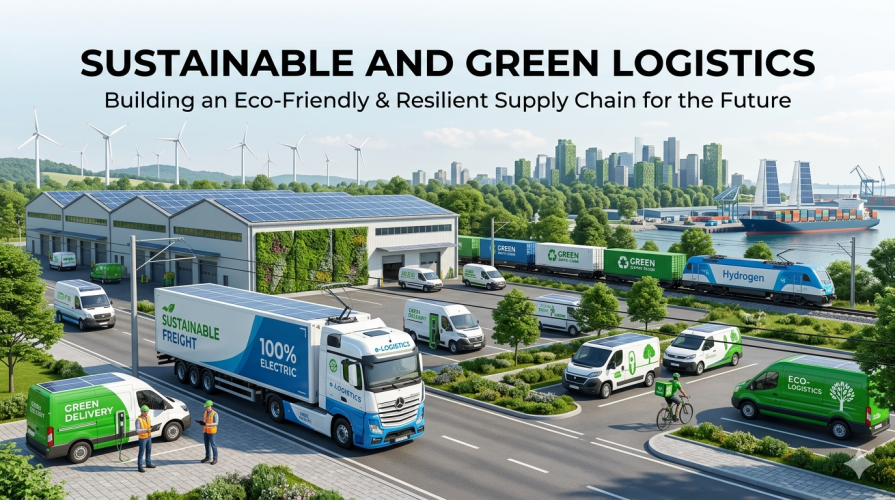
Sustainability is no longer a corporate nice-to-have – it’s a core business requirement reshaping every delivery that reaches your door. Here’s how green logistics, electric fleets, cargo e-bikes, right-sized packaging, and intelligent route planning are transforming last-mile delivery.
By 2030, the explosion of delivery vehicles on urban roads is projected to release an additional six million metric tons of carbon emissions. In major cities, last-mile delivery already contributes nearly 30% of all logistics-related CO₂ output – driven by stop-and-go driving, low vehicle utilization, repeated delivery attempts, and inefficient routing. At the same time, consumers are demanding faster, more frequent deliveries than ever before.
This collision of environmental urgency and commercial pressure is forcing a fundamental rethink of how the last mile operates. Sustainability is no longer a marketing tagline or a corporate social responsibility checkbox. It is becoming a regulatory requirement, a competitive differentiator, and increasingly, the most powerful lever for reducing costs in the most expensive segment of the supply chain.
The green logistics market reached approximately $1.65 trillion in 2025 and is projected to exceed $3.3 trillion by 2034, growing at over 8% annually. For businesses operating delivery fleets, the message is clear: decarbonize the last mile or risk falling behind on compliance, customer expectations, and profitability. This guide explores the forces driving sustainable logistics, the technologies making it possible, and how platforms like Maponomy are enabling businesses to deliver greener without sacrificing speed or margin.
The Sustainability Imperative in Last-Mile Delivery
Three converging forces are making sustainability a non-negotiable priority for logistics operations.
Regulatory pressure is intensifying. Governments worldwide are tightening emissions standards, introducing carbon pricing mechanisms, and mandating Scope 3 emissions disclosure. The EU’s Emissions Trading System now covers maritime shipping, and urban low-emission zones are expanding across European and Asian cities. In this regulatory landscape, companies that cannot demonstrate verifiable emissions reductions face financial penalties, restricted market access, and supply chain exclusion from partners who require sustainability compliance.
Consumer expectations have shifted. Studies consistently show that a majority of consumers prefer brands that demonstrate environmental responsibility, and a growing segment is willing to pay more for sustainable delivery options. Nearly 98% of consumers say the delivery experience impacts their brand loyalty – and that experience now includes the environmental credentials of how their package arrived.
Sustainability and cost reduction are converging. The most impactful green logistics strategies – route optimization, fleet utilization, first-attempt delivery success, and load consolidation – are also the most effective cost reduction strategies. Companies adopting AI-powered routing and fleet optimization are reporting 10–30% reductions in fuel consumption, which translates directly into both lower emissions and lower operating costs. Green and lean are no longer opposing forces; they are the same force.
Electric Vehicles: Electrifying the Last Mile
The most visible transformation in sustainable last-mile delivery is the rapid adoption of electric vehicles. Major logistics providers and e-commerce platforms are investing billions in electrifying their delivery fleets, driven by a combination of environmental regulation, declining battery costs, and the economic advantages of EVs in urban delivery operations.
Electric delivery vehicles are particularly well-suited for last-mile operations. Urban delivery routes involve frequent stops, low-speed driving, and relatively short daily distances – all conditions where EVs outperform combustion-engine vehicles. Regenerative braking in stop-and-go traffic recovers energy that would otherwise be lost. Zero tailpipe emissions eliminate direct carbon output. And maintenance costs are substantially lower – no oil changes, fewer brake replacements, and simpler drivetrains.
However, electrification alone doesn’t solve the sustainability challenge. An EV that follows a poorly optimized route still wastes energy, still makes failed delivery attempts, and still operates below its potential efficiency. The real gains come when electric fleets are paired with intelligent planning and routing technology.
This is where platforms like Maponomy become critical. Maponomy’s Route Planner API optimizes delivery sequences to minimize total distance and time, directly reducing the energy consumption of every vehicle in the fleet — whether electric, hybrid, or combustion. For EV fleets specifically, shorter and smarter routes mean fewer charging cycles, extended battery life, and the ability to complete more deliveries per charge. The system accounts for vehicle-specific constraints including load weight, volume, and driver working hours, ensuring that route plans are optimized not just for distance but for the actual operating characteristics of the fleet.
Cargo E-Bikes and Micro-Mobility: Greener Solutions for Congested Cities
In dense urban environments, even electric vans face limitations: congestion, parking restrictions, limited access zones, and the simple reality that a large vehicle making individual residential stops in narrow city streets is inherently inefficient. This is driving the rapid growth of cargo e-bikes, electric scooters, and other micro-mobility solutions for last-mile delivery.
Cargo e-bikes produce zero emissions, navigate congested streets with ease, require minimal parking, and can access pedestrian zones and cycle lanes that are off-limits to motor vehicles. Studies show that combining e-bikes with optimized delivery models can reduce the number of delivery journeys by up to 30% and cut total delivery costs by as much as 51% compared to traditional van-based operations.
The planning challenge with micro-mobility fleets is different from conventional vehicle routing. E-bikes have lower payload capacities, shorter ranges, and different speed profiles. Route optimization must account for these constraints — assigning smaller, denser delivery clusters to e-bike couriers while reserving larger or longer-range deliveries for vans or trucks.
Maponomy’s Directions API is designed for exactly this kind of multi-modal flexibility. It builds routes for automobiles, delivery trucks, cargo vans, bicycles, motor scooters, and pedestrians – each with mode-specific optimization. Routes can be customized to avoid tolls, highways, and ferries, and adjusted based on vehicle size restrictions. For a business operating a mixed fleet of electric vans and cargo e-bikes, this means every delivery is assigned to the right vehicle type with a route optimized for that specific mode of transport.
The Courier Navigation app extends this intelligence to the driver or rider level, providing turn-by-turn navigation optimized for the courier’s specific travel mode, with delivery sequencing, proof-of-delivery capture, and multi-language support – whether the courier is on a scooter in Mumbai, a cargo bike in Amsterdam, or an electric van in Riyadh.
Right-Sized Packaging and Waste Reduction
Sustainability in the last mile extends beyond the vehicle itself. Packaging waste represents a significant and often overlooked environmental burden. Oversized boxes filled with plastic air pillows, excessive wrapping materials, and non-recyclable packaging generate millions of tons of waste annually – and they also waste space in delivery vehicles, reducing load efficiency and increasing the number of trips required.
The trend toward “right-sized” packaging – where the packaging is tailored to fit the product with minimal excess – addresses both waste and logistics efficiency simultaneously. Smaller, more precisely sized packages mean more packages per vehicle, fewer trips, and less material heading to landfills. Companies are also accelerating the adoption of recyclable, biodegradable, and reusable packaging materials.
While packaging decisions happen upstream of delivery planning, the logistics impact flows directly into the planning layer. Better-packed, consistently sized packages improve load utilization – and the planning system needs to account for actual package dimensions to optimize vehicle capacity.
Maponomy’s Load Builder optimizes loading efficiency by planning loading and unloading sequences based on actual shipment characteristics, maximizing truck utilization across weight, volume, and monetary dimensions. When packages are right-sized, the Load Builder can fit more deliveries per vehicle, directly reducing the number of trips – and therefore the fuel or energy consumed and emissions produced per delivery.
Route Optimization: The Silent Sustainability Engine
Of all the strategies available for greening last-mile delivery, intelligent route optimization may be the most impactful – and the least visible to the end customer. Every unnecessary mile a delivery vehicle travels represents wasted fuel, unnecessary emissions, and avoidable cost. At scale, the cumulative impact is enormous.
AI-powered route optimization reduces emissions through several mechanisms simultaneously. It minimizes total distance traveled by finding the most efficient sequence of stops. It reduces idle time by avoiding congested routes and peak traffic periods. It increases delivery density by clustering nearby stops together. And it improves first-attempt success rates by aligning delivery timing with customer availability – preventing the emission-heavy redelivery cycle.
Research indicates that modern route optimization can reduce fuel consumption by 10-15% through smarter routing alone, without any changes to the fleet itself. For a business operating hundreds of vehicles, this translates into thousands of tons of avoided CO₂ annually.
Maponomy’s Route Planner API embeds this sustainability logic into every route it generates. By optimizing across delivery windows, vehicle capacity, driver schedules, service times, and real-time conditions, it produces routes that are inherently lower-emission – not as a separate sustainability feature, but as a natural consequence of maximizing efficiency. Businesses using this kind of optimization typically achieve a 10-15% reduction in logistics costs, with proportional reductions in their carbon footprint.
Address Accuracy: Preventing the Hidden Emissions of Failed Deliveries
Failed deliveries are one of the most underappreciated sources of unnecessary emissions in last-mile logistics. When a delivery fails – because the address was wrong, the customer wasn’t home, or the driver couldn’t locate the destination – the package must be returned to the depot and redelivered. This means double the vehicle miles, double the fuel or energy consumption, and double the emissions for a single package.
Approximately 5% of last-mile deliveries fail on the first attempt. In emerging markets with less standardized addressing systems, the failure rate can be significantly higher. Each failed delivery costs an average of $17 and generates a proportional increase in carbon output.
The most effective way to prevent failed deliveries is to ensure address accuracy before the vehicle ever leaves the depot. Maponomy’s Geocoding API converts addresses into precise geographic coordinates, while the Address Parsing API validates and structures incomplete or poorly formatted addresses into deliverable formats. By catching and correcting address problems at the planning stage, these tools eliminate a significant source of waste – reducing redelivery miles, cutting emissions, and improving first-attempt success rates.
Network Optimization: Systemic Sustainability at Scale
Individual route optimization addresses efficiency at the vehicle level, but the greatest environmental gains come from optimizing the entire delivery network. This means analyzing which warehouses or distribution centers should serve which delivery zones, where micro-fulfillment hubs should be located, and how to minimize the total distance between inventory and customers across the full operation.
Locating inventory closer to customers reduces delivery distances, lowers fuel consumption, and enables the use of smaller, lower-emission vehicles for shorter last-mile runs. Research projects the global micro-fulfillment market will reach approximately $10 billion by 2026, driven by exactly this logic.
Maponomy’s Network Optimizer supports this systemic approach, optimizing routes, sourcing warehouses or plants, and minimizing transit times across the full transportation network. By identifying the most efficient sourcing and delivery configurations, it helps businesses reduce not just per-route emissions but total network-level carbon output.
Real-Time Tracking: Visibility Drives Accountability
You cannot reduce what you cannot measure. Real-time tracking and analytics provide the data foundation for continuous sustainability improvement. By monitoring vehicle locations, route adherence, delivery completion rates, and driver behavior, operations teams can identify waste – unnecessary detours, extended idle times, missed consolidation opportunities – and address it systematically.
Maponomy’s Live Tracking Suite provides real-time vehicle location monitoring, historical track analysis, and automated notifications, giving logistics teams the visibility they need to measure, report, and continuously improve their environmental performance. When combined with the Distance Matrix API – which calculates travel times and distances for up to 1,000 locations across multiple transport modes – businesses gain the data infrastructure to model, measure, and minimize their delivery carbon footprint.
The Business Case: Green Equals Lean
The most compelling argument for sustainable last-mile logistics isn’t environmental – it’s financial. Every strategy that reduces emissions also reduces cost. Route optimization cuts fuel bills. Address accuracy eliminates redelivery expenses. Load optimization reduces trip frequency. Electric vehicles lower maintenance and fuel costs. And first-attempt delivery success prevents the most expensive failure mode in last-mile logistics.
Companies that treat sustainability as a standalone initiative, separate from operational optimization, miss this fundamental alignment. The businesses achieving the best environmental outcomes are the same ones achieving the best financial performance – because they have invested in intelligent planning systems that optimize for efficiency, with sustainability as an inherent and inseparable outcome.
Green logistics is no longer a separate strategy – it is the strategy. The companies that master sustainable last-mile delivery today will define both the environmental and competitive standards of tomorrow.