
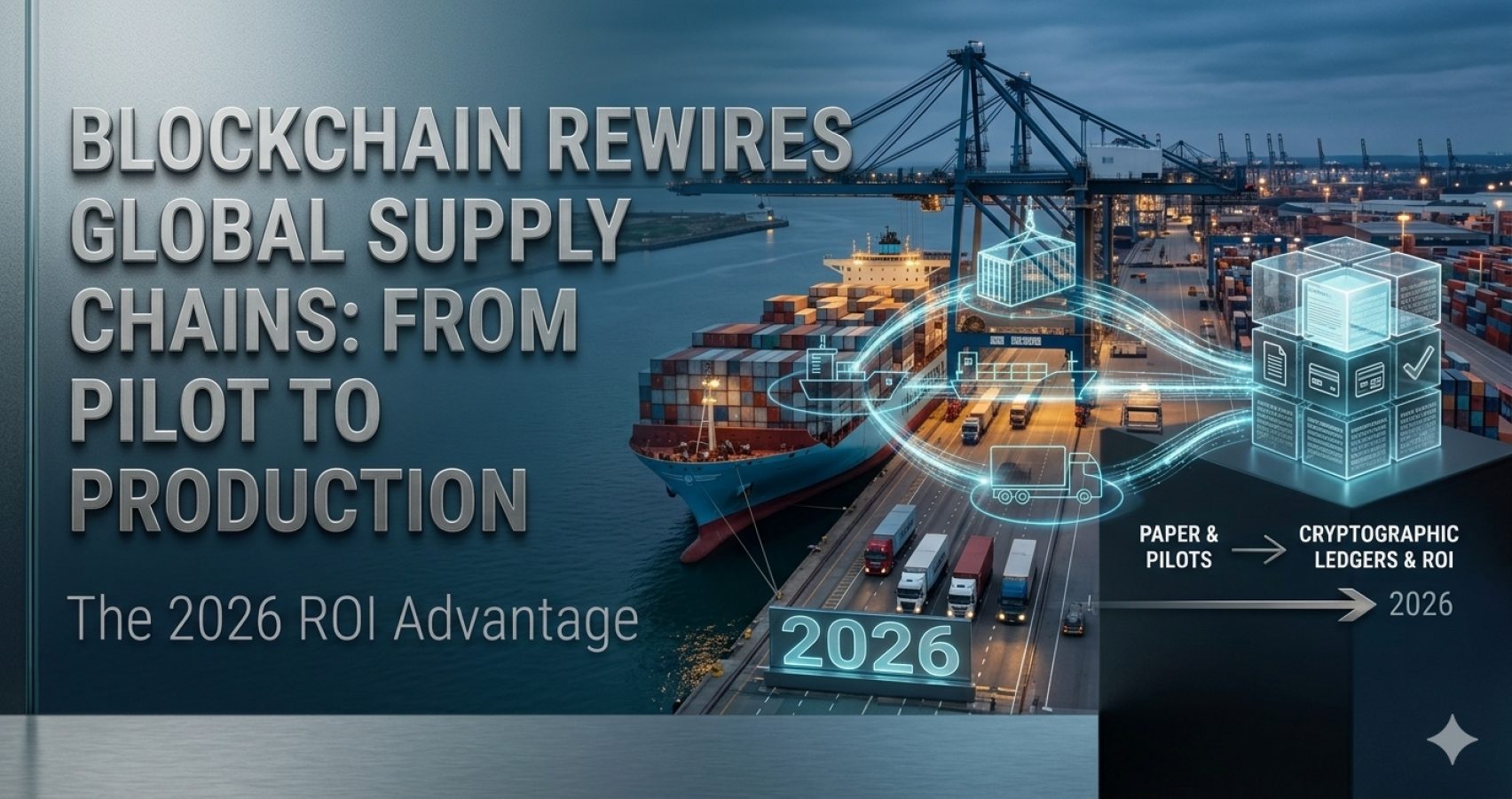
How blockchain is quietly rewiring global supply chains in 2026 – beyond the pilots, into production
An industry insight brief on where blockchain actually works in modern supply chains, where it does not, and why 2026 is the year the technology stopped being a conference-circuit curiosity and started posting measurable return on investment at scale.
Supply chains run on documents. A single international shipment can touch thirty parties, generate two hundred communications, and carry forty-plus paper or semi-digital records before the goods clear a destination port. Every handoff in that chain is a point where trust can break: a bill of lading that does not match the manifest, a certificate of origin from a supplier nobody can verify, a payment released against a proof of delivery that was signed in the wrong warehouse. For most of logistics history, the response has been more paperwork, more auditors, and more insurance. In 2026, a different response is finally scaling: cryptographic, shared, append-only ledgers that make the trust itself a feature of the data rather than a service bought on top of it.
This piece looks at where blockchain is actually working in supply chains today, where the hype has not survived the pilot phase, and what the operational economics look like when enterprises run the technology against real freight, real goods, and real money.
From Pilot to Production: The 2026 Inflection
The blockchain-in-supply-chain conversation has been running for eight years. For most of that time, it was a conversation about pilots. In 2026, the market has shifted meaningfully into production deployments with measurable ROI. Mordor Intelligence and Market Research Future both now track the global blockchain-in-supply-chain market at double-digit annual growth, with projections that put the segment well into the tens of billions of dollars by the early 2030s.
| Indicator | 2026 Value | Projection | Source |
|---|---|---|---|
| Global blockchain-in-supply-chain market | USD 3.3B+ | USD 100B+ by 2035 | Market Research Future |
| Market CAGR, 2026 to 2030 | ~45% | Not Available | Business Research Company |
| Enterprises in production (vs pilot) | ~35% of blockchain adopters | Majority by 2028 | Blockchain Council |
| Supply chain finance deals on blockchain rails | USD 90B+ annualized | Multi-trillion by 2030 | CoinLaw statistics review |
| Companies reporting full end-to-end visibility | ~11% (up from 6% in 2022) | 25%+ by 2030 | industry survey consolidation |
Table 1. The blockchain-in-supply-chain market in 2026 and its forward curve.
Sources as cited above.
What is striking is not the growth rate on its own. It is the shift in reporting: the headline cases from 2026 are no longer about proofs of concept. They are about shipped containers, cleared payments, and reduced claim cycles. The question has changed from “can this work” to “where does this work best, and at what cost.”
The Documentation Problem Blockchain Was Built For
A reasonable starting point is the paperwork itself. International trade documentation is a tax on every physical movement of goods: multiple copies, physical signatures, manual data re-entry at each node, and the inevitable mismatch when any two of those copies drift. Industry estimates of the manual labour spent on freight documentation routinely run into the tens of billions of dollars annually, and that is before counting the knock-on costs of errors and delays.
A shared, append-only ledger with cryptographically signed state transitions removes most of this cost structure in principle. Where it has been applied in production, the measured impact looks like this:
| Workflow | Pre-Blockchain Baseline | With Shared Ledger |
|---|---|---|
| Bill of lading preparation and sharing | 24 to 72 hours end-to-end | Minutes to a few hours |
| Letter-of-credit cycle time | 5 to 10 business days | 24 to 48 hours |
| Customs documentation reconciliation | Multi-step manual, high error rate | Single reconciled record |
| Dispute resolution on proof of delivery | Weeks of back-and-forth | Audit-ready in hours |
| Supplier onboarding and verification | 3 to 8 weeks for new vendor | Days with cryptographic KYC reuse |
Table 2. Operational impact of shared-ledger adoption on common supply chain documentation workflows.
Sources: Ledger Insights archive of the Maersk-IBM TradeLens pilot; ndnAnalytics 2026 enterprise ROI review.
Pilots that focused specifically on documentation workflows have been the most reliable source of positive ROI in the category. Pilots that tried to replace core enterprise systems with on-chain equivalents have generally not.
Traceability: The Case That Actually Converts Consumers
The second category of production use is traceability. The difference between visibility and traceability matters here. Visibility is about where a shipment is right now. Traceability is about where every component of a product came from, when, from whom, and under what conditions. For a logistics operator, visibility is the day-to-day priority. For a brand facing consumers who increasingly ask ethical-sourcing questions, traceability is the strategic one.
The best-documented case is in food. The Walmart food-traceability program, built on a blockchain substrate in partnership with IBM, cut the time to trace a mango from its originating farm from a reported 6 days and 18 hours down to roughly 2.2 seconds. Pharmaceuticals have followed a similar trajectory, with the IBM-KPMG-Walmart-Merck pharma pilot demonstrating that drug supply chains can be made auditable against regulatory requirements in near real time.
| Vertical | Traceability Before Blockchain | With Blockchain | Business Impact |
|---|---|---|---|
| Fresh produce | Days to trace an outbreak source | Seconds to isolate affected lots | Reduced recall scope and cost |
| Pharmaceuticals | Paper-based batch records, hard to reconcile | Immutable batch history, auditable to regulator | Regulatory compliance, counterfeit defence |
| Luxury goods | Certificate paper trail, forgery-prone | Chain-of-custody tokens | Resale provenance, insurance pricing |
| Automotive parts | Supplier declarations, periodic audits | Live component-level record | Recall precision, warranty defence |
| Textiles and apparel | Audit-visit-based ethical sourcing | Live supplier attestation | ESG reporting, brand trust |
Table 3. Traceability outcomes across major verticals using blockchain substrates in 2026.
Sources: Varmeta case study on Walmart; Interactive Crypto on the IBM-KPMG pharma pilot; Meticulous Research outlook 2026-2035.
A separate consumer insight is worth noting. Scan-to-verify behaviour on consumer packaging has grown measurably in categories where brands have made provenance a visible feature. The utility runs both ways: shoppers get assurance about origin, and brands get a direct data channel to end consumers that bypasses retailer-held purchase data.
Payments and Finance: Where the Dollar Volume Lives
If traceability converts consumers, payments convert CFOs. The single largest commercial use of blockchain rails in supply chains today is not the physical movement of goods. It is the financial flow that follows the goods. Supply chain finance deals settled on blockchain rails have crossed into double-digit-billion annualized volume, with growth rates well above the physical-goods side of the category.
| Finance Use Case | Pre-Blockchain Pain Point | On-Chain Improvement |
|---|---|---|
| Letter of credit | Multi-day cycle, high bank fees | 24-48 hour cycle, lower cost |
| Invoice financing | Fraud risk from duplicate invoices | Cryptographic uniqueness per invoice |
| Supplier early payment | Reconciliation lag, limited access for SMEs | Real-time triggered payouts |
| Cross-border settlement | Correspondent-banking latency, FX costs | Direct settlement, lower cost |
| Trade credit insurance | Underwriting on sparse data | Underwriting on verified transaction history |
Table 4. Supply chain finance workflows reshaped by blockchain rails in 2026.
Sources: CoinLaw blockchain in supply chain finance statistics; ndnAnalytics enterprise ROI review.
The pattern across these cases is consistent. Blockchain does not replace banks. It shortens the cycle between parties who already trust each other and makes trust extendable to parties who do not yet. Small and mid-size suppliers in emerging markets have been the biggest beneficiaries, because the technology lets them bring verifiable transaction history to counterparties that would previously have required much heavier credit evaluation.
Smart Contracts: Automation Without a Middleman
Smart contracts, self-executing agreements that trigger when verifiable conditions are met, have been the most-hyped and least-understood element of the stack. In 2026 the picture has sharpened considerably. The useful applications tend to share three properties: the trigger condition can be verified unambiguously from a trusted data source, the consequence is a payment or state change rather than a judgement call, and the counterparties want speed more than they want flexibility.
| Smart Contract Pattern | Trigger | Automated Action |
|---|---|---|
| Shipment-arrival payment release | GPS confirmation at destination port | Payment to carrier |
| Temperature-breach claim trigger | IoT sensor record exceeds threshold | Automatic claim filing with insurer |
| Volume-discount settlement | Cumulative purchase threshold crossed | Rebate credit to buyer account |
| Carbon-emissions attestation | Verified data from certified sensor | ESG credit minted |
| Demurrage charge | Port dwell time exceeds contracted window | Charge auto-posted to shipper |
Table 5. Smart contract patterns that are now in enterprise production.
Sources: Blockchain Council 2026 transformation review; Research Nester on supply chain traceability.
The categories that have not worked at scale are the ones where the trigger condition is judgement-based (“did the goods meet quality standards?”) or where the consequence requires human discretion (“should we accept partial delivery?”). Those categories are not getting automated by smart contracts and probably will not be.
What Has Not Worked: The Honest Audit
An honest industry insight piece needs to say what has failed as clearly as what has succeeded. The pilot graveyard around blockchain-in-supply-chain is deeper than most other enterprise technology categories, and three failure patterns dominate.
| Failure Pattern | Example | Root Cause |
|---|---|---|
| Consortium governance collapse | TradeLens winddown, late 2022 | Competitors unwilling to put data on a competitor-hosted ledger |
| Lift-and-shift replacement attempts | Early ERP-on-chain projects | Blockchain is a weak database, strong trust layer |
| Public-chain throughput ceilings | Early public-chain logistics pilots | Transaction cost and finality too slow for freight-ops scale |
| Over-engineered consumer traceability | QR-to-blockchain scans with no real audience | Consumer utility too thin to justify operational overhead |
| Unverifiable off-chain data | Garbage-in trigger inputs | Oracle problem: ledger is only as honest as its data feeds |
Table 6. Known failure patterns in blockchain-in-supply-chain deployments.
Sources: Ledger Insights archive on the TradeLens pilot and winddown; independent operator and consortium post-mortems.
The TradeLens winddown, announced in late 2022 by its sponsors after four years of consortium effort, remains the industry’s most instructive case study. The technical implementation worked. The commercial model, which required direct competitors to agree to post their trade data to infrastructure operated by one of them, did not. The lesson absorbed since then is architectural: blockchain works best as neutral shared infrastructure, not as a vendor-captive asset.
The Oracle Problem and the IoT Marriage
A ledger can only guarantee what it has been told. If the input is wrong, the on-chain record is a very reliable store of wrong information. This is the oracle problem, and it has become the single largest technical constraint on blockchain’s usefulness in supply chains. The 2026 response has been a tight coupling with IoT, RFID, and sensor networks that can produce cryptographically signed data at the point of measurement.
The marriage goes both ways. Blockchain gives IoT data a durable, tamper-evident home. IoT gives blockchain the trusted input it needs to automate decisions. Together they make the physical-world-to-digital-ledger bridge honest enough to carry commercial weight.
| Sensor Signal | Ledger Use | Commercial Outcome |
|---|---|---|
| Container temperature history | Cold-chain integrity record | Insurance pricing, claim automation |
| GPS and port-call events | Arrival-proof trigger | Payment release, demurrage calculation |
| Weight sensors at loading | Load confirmation | Dispute reduction, revenue assurance |
| RFID pallet scans | Chain-of-custody tokens | Loss and theft detection |
| Emissions sensors on trucks | Carbon accounting ledger | Regulatory compliance, ESG reporting |
Table 7. IoT-to-blockchain integrations producing measurable commercial outcomes in 2026.
Sources: Accio on blockchain-in-logistics tracking; NumberAnalytics on supply chain efficiency.
Cost Economics: Where the ROI Actually Comes From
The business case for blockchain in supply chains in 2026 is clearer than it was in 2022. The sources of return have narrowed and sharpened. Enterprises that are posting positive ROI tend to point to the same four buckets.
| ROI Bucket | Typical Range | What Drives It |
|---|---|---|
| Documentation cycle time reduction | 60 to 85% faster | Shared record removes manual reconciliation |
| Dispute and claims cycle reduction | 40 to 70% shorter | Audit-ready evidence at hand |
| Working capital release | 2 to 5% of inventory | Faster payment cycles free cash |
| Insurance premium reduction | 5 to 15% | Verifiable chain-of-custody lowers underwriting risk |
| Fraud and leakage reduction | Varies, meaningful | Cryptographic uniqueness blocks duplicate claims |
Table 8. Where enterprises consuming blockchain-in-supply-chain services report positive ROI in 2026.
Sources: ndnAnalytics 2026 enterprise ROI review; Market Growth Reports on top blockchain supply chain companies.
Inventory holding costs, estimated at 15 to 40 percent of total supply chain cost in most benchmarks, are not reduced by blockchain directly. They are reduced indirectly, because better data upstream enables tighter forecasting downstream.
The 2026 Outlook
A few summary observations are worth stating directly for the operators and the executives trying to decide what to do.
First, blockchain is now a boring technology. It is not a strategy on its own. It is a trust-layer utility that, when applied to the right workflow with honest input data, delivers measurable savings. The companies that are getting the most value from it are not the ones talking about it the most.
Second, the production use cases cluster narrowly: documentation reduction, traceability for recall-sensitive goods, supply chain finance, and sensor-triggered automation. Attempts to use blockchain for anything else have mostly not survived contact with real operations.
Third, the infrastructure question is settled. Permissioned, enterprise-grade ledgers with configurable access rights and well-defined governance are the architecture of record. Public-chain throughput and transaction-cost constraints make them unsuited to high-frequency logistics operations, and the consortium-governance failures of 2022 to 2024 have taught the industry to insist on neutral hosting.
| Theme | 2026 Position | Direction of Travel |
|---|---|---|
| Enterprise adoption | Production for a narrowing set of use cases | Broadening within those use cases |
| Governance architecture | Permissioned, neutrally hosted ledgers dominant | Industry utilities emerging |
| Pilot-to-production ratio | ~35% of adopters in production | Majority by 2028 |
| ROI expectation | 12-24 month payback common | Compressing with reusable infrastructure |
| Headline risk | Oracle problem; off-chain data integrity | Addressed via IoT, standards, certifications |
Table 9. The blockchain-in-supply-chain landscape in 2026 at a glance.
Sources as cited in each table above.
The question for enterprise decision-makers is no longer whether blockchain is real. It is whether the specific workflow in front of them matches the pattern that has been shown to work. For documentation, traceability, finance, and automation triggered by verified sensor data, the answer is now generally yes. For most other things, it is still no, and that will probably remain the case for the rest of the decade.
Sources and Credits
- Market Research Future. Blockchain in Supply Chain Market Size, Share and Growth Report 2035. marketresearchfuture.com
- Mordor Intelligence. Blockchain Supply Chain Market Size, Growth and Industry Report. mordorintelligence.com
- Meticulous Research. Blockchain Supply Chain Traceability Outlook 2026-2035. meticulousresearch.com
- The Business Research Company. Blockchain Supply Chain Market Growth Report 2026-2030. thebusinessresearchcompany.com
- Research Nester. Blockchain for Supply Chain Traceability Market. researchnester.com
- Blockchain Council. Blockchain Supply Chain in 2026: Transparency and ROI. blockchain-council.org
- Ledger Insights. Maersk-IBM supply chain blockchain pilot (TradeLens) coverage. ledgerinsights.com
- Varmeta. Walmart blockchain food traceability case study 2026. var-meta.com
- Interactive Crypto. IBM completes blockchain pharma pilot with KPMG, Walmart and Merck. interactivecrypto.com
- CoinLaw. Blockchain in Supply Chain Finance Statistics 2026. coinlaw.io
- ndnAnalytics. Blockchain in Supply Chain 2026: Five Use Cases Delivering Measurable Enterprise ROI. ndnanalytics.com
- Market Growth Reports. Which Are the Top Blockchain Supply Chain Companies in 2026? marketgrowthreports.com
- Accio. Blockchain in Logistics: Optimize Supply Chains with Transparent Tracking. accio.com
- Number Analytics. Blockchain in Logistics Enhancing Efficiency in Supply Chains. numberanalytics.com
- Market Research Intellect. Blockchain in Supply Chain Traceability Solutions Market Size. marketresearchintellect.com
Disclaimer:
Data compiled from independent industry research, pilot post-mortems, and operator case studies. Where estimates differ across sources, the most recently published figure has been used. Figures rounded for clarity. All financial values are expressed in United States dollars unless otherwise noted.