
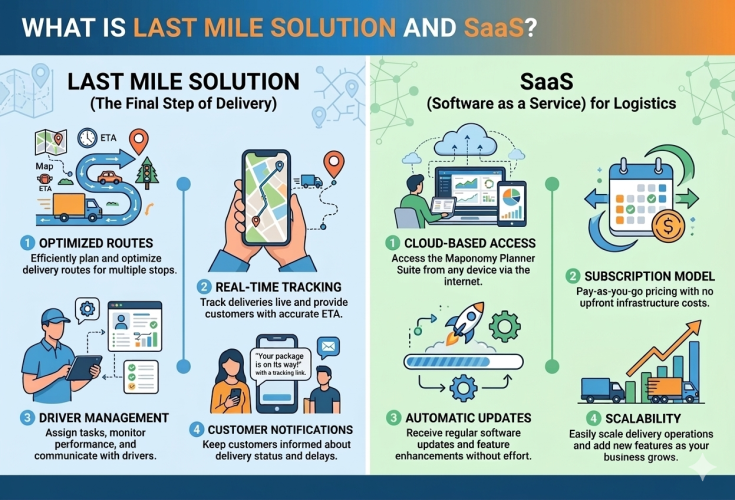
Cloud-based SaaS platforms are replacing legacy logistics systems at an unprecedented pace. Here’s how last mile solutions powered by SaaS are transforming delivery operations – and why your business can’t afford to ignore them.
A decade ago, managing last mile deliveries meant spreadsheets, phone calls, and hoping your drivers knew the fastest route. Today, the businesses winning the delivery game are the ones running their entire last mile operation from a browser – powered by intelligent, cloud-based software that optimizes every decision in real time.
The convergence of last mile solutions and SaaS (Software as a Service) technology represents one of the most significant shifts in modern logistics. It’s changing how companies plan routes, dispatch drivers, track shipments, communicate with customers, and ultimately, how they compete.
This guide explains what last mile solutions actually are, how SaaS is revolutionizing the way they’re built and delivered, and how platforms like Maponomy are giving logistics businesses of every size the tools to operate smarter, faster, and at lower cost.
What Is a Last Mile Solution
A last mile solution is any technology, platform, or strategy designed to optimize the final leg of the delivery process – the movement of goods from a distribution center, warehouse, or local hub to the customer’s doorstep. This final stretch, commonly known as the “last mile,” is widely regarded as the most expensive and operationally complex segment of the entire supply chain, often accounting for more than 53% of total shipping costs.
Last mile solutions exist to solve the problems that make this final leg so difficult: inefficient routing, failed deliveries, lack of visibility, rising customer expectations, and ballooning operational costs. A comprehensive last mile solution typically addresses several interconnected functions – route optimization, dispatch management, real-time tracking, driver navigation, proof of delivery, customer communication, and performance analytics – all working together to ensure that packages arrive on time, every time.
The scope of what qualifies as a last mile solution has expanded significantly in recent years. What once meant basic GPS tracking and paper-based route sheets has evolved into AI-powered platforms that can dynamically reroute drivers around traffic, predict delivery failures before they happen, and provide customers with minute-by-minute visibility into their shipment’s journey.
What Is SaaS and Why Does It Matter for Last Mile Logistics
SaaS – Software as a Service, is a cloud computing model in which software applications are hosted on remote servers and delivered to users over the internet, typically through a web browser or mobile app. Instead of purchasing, installing, and maintaining software on local computers or company-owned servers, businesses subscribe to a SaaS platform and access it on demand.
For logistics and delivery operations, the SaaS model offers transformative advantages over traditional on-premise software.
No heavy upfront investment. Traditional logistics software often requires expensive licenses, dedicated servers, and months of implementation. SaaS platforms operate on subscription models, allowing businesses to access enterprise-grade tools without the capital expenditure. You pay for what you use, and you can start operating within days rather than months.
Always up to date. SaaS providers continuously update their platforms with new features, security enhancements, and performance improvements. Unlike on-premise software that requires manual upgrades – often involving downtime and IT resources – SaaS updates happen automatically in the background, ensuring you always run the latest version.
Accessible from anywhere. Because SaaS runs in the cloud, your dispatch planners, warehouse managers, drivers, and executives can access the platform from any device with an internet connection. This is especially critical for logistics operations where stakeholders are distributed across warehouses, vehicles, and offices.
Scales with your business. Whether you’re managing five delivery vehicles or five hundred, a well-designed SaaS platform scales seamlessly. You can add users, expand to new regions, increase delivery volumes, or activate additional features without purchasing new infrastructure or reconfiguring systems.
Seamless integration. Modern SaaS logistics platforms are built with API-first architectures, meaning they can plug directly into your existing order management systems (OMS), enterprise resource planning (ERP) software, warehouse management systems (WMS), or customer-facing applications – creating a unified operational ecosystem rather than siloed tools.
How SaaS Is Transforming Last Mile Delivery Operations
The intersection of SaaS technology and last mile logistics has produced a new generation of delivery management platforms that are fundamentally different from the tools available even five years ago. Here’s how this transformation is playing out across key areas of delivery operations.
Intelligent Route Planning and Optimization
Route planning is the backbone of efficient last mile delivery. Traditional methods – manual plotting, static routes, or basic mapping tools – simply cannot handle the complexity of modern delivery operations where dozens of variables must be balanced simultaneously.
SaaS-based route optimization engines leverage AI and machine learning to analyze hundreds of factors in real time: traffic patterns, delivery windows, vehicle capacity, driver working hours, load weight and volume, service times, and even road restrictions. The result is routes that minimize distance and time while maximizing the number of successful deliveries per shift.
Maponomy’s Route Planner API exemplifies this approach. Available as both a SaaS web application and a plug-and-play API that integrates into existing TMS or OMS systems, it handles B2B and B2C last mile route planning – including vehicle deployment optimization, warehouse sortation, customer delivery windows, truck utilization by weight, volume, and monetary value, and driver working hour constraints. Businesses using this kind of intelligent optimization typically achieve a 10–15% reduction in logistics costs.
Automated Dispatch and Fleet Management
In legacy systems, dispatching is a manual process where planners assign deliveries to drivers based on intuition and experience. This approach breaks down quickly as delivery volumes grow and complexity increases.
SaaS-powered dispatch automation changes the equation entirely. Automated dispatch planners use real-time data and dynamic algorithms to assign the right delivery to the right driver at the right time, factoring in location, availability, vehicle type, capacity, and delivery urgency. When conditions change mid-shift – a traffic jam, a cancelled order, a priority delivery – the system recalculates and adjusts automatically.
Maponomy’s Automated Dispatch Planner operates on exactly this principle. It optimizes delivery routes while automating the entire dispatch workflow, calculates the ideal number of vehicles to deploy, and makes dynamic route adjustments based on real-time data – ensuring timely, cost-efficient deliveries without the bottleneck of manual planning.
Real-Time Tracking and Visibility
Visibility is arguably the most transformative capability that SaaS has brought to last mile logistics. In the pre-cloud era, delivery operations were essentially a black box: packages left the warehouse, and everyone hoped for the best. Today, SaaS platforms provide live, continuous visibility into every aspect of the delivery journey.
A modern live tracking dashboard shows real-time vehicle locations, delivery completion rates, route statuses, event logs, and driver activity. This data flows from GPS devices, mobile apps, and third-party integrations into a single, centralized view that operations managers can access from any browser.
Maponomy’s Live Tracking Suite delivers precisely this capability, integrating GPS pings from third-party mobile apps and GPS devices, providing both live tracks and historical track data, and sending automated notifications to all stakeholders. The result is complete operational transparency – managers can identify and resolve issues in real time, and customers always know where their package is.
Driver Mobile Apps and Courier Navigation
The driver is where strategy meets the street. Even the most sophisticated route optimization and dispatch planning mean nothing if the driver can’t execute efficiently on the ground. This is why SaaS-based last mile solutions increasingly include dedicated mobile applications for drivers and couriers.
A well-designed driver app provides optimized turn-by-turn navigation, smart delivery sequencing, proof-of-delivery capture through digital signatures and photos, automated status logging, and real-time communication with dispatch. It effectively transforms the driver’s smartphone into a powerful logistics terminal.
Maponomy’s Courier Navigation app is a mobile-first solution built specifically for last mile delivery operations. It features optimized route navigation with multiple travel mode support, delivery sequencing with accurate ETAs and distances, proof-of-delivery capture, toll, ferry, and highway avoidance options, and multi-language support — making it suitable for diverse, global workforces. The app integrates directly with Maponomy’s SaaS platform, ensuring that every action on the ground is reflected in real time on the dispatch dashboard.
Address Intelligence and Geocoding
One of the most costly and underappreciated problems in last mile delivery is inaccurate address data. In emerging markets particularly, customers often enter partial, misspelled, or unstructured addresses that traditional systems cannot resolve. The result is drivers circling neighborhoods, failed delivery attempts, and expensive return-to-origin cycles.
SaaS platforms with built-in address intelligence solve this problem at the source. Advanced geocoding and address parsing engines can interpret incomplete address inputs and return accurate geographic coordinates, enabling drivers to navigate as close as possible to the intended destination.
Maponomy’s Address Parsing and Geocoding solution is specifically designed for this challenge. It retrieves precise latitude and longitude coordinates from partially completed or semi-structured addresses, dramatically reducing failed deliveries and returns for both B2B and B2C operations. When integrated into the broader delivery workflow, this address intelligence layer prevents problems before they reach the driver.
Customer Communication and Experience
The delivery experience is now inseparable from the brand experience. SaaS-based last mile platforms enable businesses to keep customers informed at every stage through automated, multi-channel notifications – shipment tracking links, delivery alerts, estimated arrival times, and post-delivery feedback prompts delivered via SMS, email, or in-app messaging.
Maponomy’s Real-Time Customer Notification system provides multi-channel delivery updates, live shipment tracking for customers, and automated alerts at key delivery milestones. This transparency reduces missed deliveries, cuts inbound support volume, and significantly improves customer satisfaction scores.
Analytics, Reporting, and Continuous Improvement
A major advantage of SaaS platforms over traditional software is the richness of data they collect and the intelligence they extract from it. Every delivery, every route, every driver shift generates data that can be analyzed to identify inefficiencies, measure performance, and drive continuous improvement.
Modern last mile SaaS platforms provide dashboards and reports covering delivery completion rates, on-time performance, route efficiency, driver productivity, cost per delivery, and customer satisfaction metrics. This data-driven approach transforms last mile delivery from a reactive operation into a proactive, continuously optimizing system.
Dashcam and Streetview Integration
An innovative capability emerging in SaaS delivery platforms is the integration of real-time dashcam footage with interactive streetview navigation. This technology helps logistics teams verify delivery points visually before drivers arrive, monitor driver behavior and ensure accountability, and make more informed route planning decisions based on actual road conditions.
Maponomy’s Dashcam and Streetview Interface combines these capabilities into a single tool, providing an on-the-ground view of routes that helps teams plan better, verify locations, and maintain safety standards.
Network-Level Optimization
Individual route optimization is important, but the greatest efficiency gains come from optimizing the entire transportation network. SaaS-based network optimization tools analyze warehouse sourcing, loading locations, transit paths, and delivery zones holistically – identifying systemic inefficiencies that route-level optimization alone cannot capture.
Maponomy’s Network Optimizer maximizes transportation network efficiency by optimizing routes, sourcing from the right warehouses or plants, and minimizing transit times across the full supply chain.
The SaaS Advantage: Why Cloud Beats On-Premise for Last Mile
The shift from on-premise logistics software to SaaS isn’t a trend – it’s a structural transformation. Here’s why the advantages are so compelling for last mile operations specifically.
Speed of deployment. On-premise logistics systems often take months to implement. SaaS platforms can be operational in days or weeks, with no hardware to install and no IT infrastructure to configure. For businesses facing immediate delivery challenges, this speed is decisive.
Predictable costs. Subscription-based pricing replaces large capital expenditures with manageable monthly costs. During peak seasons, you can scale up capacity without purchasing additional licenses or servers. During slower periods, you’re not paying for unused infrastructure.
Modularity and customization. The best SaaS last mile platforms are modular – you can activate the specific capabilities you need and add more as your operation grows. Maponomy’s SaaS solution, for example, is designed to be modular and customizable, allowing businesses to select features for order management, route planning, live tracking, and driver navigation based on their specific requirements.
API-first architecture. SaaS platforms built with robust APIs can integrate directly into existing business systems. Maponomy’s Route Planner API is designed as a plug-and-play solution that enables last mile routing and planning within your existing TMS or OMS – meaning businesses don’t need to abandon their current systems to gain advanced optimization capabilities.
Collaboration across stakeholders. Cloud-based delivery means that warehouse managers, dispatch planners, drivers, and customers are all connected through a single platform, working from the same real-time data. This eliminates the communication gaps and information silos that plague traditional logistics operations.
Industries Benefiting from Last Mile SaaS Solutions
The flexibility of SaaS-based last mile platforms means they serve a remarkably wide range of industries. E-commerce and retail businesses use them to manage high-volume parcel deliveries with tight customer expectations. Courier and express services rely on them for route optimization and proof of delivery. Food and beverage companies need them for time-sensitive, temperature-controlled deliveries. Cold chain logistics providers use them to ensure compliance and maintain product integrity. Construction and industrial firms depend on them for managing heavy-goods deliveries to job sites. Passenger transit and ride-hailing services use the same underlying optimization and tracking technology for people rather than packages.
Maponomy’s platform serves across these sectors – from e-commerce logistics and food and beverage delivery to construction, passenger transit, and cold chain industries – with solutions that adapt to each industry’s unique constraints and requirements.
Choosing the Right Last Mile SaaS Platform
Selecting a last mile SaaS solution is a strategic decision that will shape your delivery operations for years. Here are the critical factors to evaluate.
End-to-end coverage. The most effective platforms address the full delivery workflow – from order intake and route planning through dispatch, tracking, driver navigation, proof of delivery, customer communication, and analytics. Fragmented point solutions create integration headaches and data gaps.
API and integration capabilities. Your last mile platform needs to work with your existing technology stack. Look for robust APIs that enable seamless connections with your OMS, ERP, WMS, and customer-facing systems.
Scalability and flexibility. Your delivery volumes will fluctuate. Your geography may expand. Your business model may evolve. Choose a platform that can grow with you without requiring a rip-and-replace migration.
Accuracy of routing and geocoding. The intelligence behind route optimization and address resolution directly impacts your delivery success rates and cost per delivery. Platforms with advanced AI-driven routing and address parsing capabilities will outperform those relying on basic algorithms.
Mobile experience for drivers. The driver app is where the platform meets the real world. It needs to be intuitive, reliable, and capable of working in all conditions – including areas with limited connectivity.
Data and analytics depth. You can’t improve what you can’t measure. Comprehensive reporting on delivery performance, route efficiency, driver productivity, and customer satisfaction is essential for continuous optimization.