
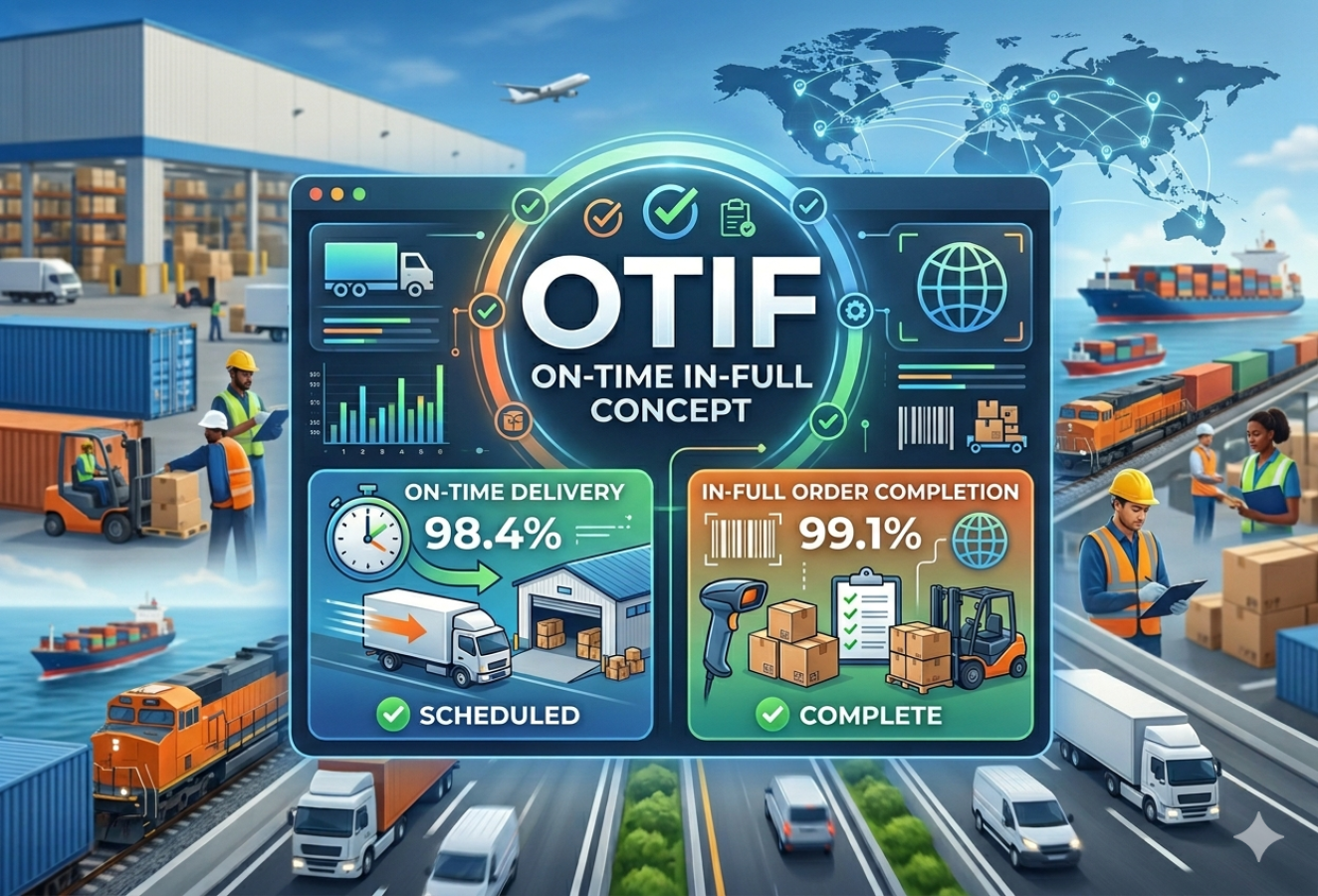
There is one metric in supply chain management that tells you more about the health of your logistics operation than any other. It is not cost per shipment. It is not fleet utilisation. It is not even customer satisfaction scores, because those are a lagging indicator of something more fundamental. The metric is OTIF, which stands for On Time In Full, and it answers the simplest and most consequential question in logistics: did the customer receive exactly what they ordered, in the right quantity, at the time they were promised or not ?
An order that arrives a day late but complete fails OTIF. An order that arrives on schedule but is missing two items out of twenty also fails OTIF. There is no partial credit. The metric is binary by design, because from the customer’s perspective, a delivery that misses either dimension has failed. A retailer whose shelves go empty because a shipment arrived twelve hours late does not care that the pallet was perfectly packed. A manufacturer whose production line halts because three components were missing from an otherwise punctual delivery does not celebrate the punctuality.
This unforgiving simplicity is precisely what makes OTIF so powerful. It compresses the entire supply chain, from demand forecasting and warehouse picking to route planning and final delivery, into a single number that exposes whether the system is working or breaking. Companies with OTIF scores above 95 percent are generally considered to operate high-performing supply chains. Companies below 90 percent are leaking money, losing customers, and accumulating operational debt that compounds with every missed delivery.
How OTIF Is Calculated: The Formula Every Supply Chain Team Should Know
The basic OTIF formula is deceptively simple. You take the number of orders that were delivered both on time and in full, divide by the total number of orders in the measurement period, and multiply by one hundred to get a percentage.
OTIF (%) = (Orders Delivered On Time and In Full / Total Orders) x 100
Some organisations break this into its two components for granular analysis. The “On Time” rate measures the percentage of orders delivered within the agreed delivery window. The “In Full” rate measures the percentage of orders delivered with the correct items and quantities. Multiplying the two rates together produces the composite OTIF score.
For example, a logistics operation completing 1,000 deliveries in a month, with 40 late deliveries and 30 incomplete deliveries, would calculate its component scores as 96 percent on time and 97 percent in full, yielding a composite OTIF of approximately 93 percent. That may sound respectable, but for a supplier serving a major retailer with a 98 percent OTIF target, those 70 failed orders represent chargebacks, strained relationships, and potential contract termination.
The critical detail that many teams overlook is the definition of “on time.” Some customers define it as delivery by a specific date. Others define it as arrival within a narrow window, sometimes as tight as thirty minutes. Similarly, “in full” can mean different things: correct product codes, correct quantities, correct packaging, or even correct documentation. Before any meaningful OTIF improvement program can begin, the definitions must be agreed upon and standardised across every stakeholder in the chain.
Why OTIF Failures Cost More Than You Think
The direct costs of OTIF failures are visible and quantifiable. Major retailers now impose financial penalties on suppliers who miss OTIF targets. Industry analysts estimate that these chargebacks can exceed five billion dollars annually across the consumer packaged goods sector alone. A single missed delivery window on a high-value retail order can trigger a chargeback of tens of thousands of dollars, often exceeding the profit margin on the shipment itself.
But the indirect costs are where the real damage accumulates. Every OTIF miss sets off a cascade of secondary disruptions. The receiving dock that expected a shipment at 8 AM now has an empty slot, followed by a scheduling pile-up when the late truck arrives during an already-busy window. The warehouse team that planned to put away and process that inventory for outbound orders now faces a delay that pushes downstream shipments off schedule. One late delivery can turn into three late deliveries within 24 hours.
The operational cost of firefighting is enormous and almost never measured. Teams spend hours investigating root causes, arranging expedited replacement shipments at premium freight rates, managing customer escalations, and manually tracking performance against a patchwork of customer-specific requirements. This reactive mode consumes the very resources that should be spent on strategic improvements like route optimisation and carrier performance analysis.
Customer trust erodes quietly but irreversibly. A B2B buyer whose production line was disrupted by a short shipment will remember it when the contract comes up for renewal. An e-commerce customer who receives the wrong items will share the experience publicly. Repeated OTIF failures do not just cost money on the current order. They reduce the lifetime value of the customer relationship and hand market share to competitors who deliver reliably.
The Five Root Causes of Low OTIF Scores in Last Mile and Distribution Logistics
OTIF failures rarely originate from a single point of breakdown. They are typically the result of compounding weaknesses across the supply chain. Understanding these root causes is the first step toward fixing them.
Poor Address Data and Geocoding Errors
A surprising number of delivery failures trace back to the very beginning of the process: the customer address. Incomplete, misspelled, or ambiguous addresses cause drivers to waste time searching for the correct location, arrive at the wrong building, or fail to find the delivery point entirely. In emerging markets, where structured addressing systems are often inconsistent, this problem is particularly acute. Every minute spent searching for an address is a minute stolen from the next delivery, and the delays cascade across the entire route.
The solution begins with cleaning and validating addresses at the point of entry. A robust address parsing and geocoding API converts raw customer input into standardised, structured addresses with precise latitude and longitude coordinates. This ensures that every delivery point in the system is accurate before it ever reaches a driver’s screen. When the geocode is correct, the navigation is correct. When the navigation is correct, the driver arrives on time. The chain of causation is direct and measurable.
Inefficient Route Planning and Vehicle Allocation
Route planning is the single largest lever for improving the “On Time” component of OTIF. A poorly planned route that sequences deliveries illogically, ignores traffic patterns, or assigns too many stops to a single vehicle virtually guarantees late deliveries in the second half of the day. The problem is compounded when planners rely on manual methods or basic tools that cannot account for the complex constraints of real-world logistics: delivery time windows, vehicle capacity limits, driver working hours, service times at each stop, and road restrictions that vary by vehicle type.
An automated route optimisation and delivery planning solution transforms this process. By ingesting all constraints simultaneously and computing mathematically optimal sequences, the system produces route plans that minimise total distance and time while respecting every delivery window. The result is a realistic, achievable plan where drivers can actually meet their commitments, rather than an aspirational schedule that begins falling apart after the third stop.
Lack of Real-Time Visibility During Delivery Execution
A perfect plan means nothing if you cannot see what is happening once vehicles leave the depot. Traffic congestion, unexpected road closures, a customer who is unavailable, or a delivery that takes longer than planned can all throw a route off schedule. Without real-time visibility, dispatchers discover these problems only when customers call to complain about a late delivery. By that point, the OTIF failure has already occurred.
Live tracking provides the visibility that enables proactive intervention. When a dispatcher can see that a vehicle is running twenty minutes behind schedule due to unexpected traffic, they can reroute the driver, reassign downstream stops to another vehicle, or notify affected customers with revised ETAs. The difference between reactive and proactive management is the difference between a systemic 85 percent OTIF and a consistently above-95 percent performance.
Inaccurate ETAs and Distance Calculations
Promising a customer a delivery window that your operation cannot reliably meet is one of the fastest paths to OTIF failure. ETAs that are calculated using straight-line distances, outdated road data, or algorithms that do not account for vehicle-specific restrictions produce delivery windows that are optimistic at best and fictional at worst.
Accurate ETAs require a directions and distance matrix API that calculates travel times based on actual road networks, real-time traffic conditions, and vehicle-specific parameters such as truck size, weight, and permitted road types. When the system accounts for toll avoidance preferences, highway restrictions, and the difference between a cargo van and a 40-foot trailer, the resulting ETAs become promises the operation can actually keep.
Disconnected Systems and Data Silos
The final and perhaps most insidious root cause is the fragmentation of information across disconnected systems. The order management system contains the delivery requirements. The warehouse system tracks inventory and picking status. The transport management system handles carrier assignments and dispatch. The driver’s mobile application captures delivery execution data. When these systems do not communicate in real time, decisions are made on incomplete information, and OTIF suffers.
Integration is not optional for high OTIF performance. The delivery planner must know what inventory is available and when it will be ready. The driver application must receive optimised routes that reflect the latest order changes. The live tracking dashboard must feed data back to the planning system so that tomorrow’s routes benefit from today’s actual performance data. Every link in the chain must share information continuously.
How Technology Improves OTIF Across the Entire Delivery Lifecycle
Improving OTIF is not a single initiative. It is a systematic upgrade of capabilities across every stage of the delivery lifecycle, from order intake to final confirmation.
Fixing Addresses Before They Enter the Delivery Pipeline
The cheapest OTIF improvement available to any logistics operation is address correction at the point of order entry. An address parsing API that validates, standardises, and geocodes every customer address before it enters the delivery pipeline eliminates the entire category of failures caused by drivers arriving at the wrong location. The reverse geocoding API serves the opposite function, converting GPS coordinates from driver check-ins or IoT devices into verified addresses that confirm the delivery was made at the correct location. Together, these capabilities create an address accuracy layer that prevents errors from propagating downstream.
Building Achievable Route Plans That Respect Every Constraint
The delivery planner suite is the computational engine that turns order data, vehicle data, and constraint data into executable route plans. It determines how many vehicles are needed, which orders go on which vehicle, in what sequence stops should be visited, and what time each delivery should occur. When this calculation accounts for delivery time windows, service times, driver breaks, vehicle weight and volume capacities, and real-time traffic forecasts, the resulting plan is not just optimal. It is achievable. And achievable plans are the foundation of high OTIF.
Tracking Execution in Real Time and Intervening Before Failures Occur
The live tracking suite closes the gap between plan and execution. GPS data from driver mobile applications, telematics devices, or third-party integrations flows into a centralised dashboard where dispatchers can monitor every vehicle, compare actual progress against the plan, and identify exceptions the moment they emerge. The system can also push automated customer notifications at key milestones: when the driver departs the depot, when the driver is a certain number of stops away, and when the driver is approaching. These notifications do not just improve customer experience. They improve OTIF by ensuring customers are available and ready to receive their deliveries.
Navigating Drivers to the Exact Delivery Point
The final metres of a delivery are where surprisingly many OTIF failures occur. A driver who cannot find the correct building entrance, who navigates to the front of a property when the delivery dock is at the rear, or who circles a commercial complex looking for the right unit is losing minutes that accumulate across dozens of deliveries per day. A courier navigation application integrated with precise directions APIs that provide turn-by-turn guidance to the exact delivery coordinates, accounting for vehicle type and road restrictions, eliminates this source of delay. When navigation is precise, dwell time drops, route adherence improves, and on-time performance climbs.
OTIF Benchmarks: What a Good Score Looks Like in 2026
OTIF benchmarks vary by industry, customer, and the complexity of the delivery operation. However, several broad thresholds have emerged as industry standards.
Scores above 95 percent are generally considered indicators of a high-performing, well-instrumented supply chain. These operations typically feature automated route planning, real-time tracking, proactive exception management, and integrated systems that share data continuously.
Scores between 90 and 95 percent represent solid but improvable performance. Operations in this range usually have good processes in place but suffer from specific recurring failure modes, such as address errors, inaccurate ETAs, or inadequate visibility, that targeted technology investments can address.
Scores below 90 percent signal systemic issues. Operations in this range are likely dealing with multiple root causes simultaneously: manual planning, disconnected systems, unreliable address data, and limited tracking capabilities. The cost of these failures, in chargebacks, expedited freight, lost customers, and operational firefighting, often exceeds the investment required to fix them several times over.
Major retailers have been steadily raising their OTIF expectations. The threshold that was considered acceptable five years ago is now grounds for penalty. The direction of the industry is clear: OTIF expectations will continue to rise, and the technology required to meet them is no longer optional.
From Metric to Strategy: Making OTIF a Competitive Advantage
The companies that treat OTIF as a strategic priority rather than a compliance obligation gain advantages that extend far beyond avoiding penalties. A consistently high OTIF score becomes a selling point in business development conversations. It signals operational maturity, reliability, and the kind of disciplined execution that customers are willing to pay a premium for.
The data generated by OTIF measurement, when captured digitally through live tracking, electronic proof of delivery, and geocoded address records, becomes a source of continuous improvement. Every delivery that fails OTIF generates a data point that can be analysed, categorised, and addressed. Over time, the patterns become visible: specific addresses that consistently cause delays, time windows that are unrealistically tight, routes that are over-loaded, carriers that underperform. Each pattern, once identified, becomes an actionable improvement opportunity.
The infrastructure required to achieve and sustain high OTIF is the same infrastructure that powers every other logistics improvement: precise geocoding and address parsing for address accuracy, intelligent route optimisation for plan quality, accurate directions and distance calculations for reliable ETAs, and real-time tracking for execution visibility. These are not separate investments for separate problems. They are layers of a single, integrated last mile delivery platform that makes high OTIF not just possible but sustainable.
The question is no longer what OTIF is. Every logistics professional knows the answer to that. The question is what your score is today, what it needs to be tomorrow, and what you are going to build to close the gap.