
The package sitting on your doorstep is a liability. From the moment a delivery driver places it on the porch and walks away, it enters a window of vulnerability. Rain, heat, curious neighbours, and the ever-growing population of porch pirates all threaten to turn a successful delivery into a customer service nightmare. According to recent consumer surveys, package theft affected nearly one in three households across the United States in 2025 alone. The financial toll on retailers and logistics providers runs into the billions annually, but the reputational damage is harder to quantify and even harder to repair.
At the same time, a parallel shift has been reshaping how deliveries are completed. The global push toward contactless interactions, initially accelerated by the pandemic, has not receded. It has hardened into a permanent consumer expectation. Customers no longer want to sign a clipboard. They do not want to open the door for a stranger. They want their packages delivered securely, verified digitally, and confirmed instantly, all without a single physical interaction between themselves and the delivery driver.
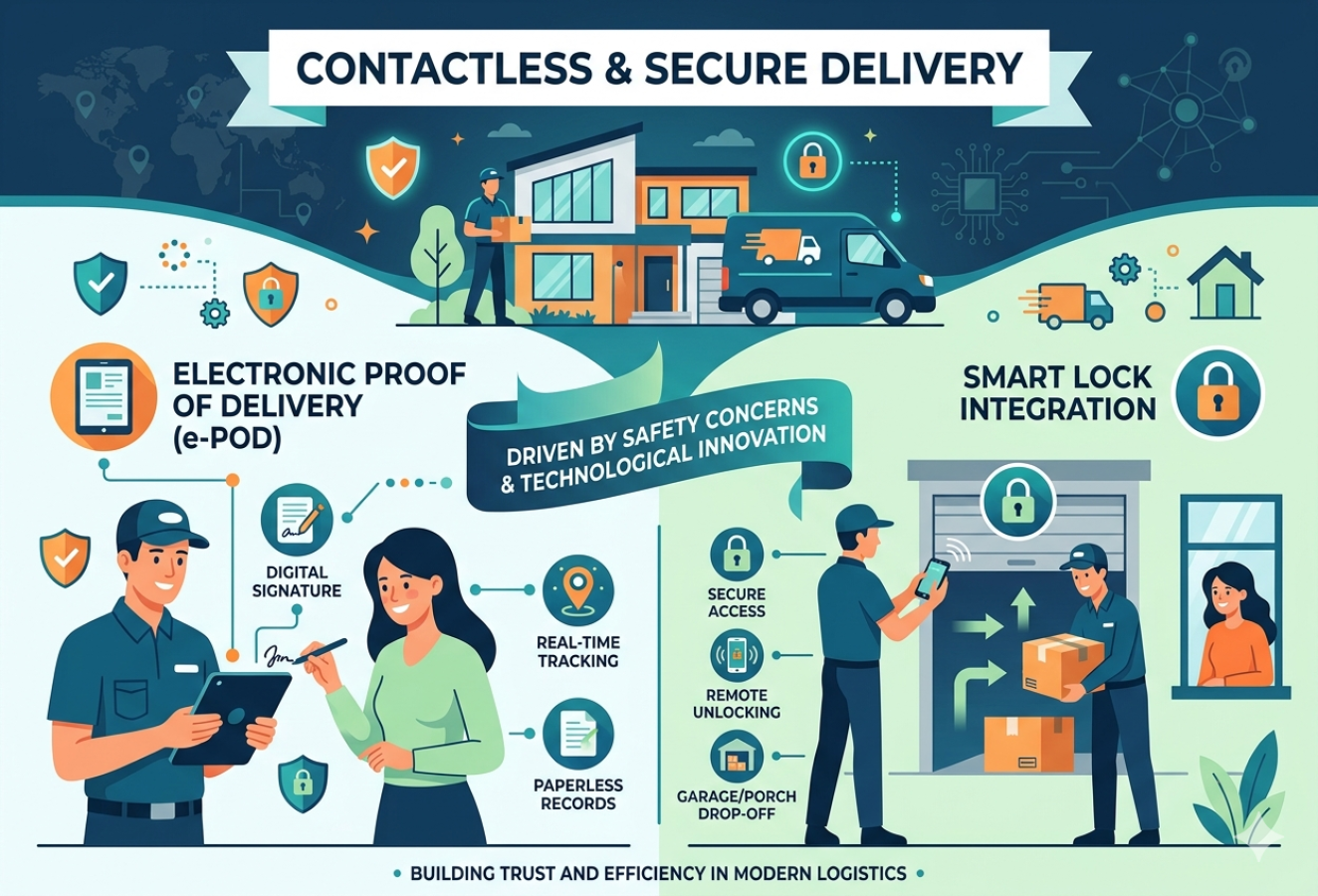
Two technologies have emerged at the centre of this transformation: Electronic Proof of Delivery, commonly known as ePOD, and smart lock integration that grants drivers temporary, controlled access to garages, porches, and secure delivery zones. Together, they represent the new standard for last mile logistics, one built on the twin pillars of contactless efficiency and verifiable security.
Why Traditional Proof of Delivery Is Failing Modern Logistics
For decades, proof of delivery meant a paper slip and a signature. The driver handed over the package, the recipient scrawled their name on a form, and the paperwork made its way back to the depot where someone eventually filed it. The system worked in a simpler era, but it was always fragile.
Paper gets lost. Signatures become illegible. Disputes arise weeks later with no reliable evidence to resolve them. A customer claims the package never arrived. The driver insists it was delivered. Without timestamped, geotagged, photographic proof, the company has no choice but to absorb the cost, issue a refund, and hope the pattern does not repeat.
The inefficiency compounds at scale. A logistics operation handling tens of thousands of deliveries per day generates a mountain of paper documentation that must be collected, transported, sorted, and stored. Administrative teams spend hours matching delivery notes to invoices. Errors in manual data entry create billing discrepancies. The entire process, from doorstep to final invoice, can take days or even weeks, tying up cash flow and creating friction at every step.
The shift to contactless delivery made these problems worse before technology made them better. When customers stopped opening their doors and drivers began leaving packages without a signature, the paper-based system lost its only verification mechanism. The signature, flawed as it was, at least provided some evidence of handover. Without it, companies were left with nothing but the driver’s word.
What Is Electronic Proof of Delivery (ePOD) and How Does It Work
Electronic Proof of Delivery replaces every weakness of the paper system with a digital equivalent that is faster, more accurate, and legally defensible. At the moment of delivery, the driver uses a mobile application to capture a constellation of data points: a time-stamped photograph of the package at the delivery location, GPS coordinates confirming the exact drop-off point, a digital signature if the recipient is present, and any relevant notes about the condition of the goods or special instructions followed.
This data is transmitted instantly to a central system where it becomes available to dispatchers, customer service teams, billing departments, and the customer themselves. There is no delay. There is no paper to lose. The moment the driver taps “delivered,” every stakeholder in the chain has access to irrefutable proof of what was delivered, where, when, and in what condition.
Key Benefits of ePOD for Delivery Operations
The implications ripple across the entire operation. Billing cycles accelerate because invoice generation can begin the instant delivery is confirmed, rather than waiting for paperwork to return to the office. Dispute resolution becomes straightforward because the photographic and geolocation evidence leaves little room for ambiguity. Fraudulent claims for missing or damaged goods decline sharply because the digital record provides objective verification.
For contactless delivery specifically, ePOD has become indispensable. The driver photographs the package at the customer’s door, the system stamps the image with coordinates and time, and the customer receives an instant notification with visual confirmation that their order has arrived. No physical interaction is required. The entire exchange is documented, verified, and archived without the driver and customer ever being in the same room.
Why Geocoding and Address Accuracy Matter for ePOD
The quality of this process, however, depends entirely on the quality of the underlying location data. A photograph of a package is only useful if the GPS coordinates confirm it was taken at the correct address. An estimated time of arrival is only meaningful if the routing data behind it reflects actual road conditions. This is where the technology stack beneath ePOD becomes critical. Precise geocoding ensures that every delivery address is resolved to exact coordinates, eliminating the ambiguity that leads to misdeliveries. Robust address parsing cleans and standardises the messy, incomplete addresses that customers enter, transforming them into structured data that drivers and navigation systems can rely on. And accurate directions and routing APIs guide drivers along optimised paths that account for traffic, vehicle type, and road restrictions, ensuring they arrive at the right place at the right time.
Without this foundation, even the most sophisticated ePOD application becomes unreliable. The photograph confirms delivery, but if the geocode was wrong, the package is at the wrong house. The timestamp proves the driver was on time, but if the route was inefficient, three other customers are now running late. Every layer of the delivery technology stack must work in concert for contactless delivery to function at the level customers now expect.
How Smart Lock Integration Prevents Package Theft and Enables Secure Delivery
Contactless delivery solved the problem of physical interaction, but it created a new one: exposure. A package left on a porch is exposed to theft, weather, and damage. For high-value deliveries, perishable goods, or pharmaceutical shipments, doorstep drop-off is simply not acceptable.
Smart lock integration addresses this by giving delivery drivers temporary, controlled access to a secure space, typically a garage, a porch enclosure, or a dedicated delivery compartment, without requiring the homeowner to be present or to interact with the driver in any way.
How One-Time Access Codes and Smart Garage Delivery Work
The mechanism is straightforward in concept but sophisticated in execution. The homeowner connects a smart lock or smart garage door opener to a delivery management platform. When a delivery is scheduled, the system generates a one-time access code or triggers a time-limited unlock window that corresponds to the driver’s expected arrival. The driver enters the code, places the package inside, and the lock re-engages automatically. The homeowner receives a notification confirming the delivery, often accompanied by a photograph or video from an integrated camera.
The security model is layered. The access code works only once and expires after use. The system logs every entry with a timestamp and, in many implementations, video verification. The homeowner retains full control through a mobile application, with the ability to revoke access at any moment. The driver never possesses a physical key and never gains permanent access to anything.
Real-Time Tracking and Route Optimization for Smart Access Deliveries
For logistics providers, integrating with smart lock ecosystems requires the same location intelligence that powers ePOD. The system must know precisely when the driver will arrive to generate the access window at the right time. This depends on real-time tracking that monitors the vehicle’s position and progress through its route, combined with distance matrix calculations that continuously update the estimated arrival time based on current conditions. If the ETA shifts because of traffic or a preceding delivery that took longer than expected, the access window must shift accordingly. A smart lock that unlocks thirty minutes before the driver arrives defeats the entire purpose.
The coordination between routing, tracking, and access control must be seamless. The delivery planner sequences stops in an order that respects delivery windows and access constraints. The live tracking dashboard gives dispatchers visibility into every vehicle’s position so they can anticipate and manage exceptions. The courier navigation application guides the driver to the precise delivery point with turn-by-turn directions that account for the specifics of the delivery, such as whether to approach from the front of the property or use a service entrance that leads to the garage.
This level of coordination was impossible with paper-based systems and manual dispatch. It requires an integrated digital infrastructure where every component, from address validation to route optimization to real-time tracking, communicates continuously.
Combining ePOD With Smart Lock Systems for End-to-End Delivery Verification
The most advanced delivery operations are not treating ePOD and smart lock integration as separate capabilities. They are converging them into a single, unified workflow that provides end-to-end security and verification from dispatch to doorstep.
In this model, the delivery begins with route planning that factors in which customers have smart access enabled and what type of access they require. The route optimization engine accounts for these constraints alongside traditional variables like distance, traffic, and delivery time windows, producing a plan that sequences stops for maximum efficiency while respecting the specific requirements of each delivery.
As the driver progresses through the route, the live tracking system communicates with the smart access platform, triggering unlock windows as the driver approaches each enabled address. Upon arrival, the driver enters the secure space, places the package, and the ePOD system captures the full suite of verification data: photographs of the package in its secure location, GPS coordinates confirming the correct address, a timestamp, and any condition notes. The smart lock re-engages, and the customer receives an instant notification with all of this information attached.
How Delivery Data Improves Route Planning Over Time
The result is a delivery that is simultaneously contactless, secure, verified, and transparent. The customer never needs to be present. The package never sits exposed on a doorstep. The entire chain of custody is documented digitally and available for review by any stakeholder at any time.
For the logistics provider, this convergence also produces operational intelligence. The data generated by every delivery, including dwell times at each stop, actual versus estimated arrival times, route adherence, and exception frequency, feeds back into the planning system. Over time, the route planner becomes more accurate because it learns from actual performance data. Service time estimates improve. ETAs tighten. The entire operation becomes progressively more efficient with each delivery cycle.
Why Contactless Delivery Drives Customer Retention and Revenue Growth
It is tempting to view ePOD and smart lock integration as operational improvements, cost-reduction measures that pay for themselves through fewer disputes and faster billing cycles. They are certainly that, but framing them purely as cost tools understates their strategic value.
Secure, contactless delivery is increasingly a factor in customer acquisition and retention. Consumers now compare delivery experiences across brands the way they once compared product quality or price. A retailer that offers verified, secure garage delivery has a tangible advantage over one that leaves packages on a wet doorstep and provides a tracking page that says nothing more than “delivered.”
Secure Delivery as a Competitive Advantage in E-Commerce and Subscription Commerce
Subscription commerce is particularly sensitive to delivery quality. A meal kit that arrives spoiled because it sat in the sun for three hours is not just a failed delivery. It is a cancelled subscription. A pharmaceutical shipment that requires temperature control and chain-of-custody documentation cannot be left on a porch. These are use cases where secure, verified delivery is not a nice-to-have but a prerequisite for the business model to function.
The data from ePOD systems also creates opportunities for service differentiation. A company that can provide its customers with a photographic record of every delivery, complete with timestamps and GPS verification, is offering a level of transparency that builds trust incrementally over hundreds of interactions. That trust translates into longer customer lifetimes, higher average order values, and stronger word-of-mouth referrals.
For logistics providers serving enterprise clients, the ability to offer ePOD and secure access integration is becoming a requirement in procurement decisions. Large retailers and distributors are including digital proof of delivery and smart access compatibility in their vendor selection criteria. Providers that cannot offer these capabilities are being excluded from consideration before the conversation even begins.
How to Implement ePOD and Smart Lock Delivery at Scale
Implementing contactless, secure delivery at scale requires investment across several domains. The driver mobile application must support photograph capture, digital signature collection, barcode scanning, and GPS logging, all within an interface simple enough that a driver completing dozens of deliveries per day can use it without friction. The backend must process and store this data in real time, making it instantly accessible to operations, billing, and customer service teams.
Address Parsing and Geocoding: The Foundation of Accurate Deliveries
Address accuracy must be addressed at the point of order entry. An address parsing and geocoding solution that corrects and standardises customer addresses before they enter the delivery pipeline prevents the downstream failures that no amount of ePOD technology can fix after the fact. A package delivered to the wrong address with perfect photographic proof is still a failed delivery.
Dynamic Route Planning for Secure Access Constraints
Route planning must be dynamic and constraint-aware. The delivery planner must handle not only traditional routing variables but also the specific requirements of secure access deliveries, including access time windows, dwell time for entering and exiting secure spaces, and fallback procedures when smart access systems are unavailable.
GPS Tracking and Live Visibility for Dispatchers and Customers
Real-time tracking must be reliable and continuous. The live tracking infrastructure must ingest GPS data from multiple sources, whether from a dedicated courier navigation application, a telematics device installed in the vehicle, or a third-party mobile integration, and present it coherently to dispatchers and customers alike. A gap in tracking data during the critical minutes around a smart-access delivery undermines the entire security model.
Finally, the directions and routing API powering the driver’s navigation must be accurate enough to bring the driver to the correct entrance of the property, not just the correct street. In dense urban environments, the difference between a front entrance and a garage entrance can be a hundred metres and a five-minute walk. Precision at this level is what separates a smooth, secure delivery from a confused driver standing at the wrong door while the access window expires.
The Future of Last Mile Delivery: Contactless, Verified, and Secure by Default
Contactless delivery is no longer an emergency response. It is the expectation. Secure delivery is no longer a premium feature. It is becoming the baseline. Electronic Proof of Delivery and smart lock integration are the technologies that make both possible at scale, and the companies that invest in this infrastructure now are positioning themselves for a logistics landscape where trust, transparency, and security are the primary currencies of customer loyalty.
The package on the doorstep was always a problem waiting for a solution. That solution has arrived, and it is digital, verifiable, and locked.