
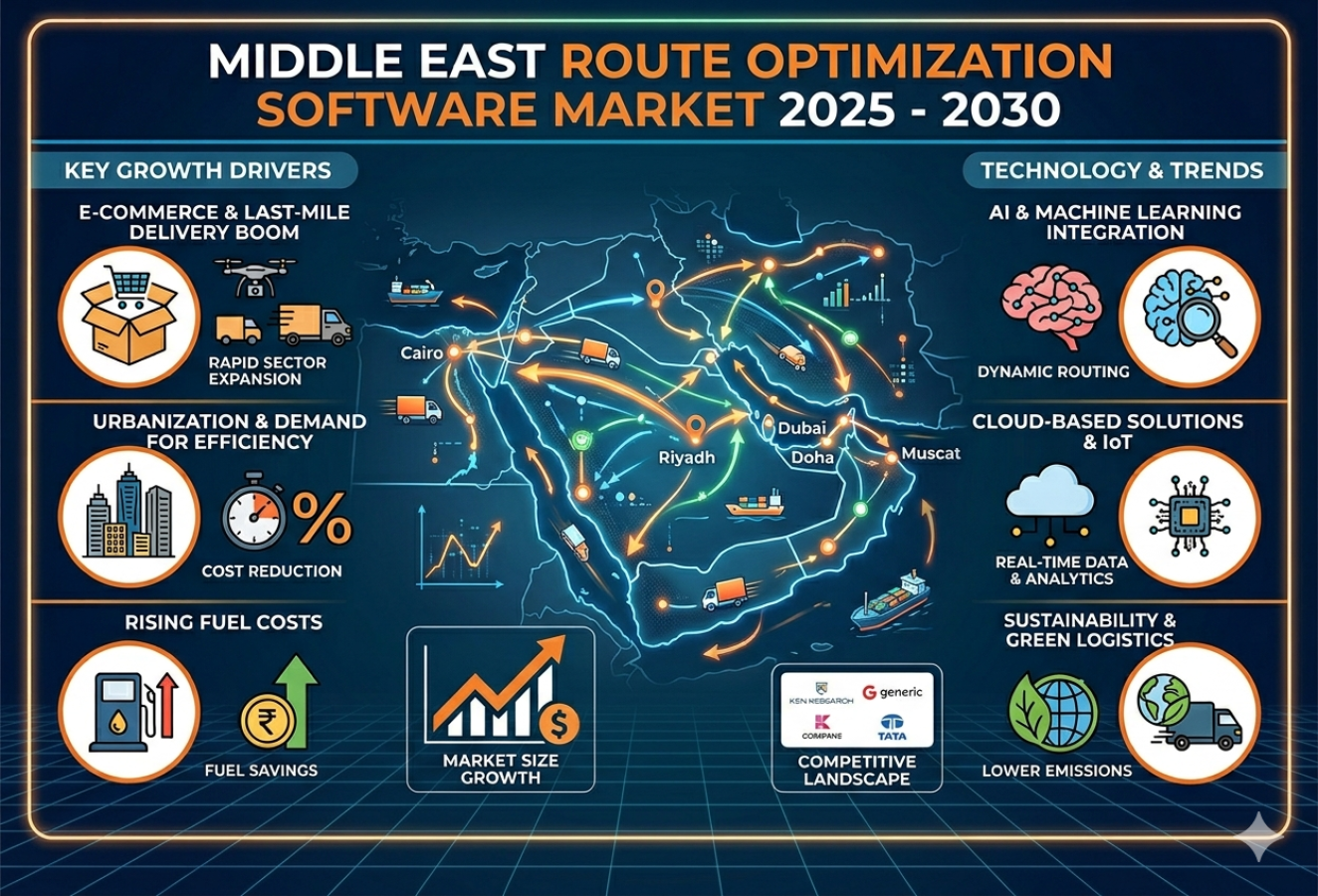
The Middle East is quietly becoming one of the most strategically important logistics markets in the world. Sitting at the crossroads of three continents, hosting some of the busiest ports and airports on the planet, and undergoing an aggressive digital transformation across its largest economies, the region has become both a global trade hub and a proving ground for next-generation logistics technology. At the centre of this transformation sits a software category that was once considered optional and is now considered essential: route optimization software.
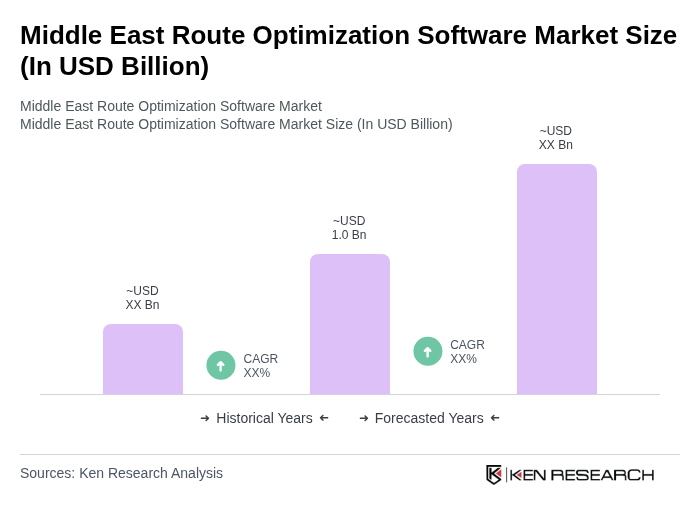
According to a recent market report from Ken Research, the Middle East Route Optimization Software Market is currently valued at approximately USD 1.0 billion, with sustained growth projected through 2030. The drivers behind this expansion are not isolated technology trends. They are structural shifts in how goods move across the region, how customers expect to be served, and how governments are reshaping the regulatory environment for transportation and logistics. Understanding this market is no longer a niche concern for software vendors. It is a strategic imperative for any business that moves freight, delivers products, or manages a fleet anywhere in the region.
Middle East Route Optimization Software Market Size and Growth Outlook
The headline figure tells part of the story. A market valued at USD 1.0 billion in a region the size of the Middle East may sound modest compared to global aggregates, but the trajectory is what matters. The growth rate is being fuelled by a combination of e-commerce expansion, massive infrastructure investment, and the kind of government-led digital transformation initiatives that tend to pull entire industries forward at once.
The GCC countries, particularly Saudi Arabia and the United Arab Emirates, dominate the regional landscape. Their geographic position as natural transit points for intercontinental trade, combined with strategic national initiatives like Saudi Vision 2030 and the UAE’s long-standing commitment to infrastructure modernisation, has created an environment where logistics technology adoption is not just encouraged but actively mandated in some sectors. The UAE government’s “Public Transport Regulations, 2023,” issued under the Roads and Transport Authority, require operators to deploy digital route planning and real-time monitoring solutions in public transportation systems. These regulations are not aspirational. They are in force, and they are reshaping what operators in the region must do to remain compliant.
The integration of artificial intelligence and machine learning into route optimization platforms is another major factor. Static route plans computed once per day are being replaced by dynamic systems that continuously recalculate based on traffic conditions, weather, and real-time order changes. The proliferation of mobile internet, smart devices, and connected vehicles provides the data layer that makes this possible. The software layer that turns that data into efficient routes is where the market value concentrates.
Market Segmentation by Software Type: What the Numbers Reveal
Not all route optimization software is created equal. The market report breaks the category down into several distinct sub-segments, each serving a different set of operational needs. Understanding these segments clarifies where the growth is concentrated and where the competitive pressure is most intense.
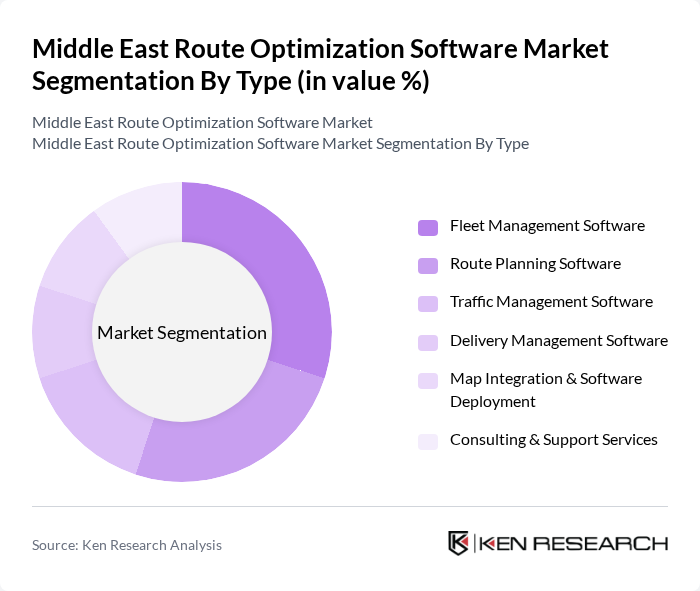
Fleet Management Software leads the market and continues to post the fastest growth. This category covers the platforms that businesses use to monitor and manage their vehicle fleets in real time, handling everything from GPS tracking and predictive maintenance to fuel management and driver behaviour analysis. The combination of telematics, IoT integration, and cloud-based dashboards has made fleet management software indispensable for logistics providers who operate at any meaningful scale.
Route Planning Software is the second major segment, focused specifically on calculating the most efficient sequences of stops for delivery vehicles given a set of constraints. This is the mathematical core of route optimization, and modern platforms solve vehicle routing problems that would have been computationally infeasible just a few years ago. A modern delivery planner suite handles capacity limits, time windows, driver working hours, service times, and vehicle-specific restrictions simultaneously, producing route plans that are both optimal and achievable.
Traffic Management Software, Delivery Management Software, Map Integration and Software Deployment services, and Consulting and Support Services round out the category. Each serves a specific role in the broader ecosystem, and together they create a technology stack that covers every stage of the delivery lifecycle. Delivery management software in particular has seen rising demand as businesses grapple with the complexity of last-mile operations in dense urban environments.
End-User Analysis: Who Is Buying Route Optimization Software in the Middle East
Understanding who is adopting route optimization software reveals where the demand is strongest and how vendor strategies should evolve. The market report segments end-users into several distinct categories, each with its own drivers and requirements.
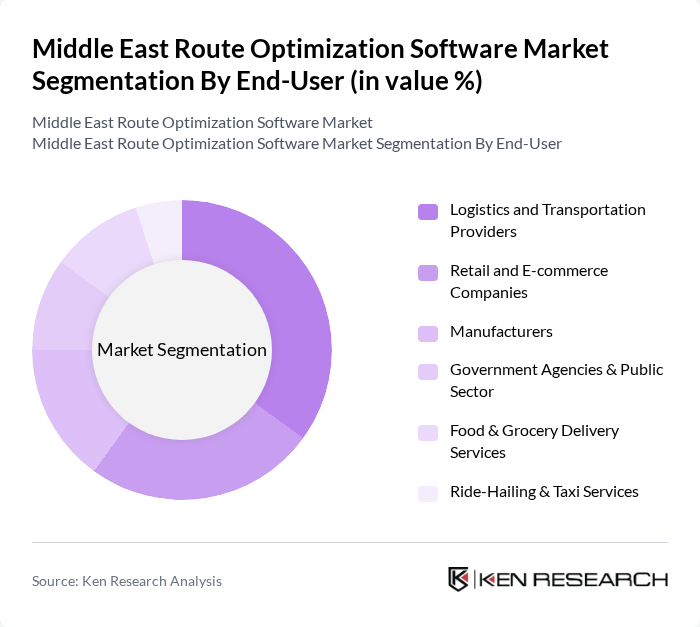
Logistics and Transportation Providers occupy the top position and are projected to remain there through the forecast period. These are the businesses whose entire operational model depends on efficient vehicle routing, and for them, route optimization software is not a productivity enhancement. It is the difference between profitable operations and unprofitable ones. The adoption rate among this segment is already high and continues to climb as providers shift from legacy systems to modern, cloud-based platforms.
Retail and E-commerce Companies form the second-largest segment, driven by the explosive growth of online shopping across the region. As consumer expectations around delivery speed and reliability tighten, retailers are investing heavily in logistics technology to keep pace. The ability to promise an accurate delivery window and then consistently meet it has become a competitive differentiator, and accurate directions and distance matrix APIs are the foundation on which that promise is built.
Manufacturers, Government Agencies and Public Sector bodies, Food and Grocery Delivery Services, and Ride-Hailing and Taxi Services make up the remaining major segments. Each has unique requirements. Manufacturers need routing that accounts for the specific constraints of industrial freight. Government agencies focus on public transportation efficiency and smart city initiatives. Food delivery services require ultra-tight delivery windows and intense last-mile optimisation. Ride-hailing platforms need real-time matching algorithms that pair drivers and passengers across constantly shifting demand patterns.
Key Growth Drivers Powering the Middle East Route Optimization Market
Several structural forces are pushing the market forward simultaneously. These drivers are not short-term trends. They are long-running shifts that will continue shaping the industry for years.
Rising Demand for Efficient Logistics in a $50 Billion Sector
The broader Middle East logistics sector is projected to reach USD 50 billion in the coming years. This is an enormous pool of spending, and the pressure to extract every possible efficiency from it is intense. Route optimization software has been shown to reduce operational costs by up to 10 percent, a figure that translates into massive savings when applied across large fleets. For a logistics operator managing hundreds of vehicles across multiple cities, the return on investment from a modern route optimization platform is not measured in months. It is measured in weeks.
The growth of trade activity in the UAE and Saudi Arabia has accelerated demand even further. New free trade zones, expanded port facilities, and cross-border e-commerce corridors have increased freight volumes, and every additional shipment is another opportunity to either capture value through efficient routing or lose value through poor planning.
Government Investment in Transportation Infrastructure
Governments across the region have committed over USD 100 billion to transportation infrastructure projects. Saudi Vision 2030 includes massive investments in logistics corridors, new cities, and port expansions. The UAE continues to position itself as the logistics hub of the broader region. These investments are not just building roads and warehouses. They are building the environment in which modern logistics technology becomes both necessary and commercially viable.
Regulatory initiatives are reinforcing this trend. The UAE’s mandate for digital route planning in public transportation is one example. Similar regulations are emerging across the GCC, often tied to sustainability targets that require operators to demonstrate measurable reductions in fuel consumption and emissions. An operator cannot credibly commit to emission reduction without the analytics infrastructure that live tracking and performance reporting provide.
Rising Fuel Costs as an Economic Forcing Function
Fuel prices in the Middle East, while historically lower than global averages, have been rising steadily. Projected average prices of USD 0.70 per litre may still sound inexpensive to buyers in Europe, but for logistics operators running thousands of vehicles millions of kilometres per year, every cent matters. Route optimization software can reduce fuel consumption by up to 10 percent by eliminating unnecessary distance, avoiding congestion, and sequencing stops more efficiently. The economic logic is undeniable.
This is also where the precision of the underlying geocoding infrastructure becomes critical. A route plan is only as good as the address data it is built on. Incorrect or imprecise geocodes lead drivers on wasted journeys, and wasted journeys burn fuel. An address parsing and geocoding API that cleans customer addresses and resolves them to accurate coordinates prevents this category of failure before it enters the routing system.
Market Challenges Facing Regional Adoption
For all the positive growth drivers, the Middle East route optimization market faces several significant obstacles that vendors and buyers alike must navigate.
High Initial Investment Costs and Adoption Barriers
Implementing modern route optimization software typically requires substantial upfront investment. For a mid-sized company, total implementation costs can exceed USD 50,000 when factoring in software licensing, integration work, training, and the hardware required to support real-time tracking. This financial barrier has slowed adoption, particularly among smaller logistics providers and businesses in markets where capital access is constrained.
Cloud-based deployment models have helped reduce this barrier by shifting costs from upfront capital expenditure to operational expenditure. A cloud-based delivery planner that can be integrated via API and paid for on a subscription basis makes modern capability accessible to businesses that cannot absorb a six-figure licensing fee. The shift toward API-first, subscription-priced models is one of the most important structural changes making the market accessible to smaller operators.
The Regional Skills Gap in Logistics Technology
The Middle East faces an estimated shortage of around 200,000 skilled workers in logistics and technology sectors. This skills gap limits the effective deployment of advanced software even when the technology itself is available. A platform that requires deep technical expertise to configure and operate is effectively useless if there is no one available to configure and operate it.
The response from leading vendors has been to simplify. Modern platforms now prioritise intuitive user interfaces, guided workflows, and automated configuration wherever possible. Solutions built around precise courier navigation applications are designed to be used by drivers with minimal training, and the back-office tools are increasingly accessible to operations staff who are not software engineers.
Market Opportunities: E-Commerce, IoT, and Smart City Integration
The challenges are real, but the opportunities are larger. Three stand out as particularly significant for the coming period.
E-Commerce Logistics Expansion Creating Software Demand
The Middle East e-commerce sector is expected to reach USD 37 billion in the near future. This expansion creates direct demand for route optimization software, as every online order that enters the system eventually becomes a physical delivery that must be planned, routed, and tracked. Retailers that cannot handle this volume with efficient software will either lose customers to faster competitors or be forced to absorb unsustainable delivery costs.
The integration of customer notification systems with routing and tracking infrastructure has become standard. Customers expect real-time visibility into their orders, and providing that visibility requires a unified system where the route planner, the tracking dashboard, and the customer-facing notifications all share the same underlying data.
IoT Adoption and Real-Time Tracking Infrastructure
IoT adoption in the Middle East logistics sector is projected to grow by 30 percent in the coming years. Sensors on vehicles, packages, and warehouse infrastructure are generating vast quantities of data that can be fed into optimization algorithms to improve everything from route planning to cold chain monitoring. The combination of IoT data and modern software creates capabilities that were simply impossible a decade ago.
Live tracking suites that aggregate GPS data from multiple sources, including driver mobile applications, dedicated telematics devices, and third-party integrations, provide the real-time operational picture that dispatchers need. Without this visibility, route plans become static artifacts that lose their value the moment a disruption occurs. With it, the entire fleet becomes a responsive system that can adapt to conditions as they change.
The Role of Modern Location APIs in Regional Market Leadership
As the Middle East route optimization market matures, the distinction between winning and losing vendors will come down to the quality and breadth of their underlying technology stack. Platforms built on modern, API-first architectures that integrate specialised capabilities from best-in-class providers are positioned to outperform legacy systems that were built as monolithic, on-premise installations.
The specific capabilities that matter are no longer mysterious. Accurate geocoding and search APIs to resolve customer addresses into precise coordinates. Robust directions and routing APIs that account for vehicle type, road restrictions, and real-time traffic. Delivery planner suites that solve complex vehicle routing problems under real-world constraints. Live tracking infrastructure that provides continuous visibility across the fleet. Courier navigation applications that guide drivers to precise delivery points. And the integration layer that allows all of these components to communicate continuously.
For regional operators evaluating their technology investments, the question is no longer whether to adopt route optimization software. That question has been settled. The question is which platform offers the right combination of capabilities, the right cost structure, and the right path to scale across the specific geographies and use cases that matter most for their business.
Future Outlook: What the Middle East Route Optimization Market Looks Like in 2030
The forecast through 2030 suggests continued strong growth driven by the convergence of several trends. Artificial intelligence will continue to move from experimental to essential, with machine learning models handling increasingly complex optimization problems in real time. E-commerce logistics will continue to expand, pulling more retailers and third-party logistics providers into the market. Government regulation will continue to tighten, particularly around emissions and public transportation efficiency, forcing adoption among operators who might otherwise have delayed.
The vendors that thrive will be those who can combine the breadth of a full platform with the depth of specialised capabilities, who can offer flexible deployment models that work for both large enterprises and small operators, and who can demonstrate measurable ROI in the specific operational contexts that regional customers face.
For a detailed breakdown of market sizing, segmentation, competitive landscape, and forecasting methodology, the complete market research is available in the Ken Research Middle East Route Optimization Software Market report, which provides deeper analysis of the regional players, end-user procurement behaviour, and multi-year forecasts through 2030.
The Middle East is no longer a secondary market for logistics technology. It is a primary battleground where the next generation of route optimization platforms will be tested, refined, and proven. The operators who invest wisely in the right tools today will be the ones defining what regional logistics looks like for the rest of the decade.
References: