
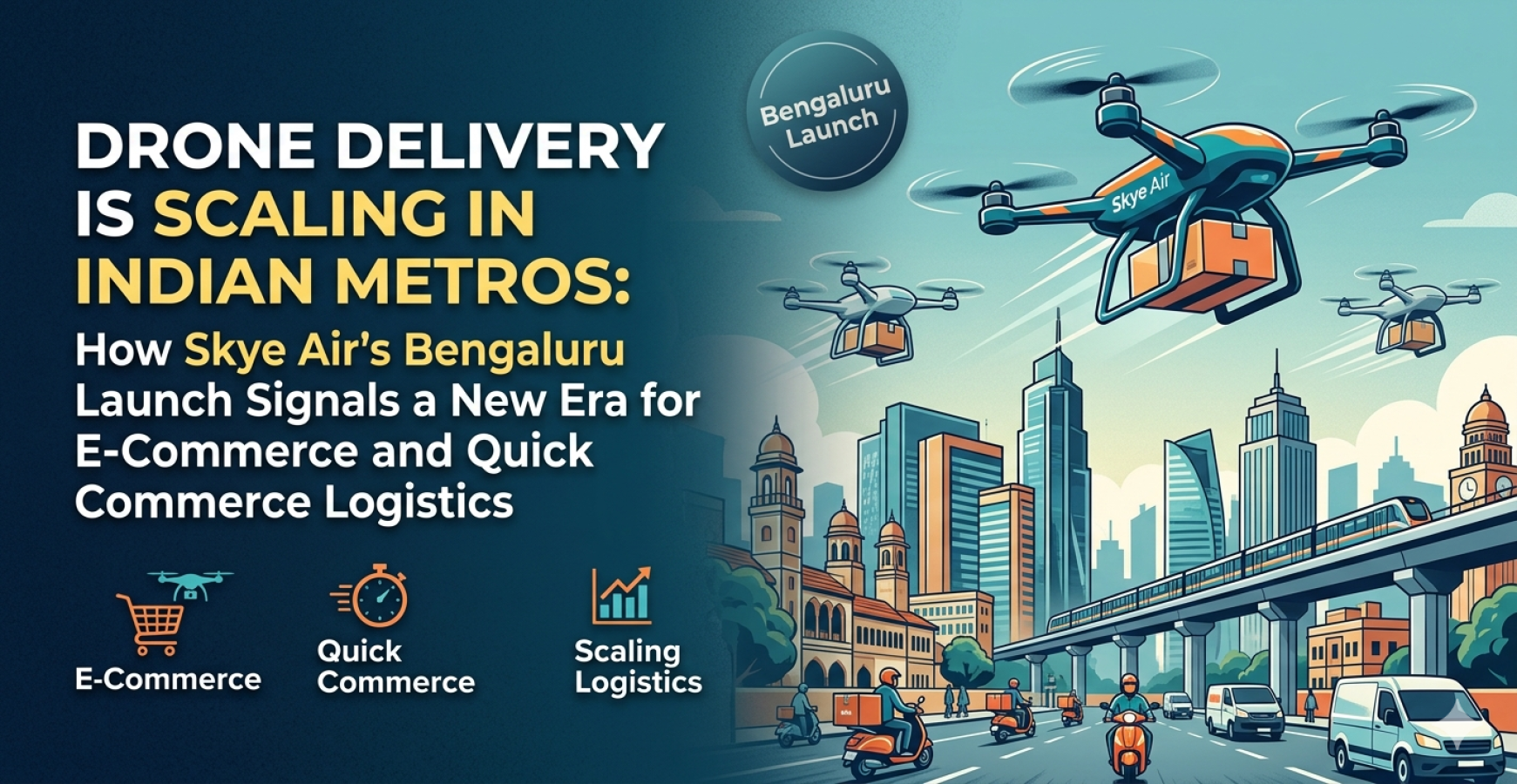
A package lifts off from a micro-hub in south Bengaluru, climbs above the traffic-choked arterials of Kanakapura Road, and descends seven minutes later at a residential complex in Konankunte. No delivery rider navigated the gridlock. No two-wheeler burned a drop of fuel. No customer refreshed a tracking page for thirty minutes wondering whether their order was stuck behind an overturned auto-rickshaw. The drone simply flew over all of it.
This is not a pilot programme or a demonstration flight. It is a commercial delivery operation running daily in one of India’s most congested cities, operated by Skye Air Mobility, the Gurugram-based hyperlocal drone delivery network that has now completed over 3.6 million autonomous deliveries across India. With its expansion into Bengaluru, Skye Air has made the city the second Indian metro, after Gurugram, to host drone-powered ultra-fast commerce at commercial scale. The company processes roughly 6,000 deliveries per day, handles approximately 200,000 packages monthly, and counts some of the country’s largest logistics players, including Bluedart, DTDC, Shiprocket, and Ecom Express, among its customers.
The Bengaluru launch is not an isolated event. It is the leading edge of a structural shift in how India’s logistics industry is approaching the last mile. The Indian drone market was valued at USD 940.6 million in 2024 and is projected to reach USD 3.23 billion by 2030. Within the delivery-specific segment, India leads major global markets with a projected compound annual growth rate of 50.4 percent, ahead of China. Drone delivery is no longer a question of whether it will work in Indian cities. The question is how fast it will scale.
Why Bengaluru? Understanding the Strategic Logic Behind the Expansion
Bengaluru was not a random choice. The city represents the ideal convergence of the conditions that make drone delivery commercially viable and urgently needed.
Traffic Congestion as a Forcing Function
Bengaluru consistently ranks among the most traffic-congested cities in the world. Average commute speeds during peak hours can drop below 15 kilometres per hour on major corridors. For a quick-commerce operation promising 10-minute delivery, this is an existential problem. A delivery rider stuck in Koramangala traffic for twelve minutes has already failed the service-level promise before reaching the first customer. The physics of ground-based delivery in Bengaluru’s traffic conditions impose a hard ceiling on speed that no amount of route optimization or fleet expansion can overcome.
Drones bypass this constraint entirely. By operating in the airspace above congestion, they decouple delivery speed from road conditions. A seven-minute aerial delivery in Bengaluru is not just faster than a ground-based alternative. It is consistently fast, regardless of whether it is a normal Tuesday afternoon or the chaos of a holiday weekend. This consistency is what makes drone delivery transformative for quick commerce, where the promise is not just speed but predictable speed.
E-Commerce and Quick Commerce Density
Bengaluru is India’s third-largest e-commerce market and one of the most digitally literate cities in the country. The concentration of tech-savvy consumers, high smartphone penetration, and established quick-commerce adoption create the demand density that drone delivery economics require. A drone operation needs a minimum threshold of orders per hour within a given service radius to achieve viable unit economics. Bengaluru’s order density, particularly in the southern and eastern residential corridors, crosses that threshold comfortably.
Regulatory Environment and Airspace Access
India’s Directorate General of Civil Aviation (DGCA) has progressively liberalised drone regulations since the introduction of the UAS Rules in 2021. The New Drone Amendment Rules of 2023 further simplified approvals and promoted commercial operations. Over 10,600 remote pilot certificates, 67 DGCA-approved drone models, and nearly 23,000 drone registrations are now in place across the country. While airspace restrictions around military installations and certain government facilities remain, the operational corridors available in Bengaluru’s suburban areas are sufficient to support commercial delivery at meaningful scale.
How Skye Air’s Hub-Pod-Walker Model Works in Practice
Skye Air does not simply fly a drone from a warehouse to a doorstep. The operation uses a hybrid logistics architecture called the hub-pod-walker model, specifically designed for the complexity of Indian urban environments.
The Three-Stage Delivery Chain
The process begins at a hub, typically a micro-fulfilment centre or a logistics partner’s facility, where packages are sorted and loaded onto drones. The drone, Skye Air’s flagship Skye Ship One, lifts off and flies to a designated pod, a secure collection point installed at a residential complex, commercial building, or neighbourhood access point. The pod functions as a mini cross-dock, receiving the aerial delivery and holding it securely until the final handoff. A walker, a human delivery agent operating on foot within the complex, completes the last few metres from the pod to the customer’s door.
This three-stage architecture solves several problems simultaneously. It eliminates the need for the drone to navigate the interior of gated residential complexes, where low-hanging cables, trees, and narrow corridors create obstacles that are difficult for aerial systems to handle safely. It provides a secure intermediate storage point that prevents package theft or weather exposure. And it preserves employment in the delivery ecosystem by integrating human walkers into the chain rather than replacing them entirely. Skye Air has been explicit that its model is designed to complement the gig economy rather than displace it.
The Skye UTM Airspace Management Platform
Behind the visible drone flights is an AI-powered airspace management platform called Skye UTM (Unmanned Traffic Management) that coordinates flight paths, manages deconfliction with other airspace users, monitors weather conditions, and ensures compliance with DGCA regulations. As the number of concurrent flights increases, this digital infrastructure becomes as important as the drones themselves. Without reliable airspace management, scaling from dozens of daily flights to thousands would be operationally impossible.
The Business Case: Reducing Logistics Costs From 15 Percent to 9 Percent
The economic argument for drone delivery in India is built on a specific and measurable claim: that the technology can reduce the logistics cost burden for e-commerce and quick-commerce companies from approximately 15 percent of order value to around 9 percent. For an industry where margins are razor-thin and unit economics are the difference between survival and shutdown, a six-percentage-point reduction in logistics cost is transformative.
Where the Savings Come From
The savings derive from several sources. First, drones eliminate fuel costs for the aerial portion of the journey. Second, they dramatically reduce the time per delivery, which means fewer delivery agents are needed to handle the same volume of orders. Third, they reduce failed delivery attempts, because the pod-based model ensures packages are received even when the customer is not immediately available. Fourth, they reduce vehicle maintenance and insurance costs that accumulate across large fleets of two-wheelers.
The environmental dividend reinforces the economic case. Each drone delivery reduces carbon emissions by approximately 520 grams compared to a traditional ground-based delivery. Across 200,000 monthly packages, that translates to roughly 2.6 metric tonnes of carbon dioxide savings per month from a single city operation. As sustainability reporting requirements tighten for Indian companies and their global clients, this measurable emission reduction becomes a competitive advantage in its own right.
Investor Confidence and Funding Trajectory
The market has validated the business model with capital. In March 2026, Skye Air closed a USD 9 million Series B funding round led by IAN Alpha Fund, with participation from AVNM Ventures, Faad Capital, Bajaj Capital, and other investors. The funding is earmarked for expansion beyond Delhi-NCR into Bengaluru, Mumbai, Pune, Hyderabad, and Kolkata over the next 18 months, as well as investment in the Skye UTM platform and the integration of autonomous drones with intelligent ground logistics systems. The company has also established a strategic partnership to deploy secure app-accessible delivery pods, starting with 60 units in Gurugram and plans to scale to 500 units across its service areas.
India’s Drone Delivery Market in Context: The Numbers Behind the Momentum
The broader market dynamics explain why Skye Air is not alone in betting on Indian drone logistics, even though it is currently the most visible operator in the commercial delivery space.
Market Size and Growth Projections
The Indian delivery drone market generated USD 22.9 million in revenue in 2023 and is projected to reach USD 397.8 million by 2030, representing a compound annual growth rate of 50.4 percent. This makes India the fastest-growing delivery drone market in the Asia Pacific region. The broader Indian drone market, spanning all applications from agriculture to defence to infrastructure inspection, was valued at USD 940.6 million in 2024 and is expected to reach USD 3.23 billion by 2030.
Regulatory Tailwinds
The Indian government has taken a deliberately pro-drone stance. The Liberalised Drone Rules of 2021 replaced restrictive earlier regulations with a streamlined framework that reduced compliance layers, lowered fees, and opened the sector to startups and small businesses. The Production-Linked Incentive (PLI) scheme allocates 120 crore rupees for drone and drone component manufacturing. A 100 percent FDI policy under the automatic route permits foreign investment in drone manufacturing and services. Initiatives like the Medicine from the Sky project, which delivers vaccines and diagnostic kits to remote villages, have demonstrated the social value of drone logistics and built public support for the technology.
The DGCA’s DigitalSky platform provides the regulatory infrastructure for drone registration, pilot certification, and flight approvals. While bureaucratic delays in pilot certification processing and the complexity of airspace permissions around major metros remain challenges, the trajectory is clearly toward greater operational freedom.
The Quick Commerce Connection
India’s quick-commerce sector has been one of the fastest-growing segments in global retail, with multiple platforms now promising delivery in 10 to 30 minutes for groceries, electronics, and everyday essentials. This hyper-speed promise has created an infrastructure arms race in which dark stores, micro-fulfilment centres, and last-mile fleet capacity are the competitive battlegrounds. Drone delivery slots directly into this architecture by offering a delivery channel that is faster than any ground alternative and does not degrade in performance during peak congestion hours.
The partnership between Skye Air and Shiprocket, one of India’s largest e-commerce shipping aggregators, illustrates how drone delivery is being integrated into the existing logistics ecosystem rather than being positioned as a replacement. Shiprocket’s seller network gains access to drone delivery as an additional fulfilment option, allowing them to offer faster delivery in drone-enabled service areas without changing their existing workflows.
Challenges and Constraints: What Still Needs to Be Solved
For all the momentum, drone delivery in Indian metros faces constraints that must be acknowledged honestly.
Payload and Range Limitations
Current drone platforms, including Skye Air’s Skye Ship One, are optimised for payloads up to 10 kilograms. This covers the vast majority of quick-commerce and small-parcel e-commerce deliveries but excludes bulky items, large grocery orders, and heavier shipments. The operational range for battery-powered drones is typically 10 to 30 kilometres, which is well-suited for hyperlocal delivery but insufficient for inter-city or even cross-city logistics in a sprawling metro like Bengaluru. Drone delivery will complement ground-based logistics, not replace it entirely.
Airspace Complexity in Dense Urban Environments
Indian metros present unique airspace challenges. Dense clusters of high-rise buildings, extensive overhead cabling, bird populations, and the proximity of some residential areas to military installations and airports create operational constraints that limit where and when drones can fly. The number of planned national drone corridors that are actually operational remains limited, and obtaining permissions even in approved zones can involve delays that undermine the speed advantage that is the entire point of the service.
Weather Sensitivity
Bengaluru’s monsoon season, which can bring heavy rainfall and strong winds for several months of the year, will test the operational resilience of drone delivery in ways that the drier conditions of Gurugram do not. Most commercial delivery drones are not certified for flight in heavy rain or wind speeds above 30 to 40 kilometres per hour. Seasonal downtime during the monsoon could reduce annualised utilisation rates and affect the economics of the operation.
Public Acceptance and Safety Perception
Consumer surveys in India generally show high enthusiasm for drone delivery, particularly among younger, urban, tech-savvy demographics. However, incidents elsewhere in the world, including drone crashes and near-misses, receive amplified media coverage that can shift public perception rapidly. Building trust requires an impeccable safety record, transparent communication, and genuine community engagement in the neighbourhoods where drones operate.
The Road Ahead: From Two Cities to Twenty
Skye Air’s stated ambition is to expand into Mumbai, Pune, Hyderabad, and Kolkata within 18 months, with the long-term vision of building a nationwide drone delivery network that integrates autonomous aerial systems with ground-based robotics and intelligent airspace management into what the company describes as a “Physical AI stack.”
The transition from two cities to twenty will require solving several scaling challenges simultaneously. Manufacturing capacity must increase to support thousands of drones rather than hundreds. Pod infrastructure must be deployed across hundreds of residential and commercial complexes in each new city. Airspace approvals must be secured in metros with varying regulatory environments and military sensitivities. And the Skye UTM platform must prove it can manage thousands of concurrent flights across multiple cities without compromising safety or reliability.
The broader Indian ecosystem is moving in the same direction. Multiple startups are pursuing drone logistics across healthcare, agriculture, and industrial supply chains. Global players are watching India’s regulatory environment and market dynamics closely. And the Indian government’s stated goal of making the country not just an adopter but a global leader in drone logistics suggests that policy support will continue to strengthen.
What Skye Air has demonstrated in Bengaluru is that drone delivery in Indian metros is not a theoretical possibility or a future aspiration. It is a present-tense commercial operation, processing real orders for real customers through real logistics partners. The seven-minute delivery from hub to pod over Kanakapura Road is not the end of the story. It is the opening paragraph of a chapter that will reshape how India’s fast-growing e-commerce and quick-commerce sectors move goods through the most congested cities on the planet.
The drones are already in the air. The question now is how fast the infrastructure on the ground can keep up.