
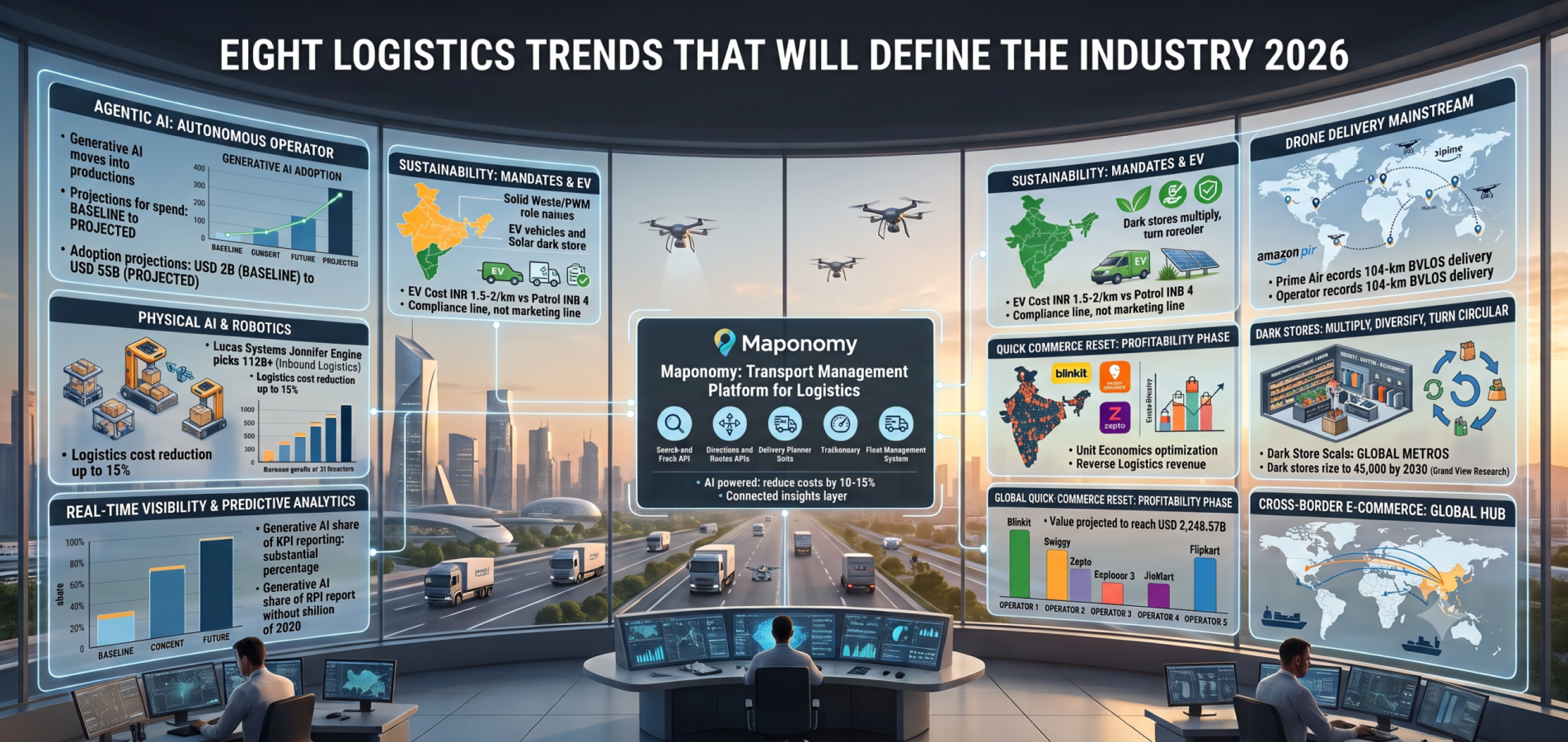
From agentic AI and autonomous fleets to sustainability mandates and India’s quick-commerce reset
The logistics industry entered 2026 in a fundamentally different posture than it held eighteen months ago. Cash discipline replaced growth-at-all-costs, generative AI moved from proof-of-concept to production, sustainability rules turned from voluntary pledges into enforceable statute, and last-mile execution was rebuilt around real-time data. According to MHI, 2026 is the turning point at which supply chains stopped reacting to disruption and started anticipating it, and Gartner expects spending on SCM software with agentic AI alone to grow from under USD 2 billion in 2025 to USD 53 billion by 2030. Below are the eight trends most likely to define industry execution this year.
Agentic AI Moves from Assistant to Autonomous Operator
Generative AI helped teams work faster in 2024 and 2025. In 2026 agentic AI acts on its own. According to AJOT’s 2026 report, agentic systems now monitor capacity, flag coverage risks, and manage exceptions without waiting for a human. Capgemini reports 93 percent of organizations are exploring or deploying generative AI, with the share of businesses using it jumping from 6 percent in 2023 to 30 percent in 2025. Effective adoption requires clear frameworks, reskilling, and process redesign around agents rather than the reverse.
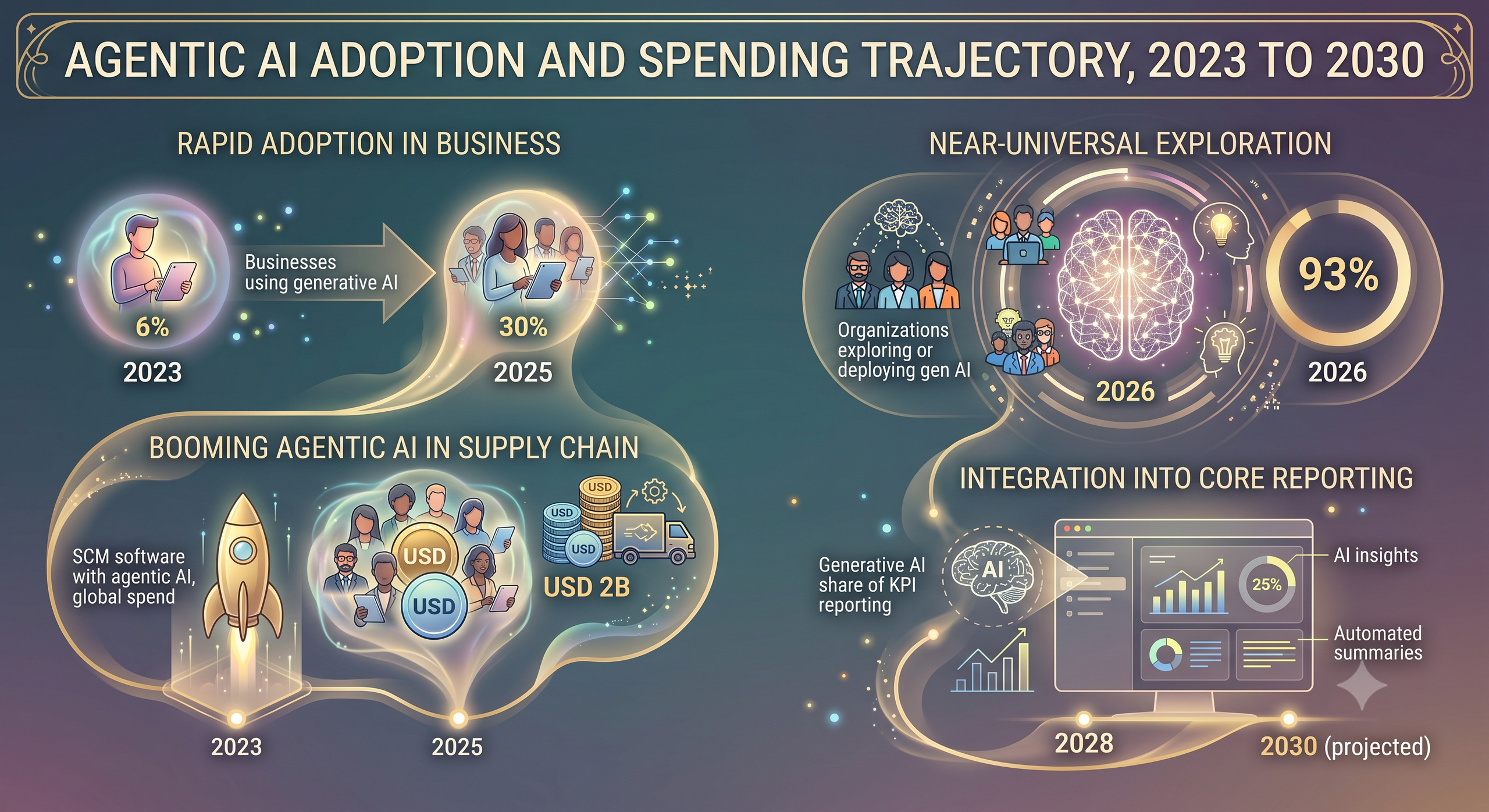
| Metric | Value | Year |
|---|---|---|
| Businesses using generative AI | 6% | 2023 |
| Businesses using generative AI | 30% | 2025 |
| Organizations exploring or deploying gen AI | 93% | 2026 |
| SCM software with agentic AI, global spend | USD 2B | 2025 |
| SCM software with agentic AI, projected | USD 53B | 2030 |
| Generative AI share of KPI reporting | 25% | 2028 (projected) |
Figure 1. Agentic AI adoption and spending trajectory, 2023 to 2030.
Sources: Capgemini via Mecalux; Gartner (2026); Coursera (2026)
Sustainability Becomes Regulated, Not Optional
The regulatory floor has risen materially. In India, the Solid Waste Management Rules 2026 and PWM Amendment Rules 2026 formally categorize quick commerce platforms as brand owners with explicit product-lifecycle liabilities, and the 2024 anti-greenwashing guidelines prohibit unsubstantiated green claims. Fleets are electrifying to match: EVs cost INR 1.5 to 2 per km compared with INR 4 for petrol, and dark stores are being re-engineered with solar rooftops and battery-swapping stations. Sustainability is now a compliance line, not a marketing line.
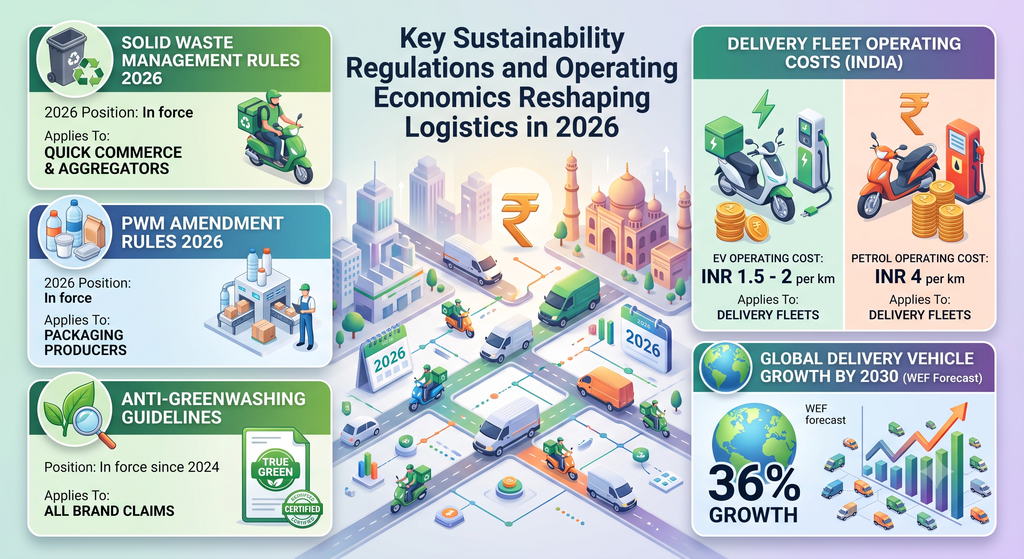
| Regulation or Metric | 2026 Position | Applies To |
|---|---|---|
| Solid Waste Management Rules 2026 | In force | Quick commerce, aggregators |
| PWM Amendment Rules 2026 | In force | Packaging producers |
| Anti-Greenwashing Guidelines | In force since 2024 | All brand claims |
| EV operating cost (India) | INR 1.5 to 2 per km | Delivery fleets |
| Petrol two-wheeler operating cost | INR 4 per km | Delivery fleets |
| Global delivery vehicle growth by 2030 | 36% | WEF forecast |
Figure 2. Key sustainability regulations and operating economics reshaping logistics in 2026.
Sources: KPMG India (2026); Outlook Business (2025); World Economic Forum.
Quick Commerce Enters Its Profitability Phase
Quick commerce spent 2022 to 2024 chasing user growth. In 2026 the environment has shifted: rising fuel costs, tighter monetary conditions, and shareholder pressure on unit economics are forcing platforms to optimize for margin. India’s quick-commerce leaders now operate over 2,200 dark stores across more than 35 metros per ClickPost, but the winning battles are being fought on route density, EV mix, and reverse-logistics revenue rather than pure delivery speed. The 10-minute promise is table stakes; the profit is in what happens around it.
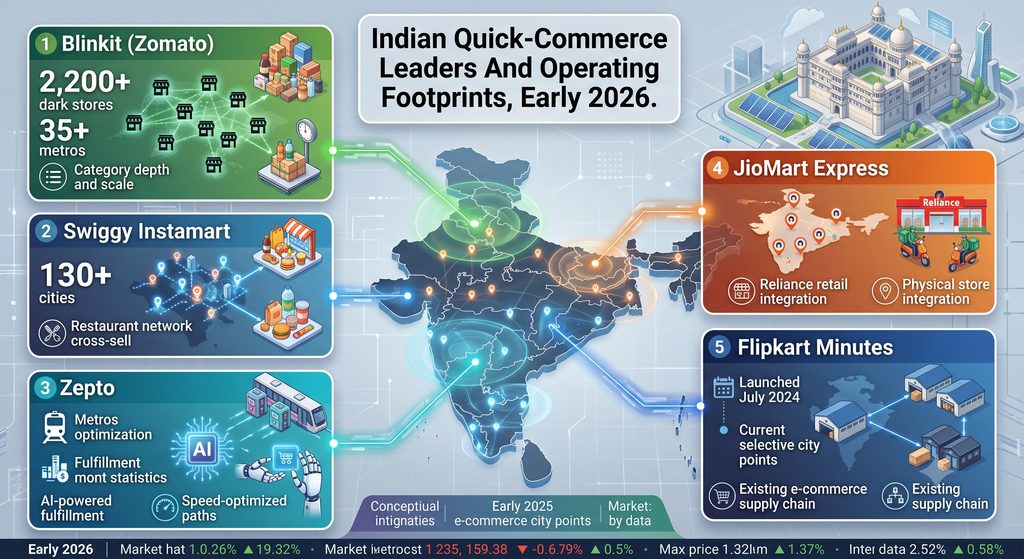
| Platform | Coverage | Distinctive Strength |
|---|---|---|
| Blinkit (Zomato) | 2,200+ dark stores across 35+ metros | Category depth and scale |
| Swiggy Instamart | 130+ cities | Restaurant network cross-sell |
| Zepto | Major metros | AI-powered fulfillment |
| JioMart Express | Reliance retail integration | Physical store integration |
| Flipkart Minutes | Launched July 2024 | Existing e-commerce supply chain |
Figure 3. Indian quick-commerce leaders and operating footprints, early 2026.
Source: ClickPost (2026).
Dark Stores Multiply, Diversify, and Turn Circular
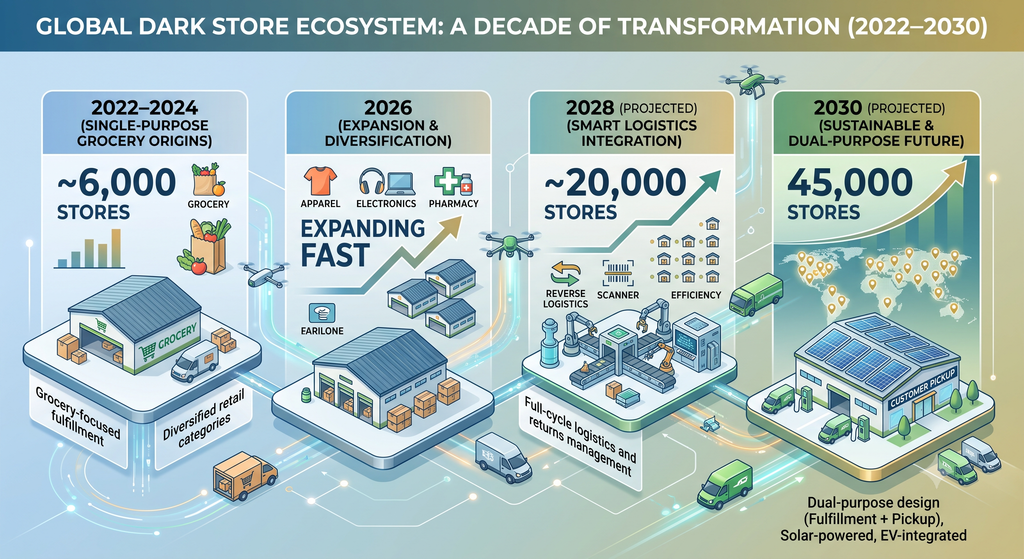
Dark stores are expanding beyond grocery into apparel, electronics, and pharmacy fulfillment, and are increasingly redesigned as dual-purpose nodes. As KPMG India notes, delivery fleets can double as reverse-logistics networks: riders drop off orders and pick up returns, rigid plastics, and end-of-life electronics on the same trip. Globally, the count of dark stores is expected to rise from around 6,000 today to 45,000 by 2030.
| Timeframe | Global Dark Store Count | Function Profile |
|---|---|---|
| 2022 to 2024 | ~6,000 | Grocery-focused, single-purpose |
| 2026 | Expanding fast | Diversifying into apparel, electronics, pharmacy |
| 2028 (projected) | ~20,000 | Reverse-logistics enabled |
| 2030 (projected) | 45,000 | Dual-purpose, solar-powered, EV-integrated |
Figure 4. Global dark store ecosystem: a decade of tranformation 2022-2030.
Sources: Grand View Research; KPMG India (2026).
Physical AI and Polyfunctional Robots Scale in the Warehouse
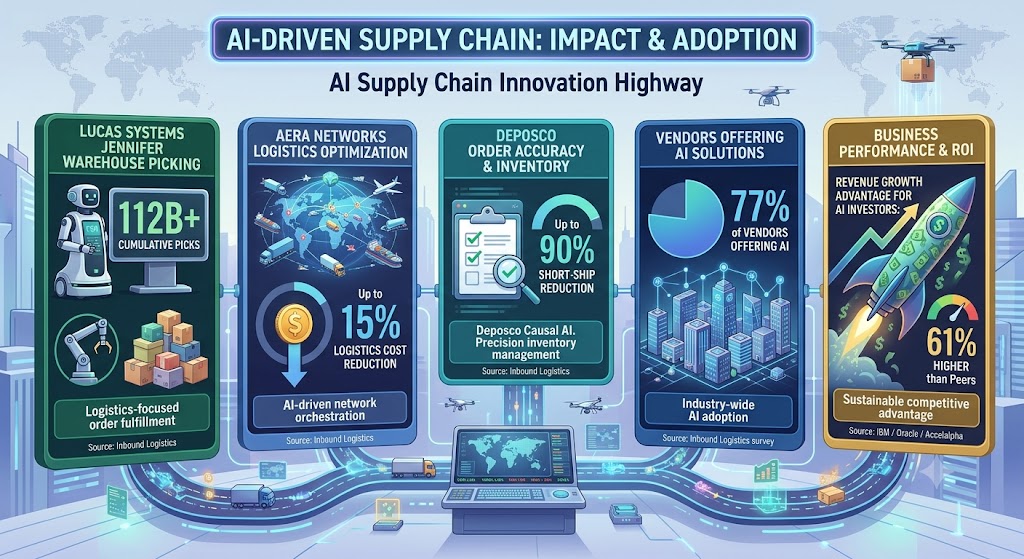
Gartner’s 2026 technology trends name polyfunctional robots and physical AI, which combine AI models with IoT sensors and robotics, as two of the year’s biggest inflection points. Lucas Systems’ Jennifer engine has now powered over 112 billion picks per Inbound Logistics, and Aera-style orchestration is cutting logistics costs by up to 15 percent for early adopters. The labor crunch that dominated 2021 has become the catalyst that makes robotics a permanent warehouse feature, not a pilot line item.
| Deployment or Impact | Value | Source |
|---|---|---|
| Lucas Systems Jennifer cumulative picks | 112B+ | Inbound Logistics |
| Aera orchestration logistics cost reduction | Up to 15% | Inbound Logistics |
| Deposco Causal AI short-ship reduction | Up to 90% | Inbound Logistics |
| Vendors offering AI in supply chain solutions | 77% | Inbound Logistics survey |
| Revenue growth advantage for AI investors | 61% higher than peers | IBM / Oracle / Accelalpha |
Figure 5. AI-Driven Supply Chain : Impact And Adoption, 2026.
Sources: Inbound Logistics (2026); Coursera (2026).
Autonomous Vehicles and Drone Delivery Enter Mainstream Deployment
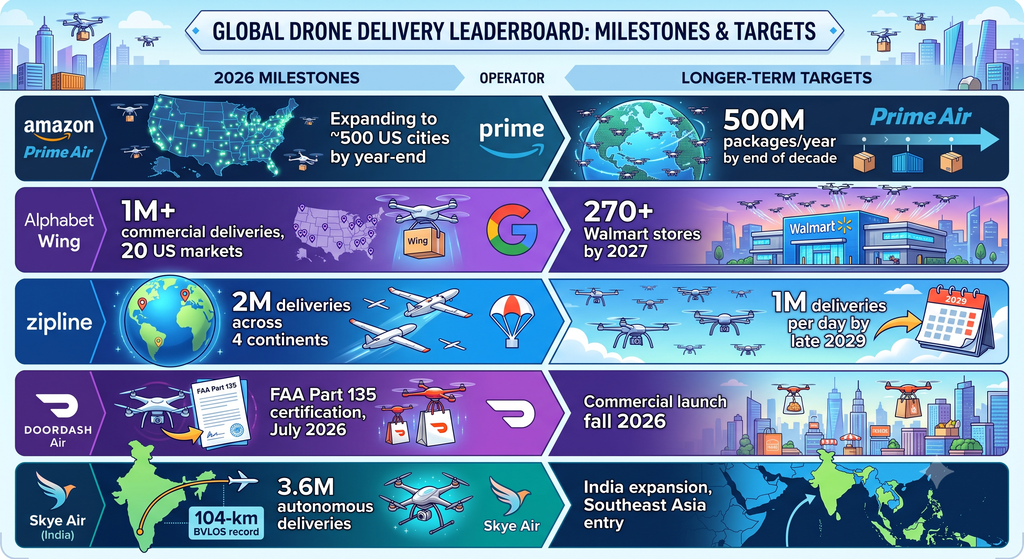
2026 is the year drone delivery crossed from novelty into infrastructure. Amazon Prime Air is expanding sixfold to nearly 500 US cities by year-end. Wing has crossed one million commercial deliveries, Zipline has passed two million across four continents, and DoorDash Air launches commercial operations this fall. In India, Skye Air has recorded 3.6 million autonomous deliveries. The FAA’s proposed Part 108 rule replaces case-by-case waivers with a standardized pathway, and the EU’s U-Space framework does the same in Europe.
| Operator | 2026 Milestone | Longer-Term Target |
|---|---|---|
| Amazon Prime Air | Expanding to ~500 US cities by year-end | 500M packages/year by end of decade |
| Alphabet Wing | 1M+ commercial deliveries, 20 US markets | 270+ Walmart stores by 2027 |
| Zipline | 2M deliveries across 4 continents | 1M deliveries per day by late 2029 |
| DoorDash Air | FAA Part 135 certification, July 2026 | Commercial launch fall 2026 |
| Skye Air (India) | 3.6M autonomous deliveries, 104-km BVLOS record | India expansion, Southeast Asia entry |
Figure 6. Global drone delivery leaderboard: milestones & targets.
Sources: CNBC (2026); Digital Commerce 360 (2026); Value for Startups (2026).
Cross-Border E-commerce Continues to Reshape Trade Lanes
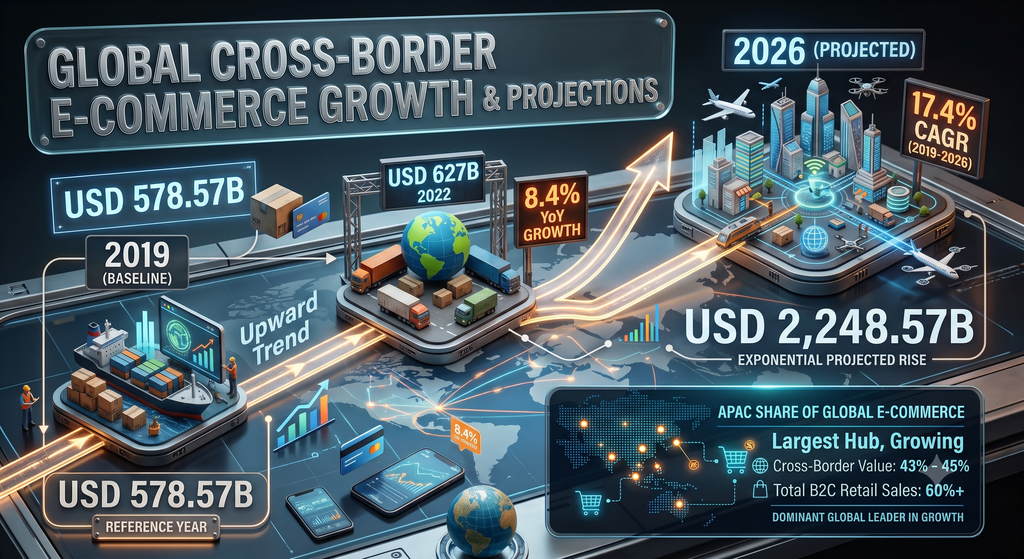
Cross-border e-commerce, valued at USD 578.57 billion in 2019, is on track to reach USD 2,248.57 billion by 2026 at 17.4 percent CAGR, with Asia-Pacific becoming the largest import-export hub. What has changed is the shift toward AI-enabled data extraction and unified intelligence platforms that stitch together freight procurement, customs, and last-mile visibility in a single decision layer. Manufacturers, retailers, and freight forwarders are buying integrated stacks rather than point tools, in line with the WiseTech Global outlook on connected insights.
| Year | Cross-Border E-commerce Value | Growth Rate |
|---|---|---|
| 2019 (baseline) | USD 578.57B | Reference |
| 2022 | USD 627B | 8.4% YoY |
| 2026 (projected) | USD 2,248.57B | 17.4% CAGR from 2019 |
| APAC share of global e-commerce | 43% – 45% (Cross-Border Value) 60%+ (Total B2C Retail Sales) | Dominant global leader |
Figure 7. Global cross-border e-commerce growth and projections 2019 to 2026.
Sources: AllTheResearch; Forrester; WiseTech Global via AJOT (2026),eMarketer/Insider Intelligence, Polaris Market Research, and International Trade Administration (Trade.gov) 2024–2026 Forecasts.
Real-Time Visibility, Predictive Analytics, and Self-Healing Chains
The centerpiece of 2026 investment is real-time visibility fused with predictive analytics and increasingly self-healing execution. According to IBM, Oracle, and Accelalpha research cited by Coursera, firms investing heavily in AI for supply chain achieve 61 percent higher revenue growth than peers, and Gartner predicts generative AI will handle 25 percent of KPI reporting by 2028. Route errors are dropping 20 percent-plus, short-ships have been cut by up to 90 percent in early Causal AI deployments, and dispatch systems now detect issues and self-correct without human initiation.
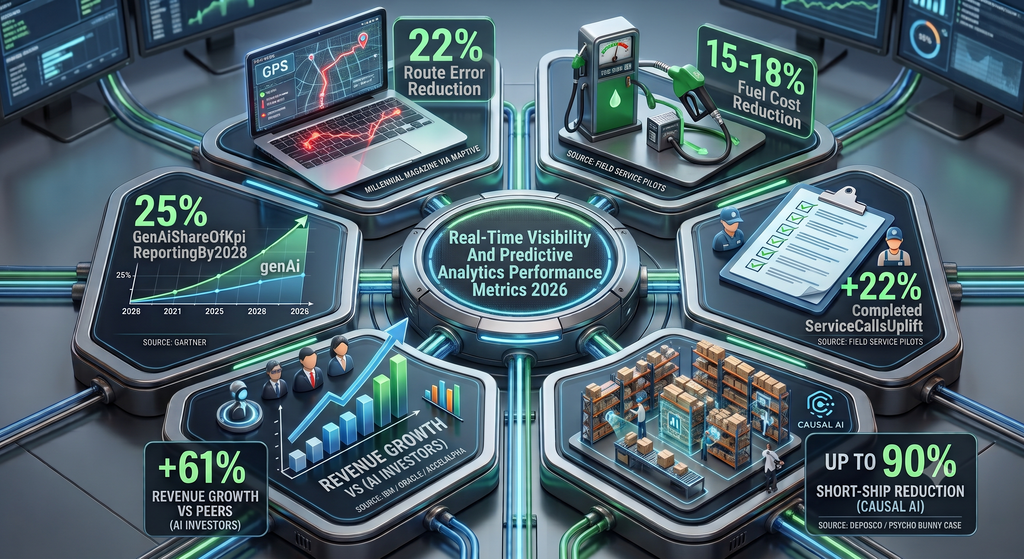
| Capability | Measured Impact | Source |
|---|---|---|
| Route error reduction | 22% | Millennial Magazine via Maptive |
| Fuel cost reduction | 15 to 18% | Field service pilots |
| Completed service calls uplift | +22% | Field service pilots |
| Short-ship reduction (Causal AI) | Up to 90% | Deposco / Psycho Bunny case |
| Revenue growth vs peers (AI investors) | +61% | IBM / Oracle / Accelalpha |
| Gen AI share of KPI reporting by 2028 | 25% | Gartner |
Figure 8. Real-time visibility and predictive analytics performance metrics, 2026.
Sources: Maptive (2026); Inbound Logistics (2026); Coursera (2026).
The 2026 stack requires four things at once: an AI decision layer that acts autonomously, sustainability-native operations that satisfy new regulation, a routing engine that keeps the last mile predictable, and a data fabric that makes it all observable in real time.
Where Maponomy Fits: The Transport Management Layer for 2026
Every trend above shares a common requirement: a transport management stack that ingests real-time signals, routes dynamically, tracks continuously, and integrates cleanly with warehouse, EV fleet, and customer-notification systems. This is the problem Maponomy, a part of Potters Technologies, has been solving for enterprises across mobility, last-mile, cold chain, and e-commerce logistics. It positions itself as an AI-powered transport management platform that reduces logistics costs by 10 to 15 percent, and its product suite maps directly onto the 2026 operating requirements.
The Product Suite
Search and Place API. Geocoding, reverse geocoding, address parsing, and distance-matrix endpoints via the Search and Place API, built for the address-quality problem that determines whether last-mile delivery succeeds on the first attempt. Correct addresses drive first-attempt success rates, and Maponomy makes them programmatically enforceable across order intake, dispatch, and driver navigation.
Directions and Routes APIs. The Directions and Routes APIs return accurate route lengths, ETAs, and turn-by-turn navigation with traffic-aware dynamic re-routing. For micro-mobility, ride-hailing, and quick-commerce operators, they anchor fare calculation, driver incentives, and multi-stop sequencing.
Delivery Planner Suite. A customizable SaaS covering order management, route planning, live tracking, and driver mobile apps under the Delivery Planner Suite. Includes an Automated Dispatch Planner that calculates ideal vehicle count, a Load Builder for loading and unloading optimization, and a Manual Route Planner for human overrides. Maponomy quotes 10 to 15 percent cost reduction for end-to-end deployments.
Trackonomy and Fleet Management. Trackonomy provides a Live Tracking Dashboard covering real-time vehicle location, historical tracks, GPS pings from third-party mobile apps and devices, and configurable notifications. The Fleet Management System adds vehicle telematics, video telematics, and a smart Dashcam and Streetview navigation interface for driver-safety monitoring and delivery-point verification. Reports and Analytics surface completion rates, route statuses, and driver activity in a single dashboard.
Network Optimizer. For multi-hub distribution, the Network Optimizer minimizes transit times and recommends optimal warehouse or plant sourcing for each origin-destination pair, converting network design from a quarterly consulting exercise into an ongoing operating discipline.
Driver and Courier Mobile App. A mobile-first app with multi-language support, multiple travel modes, delivery sequencing, toll-and-highway avoidance, and integrated proof-of-delivery capture via signature and photo. Available on both Android and iOS, reflecting Maponomy’s expansion beyond India into Southeast Asia and the Gulf.
| Product | Primary Function | Best-Fit Use Case |
|---|---|---|
| Search and Place API | Geocoding, address parsing, reverse geocoding | First-attempt delivery success |
| Directions and Routes APIs | Routing, ETAs, turn-by-turn navigation | Ride-hailing, micro-mobility, quick commerce |
| Delivery Planner Suite | Dispatch, load building, route planning | End-to-end last-mile SaaS |
| Trackonomy | Live tracking dashboard | Real-time visibility |
| Fleet Management System | Telematics, dashcam, streetview | Driver safety and compliance |
| Network Optimizer | Multi-hub routing and sourcing | Enterprise network design |
| Driver Mobile App | Turn-by-turn, POD capture, sequencing | Field execution on iOS and Android |
Figure 9. Maponomy product suite mapped to logistics use cases, 2026.
Source: Maponomy (2026).
Why The Fit Is Tightening
The 2026 stack requires four things at once: an AI decision layer that acts autonomously, sustainability-native operations that satisfy new regulation, a routing engine that keeps the last mile predictable, and a data fabric that makes it all observable in real time. Maponomy sits at the intersection of the last three and integrates cleanly with the agentic AI layer above it. That combination is why enterprises modernizing their logistics stacks in 2026 are moving Maponomy from a shortlist item to the default routing, tracking, and dispatch platform.
Outlook
If the through-line of 2022 was digitization, the through-line of 2026 is autonomy. Agentic AI, autonomous fleets, self-healing supply chains, and continuous visibility are converging on a single operating model that will define the winning operators of the next five years. The organizations leading will be the ones treating their transport management platform as core infrastructure rather than a supporting tool, and choosing a partner that combines routing, tracking, fleet, and dispatch under a coherent API and SaaS layer. Maponomy is one of the small set of platforms building exactly that combination.
| Trend | Headline Data Point | Source |
|---|---|---|
| Agentic AI adoption jump | 6% to 30% in two years | Capgemini |
| Agentic SCM software spend | USD 2B (2025) to USD 53B (2030) | Gartner |
| India regulatory shift | SWM Rules 2026, PWM Amendment 2026 | KPMG India |
| EV vs petrol operating cost | INR 1.5 to 2 vs INR 4 per km | Outlook Business |
| Global dark store expansion | 6,000 today to 45,000 by 2030 | Grand View Research |
| Robotic picks (Lucas Systems) | 112 billion cumulative | Inbound Logistics |
| Amazon Prime Air rollout | Nearly 500 US cities by end 2026 | CNBC |
| Cross-border e-commerce | USD 2,248.57B by 2026 | AllTheResearch |
| AI supply chain revenue advantage | 61% higher growth than peers | IBM via Coursera |
Figure 10. The 2026 trend map at a glance.
Sources and Credits
- MHI. Top Supply Chain Trends for 2026. mmh.com
- Gartner. Top Supply Chain Technology Trends for 2026. gartner.com
- AJOT. 2026 Logistics Tech Trends. ajot.com
- eMARKETER / Insider Intelligence: The global metrics can be found on the EMARKETER Forecasts Platform and are outlined in detail in their yearly Worldwide Retail Ecommerce Forecast Report.
- Polaris Market Research: Regional breakdown statistics are hosted on the Polaris Cross-Border B2C E-Commerce Market Analysis Page.
- International Trade Administration (Trade.gov): Industry footprint evaluations are published under the ITA eCommerce Sales & Size Forecast Directory.
- Mecalux, citing Capgemini and Deloitte. Logistics Trends for 2026. mecalux.com
- Inbound Logistics. Supply Chain Technology Trends Reshaping Logistics in 2026. inboundlogistics.com
- Coursera. Major Supply Chain Trends in 2026. coursera.org
- KPMG India. Indian Quick Commerce Sustainability, May 2026. kpmg.com
- ClickPost. Top Quick Commerce Companies in India 2026. clickpost.ai
- CNBC. Amazon Prime Air expansion coverage, August 2026. cnbc.com
- Digital Commerce 360. Drone delivery competitive landscape 2026. digitalcommerce360.com
- Value for Startups. Skye Air Mobility Investor Report 2026. valueforstartups.in
- Maptive. Location Intelligence Software 2026. maptive.com
- Outlook Business. EV Fleet Operators and Quick Commerce. outlookbusiness.com
- Maponomy. Official website. maponomy.com
- Potters Technologies. Parent company website. potterstech.com
NOTE:
Data compiled from public market research reports, industry surveys, and vendor disclosures. Figures rounded for clarity. All financial values are expressed in United States dollars unless otherwise noted.