
Let’s go back in time a bit. Remember how relieved you were the first time an urgent prescription reached your doorstep in under 30 minutes, delivered by an online pharmacy app when you needed medication that same evening? Getting the order faster is a genuinely valuable experience, sometimes even a clinically important one. But if you receive the same service levels again, would you still be as surprised? Surely not. It needs to surpass the previous experience to keep the element of surprise alive.
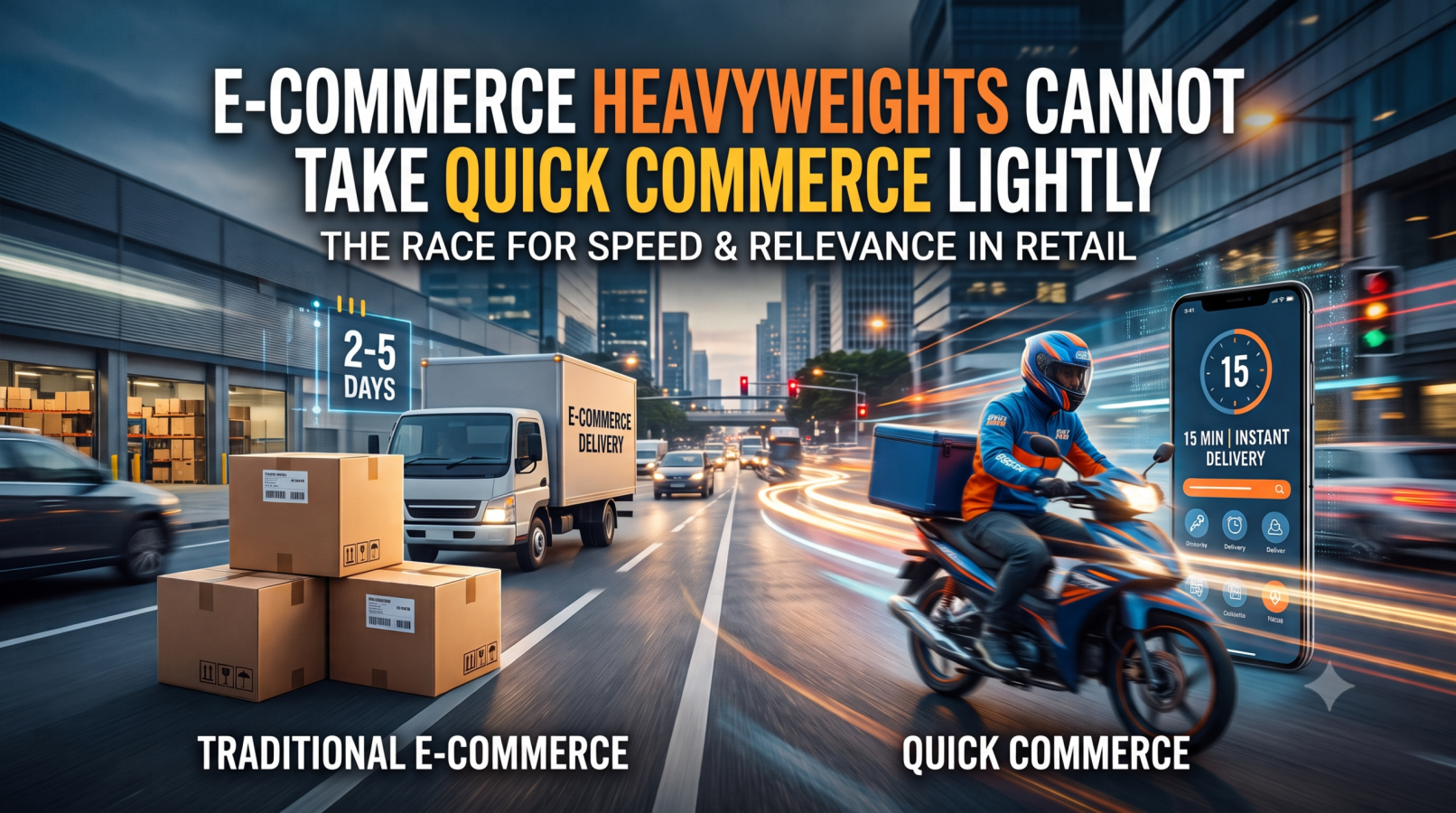
Let’s have a quick look at how consumer delivery expectations arrived at this juncture, and why every serious eCommerce business now has to think carefully about how quick commerce reshapes what customers demand.
The Then: Same-Day Deliveries Had a Successful Run
eCommerce took the world by storm in the early 2000s. Rapid technology adoption and internet penetration can take much of the credit. More people switching to online purchasing increased the pressure to strengthen delivery services. Mobile commerce raised the bar further, with consumers ordering on the move and in record volumes via apps.
Same-day delivery, once a premium feature, became a routine expectation for many product categories. As highlighted in ongoing research summarised by McKinsey and Company, a majority of shoppers now cite delivery speed as a decisive factor in where they choose to buy, and a meaningful share will pay a premium for faster fulfillment. A significant proportion will also abandon carts when same-day options are not available.
The pandemic-induced stay-at-home restrictions accelerated all of this. Brands rushed to deliver everything to the customer’s doorstep, from groceries to medicines to daily essentials. What began as a necessity has now settled into an expectation. Today, doorstep deliveries are not only driven by need but by convenience, and flourishing expectations warrant deliveries in less than an hour, paving the way for the quick commerce model.
Why eCommerce Companies Need to Pull Up Their Socks Now
Stemming from the demand for instant gratification, quick commerce is massively impacting eCommerce. It is training customers to expect faster and more transparent delivery experiences across every category, not just groceries. Independent forecasts consistently predict multi-fold growth for quick commerce over the next several years, with tens of millions of households already addressable and market sizes reaching into the tens of billions of dollars in major geographies. Undoubtedly, the scope is huge, and the opportunities are unmissable.
The sector is drawing intense competition, with existing delivery aggregators consolidating and new entrants continuing to enter every year. Customers can expect a small basket order delivered as fast as ten minutes to their doorstep. According to insights from Gartner, evolving customer expectations are driving disruption-led innovation right across the last mile, and businesses that hesitate now face structural disadvantages that are difficult to reverse later.
Let’s look at how the popularity of quick commerce will impact eCommerce brands, and how the right operational infrastructure can help them respond.
Delivery Expectations from eCommerce Brands Will Evolve
As quick commerce providers shrink fulfillment windows, eCommerce brands will have to drive faster and more convenient delivery options to remain relevant. This is not a matter of adding one new service tier. It is a matter of rebuilding the underlying operational stack so that faster deliveries are the default rather than the exception. Two moves stand out as fundamental.
Bringing inventory closer to the customer. To match the speed of quick commerce, eCommerce players will have to strategically place inventory closer to customer concentrations. This means moving away from centralised distribution centres serving large geographies and toward a networked model of dark stores, micro-fulfillment centres, and neighbourhood hubs.
The Maponomy Network Optimiser, part of the Maponomy Delivery Planner Suite, supports this strategic decision by analysing demand density, candidate hub locations, and road network travel time characteristics to identify placements that maximise coverage within tight time budgets. Layered with the Maponomy Search and Place API, planners can evaluate the operational geography of any market and model different network configurations before committing capital to physical infrastructure.
Partnering with neighbourhood stores. As demand surges and customers expect orders within minutes rather than hours, partnering with local stores emerges as a strong strategy. The retail-as-hub model, in which existing convenience stores, supermarkets, and specialty outlets become fulfillment nodes, allows brands to launch in new neighbourhoods without capital-intensive infrastructure. The Maponomy Search and Place API supports the discovery and evaluation of these candidate partners at scale, using structured queries against a rich places dataset to identify the retail nodes best positioned by geography, category, and reachable customer base.
Compressing the Delivery Time Budget
Even with well-placed hubs and strong retail partnerships, quick commerce cannot succeed if the last mile itself is not tightly optimised. Ten and 15 minute delivery windows leave no slack for inefficient routing, slow dispatch, or wandering last-metre searches.
The Maponomy Route Optimization API, also part of the Delivery Planner Suite, sequences pickups and deliveries against realistic travel time budgets. The Maponomy Distance Matrix API computes the precise pairwise travel times that the optimizer needs to make sensible sequencing decisions. The Maponomy Automated Dispatch Planner consumes these inputs in real time, assigning each new order to the courier and node combination that minimises total time to the customer without breaking commitments already in flight.
For quick commerce operations running against sub-hour promises, this real-time optimisation is what allows the platform to keep pace with continuously arriving orders while consistently meeting delivery windows. Research from McKinsey and Company has repeatedly highlighted that tech-enabled last mile operations can produce meaningful cost and speed improvements over legacy models, with the difference compounding over time as the underlying data quality feeds progressively better decisions.
Real-Time Visibility Matches Customer Expectations
Quick commerce customers expect to see exactly where their order is at any moment. A black box between order placement and doorstep, even one that resolves in under 30 minutes, generates support calls, customer anxiety, and lower repeat purchase rates.
Trackonomy, the Maponomy live tracking suite, provides both the operational visibility that dispatchers need to intervene early on any developing delay and the customer-facing tracking experience that anchors the delivery moment. The Maponomy Reverse Geocoding API transforms the raw GPS stream from courier devices into readable location updates that customers can interpret at a glance. Dispatchers see the same underlying data in a form that supports proactive intervention rather than reactive damage control.
Quick Commerce Will Sprawl Beyond Grocery Deliveries
Grocery is the entry category for quick commerce, but the model is spilling rapidly into other segments. Consumer research consistently ranks apparel, electronics, personal care, and pet supplies as major and fast-growing candidates for on-demand delivery. Many quick commerce operators are already extending their catalogues or building specialty micro-fulfillment nodes for these categories. As the trend continues, eCommerce brands across the board will have to accept that on-demand delivery is not confined to groceries and evaluate how to serve every product category with the same speed and visibility.
The unified Maponomy platform, spanning the Search and Place API, Directions and Routes APIs, Delivery Planner Suite, and Trackonomy, is designed to handle these expanded scenarios without operators having to rebuild their location infrastructure for each new product line. Whether the delivery is a bag of vegetables, a set of over-the-counter medicines, or a piece of consumer electronics, or a medicine, the underlying orchestration is the same.
Conclusion
Quick commerce is not a niche experiment for eCommerce heavyweights to observe from a distance. It is a permanent reshaping of consumer delivery expectations that is already spilling into every product category and every serviceable geography. The businesses that succeed in this environment are the ones that rebuild their operational stack around dense fulfillment networks, retail partnerships, tight route optimisation, real-time dispatch, and consistent customer visibility. Investing in a unified location and delivery orchestration platform such as Maponomy, combining the Search and Place API, Directions and Routes APIs, Delivery Planner Suite, and Trackonomy, is one of the highest-leverage moves an eCommerce brand can make to compete on speed without giving up cost discipline. As quick commerce continues to grow, the platforms that adapt early will be the ones that customers still choose in five years. Those that treat it lightly may find themselves competing for a shrinking share of a market whose expectations have already moved on.