
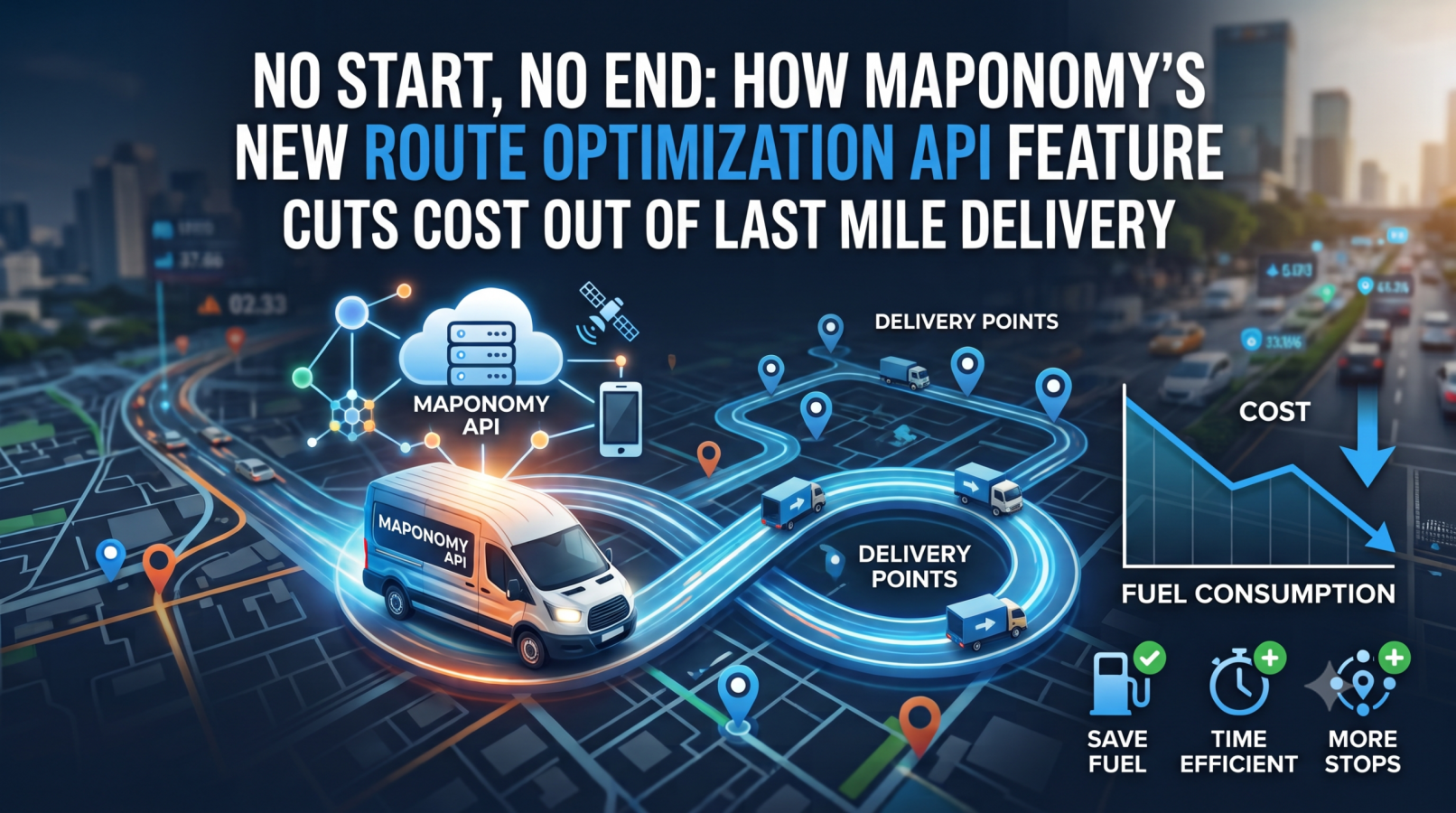
Every route optimization engine ever built has, until recently, made two assumptions that seem so obvious they barely register. First, that a vehicle begins its day at a fixed depot or warehouse. Second, that it ends the day by returning to that same depot. These two anchors have shaped route planning for decades, and for the traditional truck-out-and-back operations they were designed for, they made perfect sense. But modern last mile delivery has quietly outgrown these assumptions. Reverse logistics operations run pickup-only routes. Gig couriers start their shifts from wherever they happen to be. Contract drivers who own their vehicles head home rather than to a depot when they finish. Hybrid delivery models mix pickups and drop-offs in patterns that no closed-loop route can capture cleanly. The Maponomy Route Optimization API, part of the Maponomy Delivery Planner Suite, now supports a new capability called No Start No End that removes both of these built-in constraints, and the cost implications for last mile operators are significant.
What No Start No End Means
The No Start No End feature refers to two related but distinct relaxations of the traditional route model. The No Start option handles routes where the vehicle does not need to begin at a fixed depot. This is most useful for pickup runs, where a driver simply moves from one pickup point to the next collecting items, and the earliest pickup can effectively serve as the start of the route. The No End option handles routes where the vehicle does not need to return to the depot at the end. This suits delivery operations where the driver finishes the day at wherever their last delivery lands, whether that is their home, a partner facility, or simply the closest safe parking. When both options are applied together, the route becomes fully open-ended, freed from any anchoring at either terminus.
This may sound like a minor technical adjustment, but the operational and financial implications are substantial.
The Hidden Costs in Traditional Routing
Traditional route optimization forces every vehicle to include two legs that often have no operational purpose: the leg from the depot to the first stop, and the leg from the last stop back to the depot. In many operations these two legs represent a meaningful share of total kilometres driven, total fuel consumed, and total driver hours logged. On a route where the first pickup and the last delivery are both far from the depot, the outbound and return legs may account for as much extra travel as several actual customer stops combined.
The direct cost of these legs is easy to quantify: fuel, vehicle wear, and paid driver time for movement that produces no revenue. The indirect cost is often larger: driver shifts stretched by unnecessary depot travel, tighter time windows forced by the depot detour, and fleet utilisation reduced because vehicles are unavailable during depot transit. For last mile operators running on thin margins, these hidden costs sit inside every route the engine produces, without ever being visible as a line item.
Where No Start No End Delivers Real Savings
Several last mile categories benefit disproportionately from open-ended routing.
Pickup-only operations. Reverse logistics, e-commerce returns, laundry collection, waste and recycling pickups, and courier pickup runs are all effectively one-directional: the vehicle collects items across the day and delivers them to a single consolidation point at the end. Forcing the day to start at a depot far from the first pickup imposes a pure overhead cost. The No Start option lets the route begin at the first pickup itself, or at wherever the driver happens to start their shift, eliminating the empty outbound leg entirely.
Delivery-only operations ending in the field. Contract delivery drivers, gig couriers, and owner-operator fleets frequently want their day to end at their last delivery rather than a depot they never sleep at. The No End option lets the route be optimised on that basis, meaning the final delivery is chosen partly to place the driver closest to home or to their next shift starting point. Driver satisfaction improves and idle return-to-depot kilometres disappear from the operating cost line.
Hybrid pickup and delivery models. Some last mile operations mix pickup and delivery stops in the same route, especially in on-demand and same-day categories. When both start and end are open, the optimizer can sequence pickups and deliveries in whatever order actually minimises total travel, without artificially bending the sequence around depot returns.
Multi-vehicle networks with rolling handoffs. Fleets that do vehicle handoffs mid-day, cross-dock between vehicles, or use micro-fulfillment relay models often need routes that end wherever the operational handoff happens, not where the vehicle started. Open-ended routing supports these patterns natively.
How Maponomy Implements the Feature
The Maponomy Route Optimization API exposes the No Start and No End options as configurable parameters on route planning requests. Operators do not need to choose a single mode for the whole operation. Different routes in the same daily plan can carry different configurations, so a fleet that runs pickup-only routes alongside classic depot-anchored delivery routes can optimise both correctly in the same planning cycle.
Underneath, the routing engine draws on the Maponomy Distance Matrix API to compute the travel-time cost matrix between every relevant point, and on the Maponomy Directions and Routes APIs for the underlying road network and turn-by-turn logic. Open-ended routes still respect every operational constraint the traditional model supports: vehicle capacity, driver shift hours, customer time windows, vehicle type compatibility, and any other rules the operator has configured. The only difference is that the algorithm is free to choose the first and last stops based on total cost rather than on artificial depot anchors.
The Maponomy Automated Dispatch Planner applies the same flexibility to real-time order allocation. When a new pickup or delivery request arrives, the planner can assign it to a courier whose route is open at either end, extending the route without forcing a return-to-depot detour that would inflate the marginal cost of the new stop.
Enabling Broader Operational Models
The No Start No End capability does more than trim fuel and time from existing routes. It enables operating models that were not viable under the closed-loop assumption.
Gig delivery networks, in which independent couriers accept and complete jobs from wherever they are, become substantially more efficient when the routing engine treats their current location as a legitimate route start rather than forcing an outbound leg from a virtual depot. Franchise and distributed micro-hub models, where each courier is associated with a neighbourhood presence rather than a central warehouse, benefit similarly. Same-day and hyperlocal quick commerce operations, where couriers frequently start their day from home and end at the point of last delivery, gain a routing model that reflects how their fleet actually operates. Reverse logistics providers who never had a use for the return leg can now finally stop paying for it.
Each of these models represents a chunk of the last mile market that traditional routing algorithms served poorly. Open-ended optimisation brings them under the same rigorous engine that handles closed-loop operations, without forcing them to accept costs the model was imposing artificially.
Integration Across the Maponomy Stack
The No Start No End capability produces the most value when it operates as part of an integrated last mile stack rather than as a standalone routing switch. The Maponomy Search and Place API provides the geocoding and address parsing that turn every pickup and delivery address into a precise coordinate the optimizer can act on. Trackonomy, the Maponomy live tracking suite, gives dispatchers real-time visibility into open-ended routes as they unfold, allowing intervention when conditions change mid-route. The Courier Navigation app inside the Delivery Planner Suite delivers the optimised open-ended sequence to each driver with turn-by-turn navigation, integrated proof of delivery capture, and direct communication with the dispatcher, ensuring that the plan produced by the routing engine translates into successful execution in the field.
Because every layer draws from a coordinated infrastructure, an open-ended route planned by the optimizer is executed on the same platform that geocoded its addresses, dispatched its assignments, and tracks its progress. The consistency is what allows the full cost saving to reach the bottom line rather than being partly reabsorbed by handoffs between fragmented systems.
Conclusion
The No Start No End feature in the Maponomy Route Optimization API removes a pair of assumptions that have been quietly imposing cost on last mile operators for decades. Pickup-only routes, delivery-only routes ending in the field, hybrid pickup-and-delivery flows, and gig or franchise fleet models all benefit directly from open-ended optimisation. Fuel and time spent on depot legs that produce no revenue disappears from the operating cost line. Drivers finish their shifts at more sensible places. New operating models become viable without giving up rigorous route planning. For last mile businesses evaluating where to find their next round of cost efficiency, this small change in the routing model turns out to unlock some of the largest structural savings available in the category.