
If you have ever placed an order online and found yourself refreshing the tracking page every ten minutes, you already understand the anxiety that drives one of the most expensive problems in modern logistics. That anxiety has a name in the supply chain world: WISMO, short for “Where Is My Order.” It is the single most common customer service inquiry across e-commerce, food delivery, courier services, and B2B distribution networks. And it is costing businesses billions of dollars every year.
WISMO is not merely a customer support metric. It is a diagnostic signal. When customers feel compelled to ask where their order is, they are telling a company that its communication infrastructure has failed. The shipment may be perfectly on schedule, the driver may be two blocks away, but if the customer cannot see that information in real time, none of it matters. The perception of uncertainty becomes the reality of dissatisfaction.
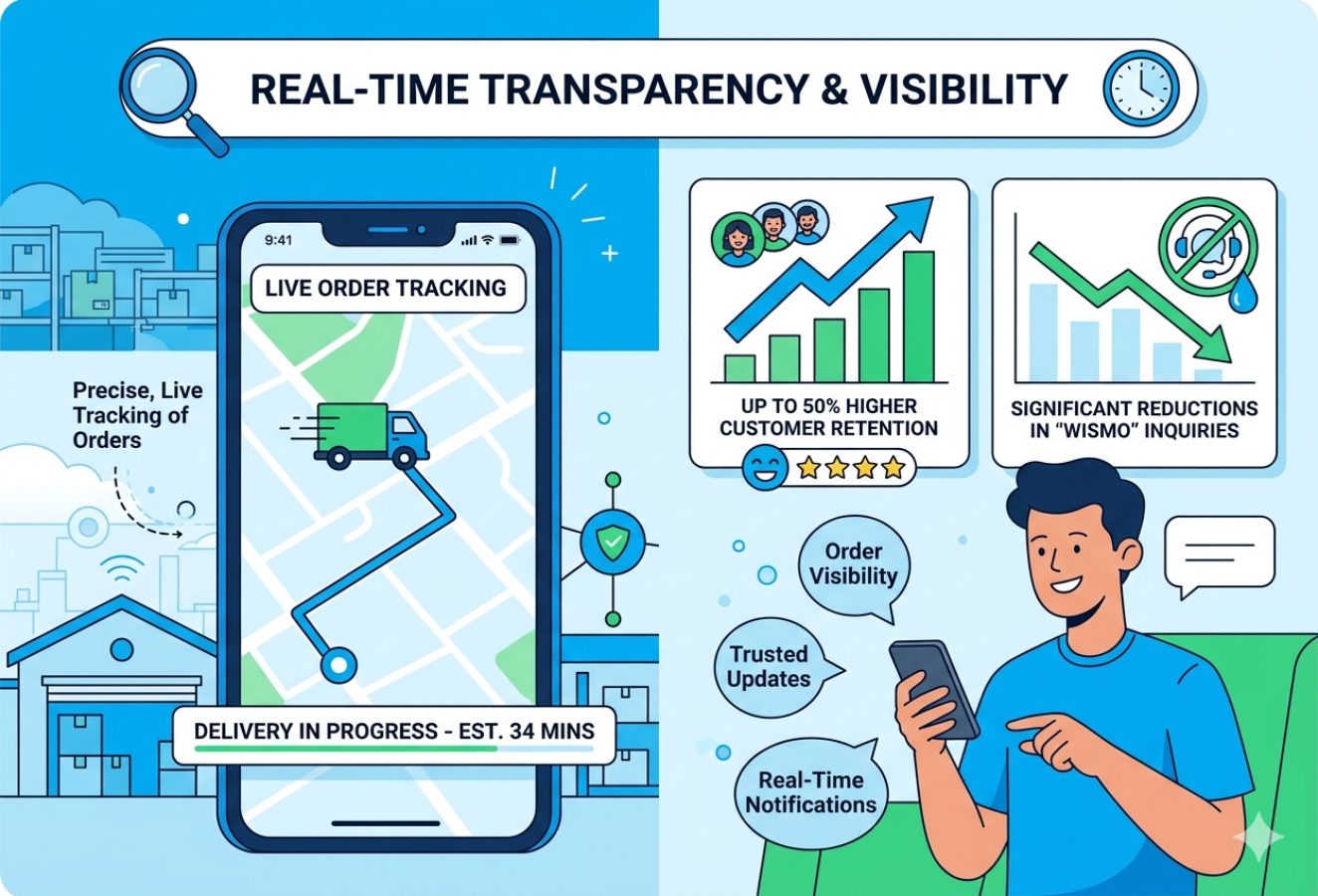
The companies that have recognized this and invested in real-time transparency and visibility across their delivery operations are now reaping extraordinary rewards. Research across multiple industries confirms that businesses providing precise, live tracking of orders have achieved up to 50 percent higher customer retention rates and dramatic reductions in WISMO-related support tickets. The question is no longer whether real-time visibility matters. The question is how fast you can implement it before your competitors do.
The True Cost of “Where Is My Order”
Most businesses underestimate the financial impact of WISMO inquiries because they measure it narrowly. They count the number of support calls, estimate the per-call cost, and arrive at a figure that seems manageable. But that calculation misses the deeper damage.
Every WISMO call represents a customer whose trust has eroded. Studies from leading logistics analysts suggest that roughly 30 percent of all customer service contacts in e-commerce are WISMO-related. For a mid-sized retailer handling thousands of orders per day, that translates into hundreds of daily support interactions that could have been prevented entirely with better tracking infrastructure. Each interaction costs between three and eight dollars when accounting for agent time, telephony infrastructure, and overhead. Scale that across a year and the figures become staggering.
But the direct cost of support is only the surface. The indirect costs are far more damaging. Customers who cannot track their orders are significantly more likely to initiate chargebacks, demand refunds for orders that are actually in transit, leave negative reviews, and abandon the brand entirely. A single negative delivery experience can undo months of carefully built brand loyalty. In subscription commerce, where lifetime value depends on consistent satisfaction, a WISMO problem is not just a support issue. It is a revenue crisis.
The root cause, almost universally, is a lack of real-time visibility. Orders enter a black hole between dispatch and delivery. The customer sees a status that says “shipped” and then nothing for hours or even days. In that silence, anxiety multiplies, and the phone starts ringing.
Why Real-Time Tracking Has Become Non-Negotiable
Consumer expectations have shifted permanently. The era of “your order will arrive in 5 to 7 business days” with no further updates is over. Today’s customers, conditioned by the transparency of ride-hailing apps and food delivery platforms, expect to see their order moving on a map in real time. They expect accurate estimated arrival times. They expect proactive notifications when something changes. Anything less feels like a failure.
This shift is not confined to B2C. B2B buyers, warehouse managers, and procurement teams now demand the same level of visibility. A manufacturer waiting for a critical component shipment needs to know its precise location to coordinate production schedules. A retailer expecting a stock replenishment needs real-time tracking to manage inventory buffers. The entire supply chain, from first mile to last mile, now operates on the assumption that location data is available, accurate, and current.
Achieving this level of transparency requires a technology stack that can handle several critical functions simultaneously. First, it requires precise geocoding to convert addresses into exact coordinates so that every pickup and delivery point is accurately mapped. Without clean, structured address data, tracking becomes unreliable from the very start. Second, it requires robust routing and directions APIs that calculate not just the shortest path but the most efficient one, accounting for real-time traffic, vehicle type, road restrictions, and delivery time windows. Third, it requires a live tracking infrastructure that ingests GPS data from drivers, vehicles, or third-party devices and presents it to stakeholders in real time.
Each of these components must work together seamlessly. A geocoding error that places a delivery point 200 meters from the actual location will cascade through the entire system, causing incorrect ETAs, failed deliveries, and ultimately, another WISMO call.
Anatomy of a WISMO-Free Delivery Operation
Understanding what eliminates WISMO requires understanding the full lifecycle of a delivery from the customer’s perspective. The journey begins the moment they place an order and ends when the package is in their hands. At every stage, there is an opportunity to either build confidence or erode it.
Stage One: Order Confirmation and Dispatch Planning. The customer receives an order confirmation, but what happens behind the scenes is equally important. The operations team must plan which vehicle will carry the order, what route it will take, and when it will arrive. This is where intelligent route optimization becomes critical. An automated dispatch planner that considers vehicle capacity, delivery windows, driver working hours, and geographic clustering can generate efficient route plans that make accurate ETAs possible from the outset. If the route plan is sloppy, every downstream promise to the customer becomes unreliable.
Stage Two: In-Transit Visibility. Once the vehicle departs the warehouse, the customer should be able to see progress in real time. This requires continuous GPS tracking, rendered on a map with a projected arrival time that updates dynamically as conditions change. The Distance Matrix API plays a crucial role here, calculating travel times and distances between the vehicle’s current position and remaining delivery stops so that each customer sees an ETA that reflects actual road conditions, not a static estimate computed hours ago.
Stage Three: Proactive Notifications. The best delivery operations do not wait for the customer to ask. They push updates at key milestones: when the order is dispatched, when the driver is a certain number of stops away, when the driver is approaching, and when delivery is complete. These notifications, whether delivered via SMS, email, or in-app push, preempt the WISMO impulse entirely. The customer never needs to ask because the answer arrives before the question forms.
Stage Four: Proof of Delivery. The final moment of truth. A photograph of the package at the door, a digital signature, a timestamp with GPS coordinates. This closes the loop completely and eliminates post-delivery disputes. Modern courier mobile applications now capture all of this automatically, feeding it back into the central system where both the operations team and the customer can access it instantly.
When all four stages are instrumented with real-time data, WISMO inquiries do not just decrease. They virtually disappear.
The Technology Behind Transparency
Building a real-time visibility platform from scratch is a formidable engineering challenge. It requires expertise in geospatial data processing, real-time event streaming, mobile application development, and scalable cloud infrastructure. Most logistics companies are not technology companies at their core, and attempting to build these capabilities internally often results in years of development time, ballooning costs, and a product that is outdated before it launches.
This is precisely why API-first platforms have become the preferred approach. Rather than building everything from the ground up, companies can integrate specialized services that handle the heavy lifting. A well-designed Geocode API can clean and standardize millions of customer addresses, converting them into precise coordinates that feed into routing and tracking systems. An Address Parsing API can take the messy, incomplete, or misspelled addresses that customers inevitably enter and transform them into structured, deliverable formats. This alone can reduce failed deliveries by double-digit percentages.
For routing, a Directions API that supports multiple travel modes, accounts for vehicle-specific restrictions like truck size and weight limits, and incorporates live traffic data can produce ETAs that are accurate to within minutes rather than hours. When that API also supports avoidance of tolls, ferries, and highways based on operational preferences, the route plans become not just accurate but also cost-optimized.
The Route Planner API takes this further by solving the complex vehicle routing problem at scale. Given a set of delivery orders, a fleet of vehicles with varying capacities, and a set of constraints like delivery time windows, maximum working hours, and service times at each stop, the API produces an optimized plan that minimizes total distance and cost while respecting every constraint. This is the computational backbone that makes reliable ETAs possible.
Finally, a live tracking suite that integrates GPS data from mobile apps, telematics devices, or third-party tracking hardware provides the real-time heartbeat of the entire operation. When this data is surfaced to customers through a branded tracking page or integrated into the company’s existing application, the result is a seamless experience that eliminates uncertainty.
Measuring the Impact: From WISMO to Loyalty
The return on investment for real-time visibility is not theoretical. Companies that have implemented comprehensive tracking and notification systems report consistent, measurable results.
Customer retention improves because trust is reinforced with every delivery. When a customer can watch their order approach and receive it exactly when expected, the experience becomes a competitive differentiator that no pricing strategy can replicate. The data supports this: businesses providing real-time updates have seen up to 50 percent higher customer retention compared to those relying on static tracking.
Support costs decline sharply. With proactive notifications handling the communication burden, support teams can be redeployed from answering repetitive WISMO calls to handling genuinely complex issues that require human judgment. Some companies have reported 60 to 80 percent reductions in delivery-related support contacts after implementing real-time tracking and automated notifications.
Operational efficiency increases as a byproduct. When dispatchers and operations managers have a live view of every vehicle in their fleet, they can identify delays as they happen and intervene before they cascade. A driver stuck in unexpected traffic can be rerouted dynamically. A missed delivery window can trigger an immediate customer notification with a revised ETA, turning a potential complaint into a moment of transparency that actually strengthens trust.
Failed delivery rates drop because accurate geocoding and address parsing ensure drivers arrive at the correct location, and because customers who can see their driver approaching are more likely to be available to receive the package.
The Strategic Imperative
WISMO is not a customer service problem that can be solved by hiring more agents. It is an infrastructure problem that can only be solved by building or integrating the right technology. Every company that moves physical goods, whether it is an e-commerce retailer, a grocery delivery service, a pharmaceutical distributor, or a B2B logistics provider, must now treat real-time visibility as core infrastructure rather than an optional enhancement.
The companies that act on this understanding will build enduring customer relationships, operate leaner support organizations, and run more efficient delivery networks. The companies that dismiss WISMO as just another support metric will continue to bleed money, lose customers, and wonder why their retention numbers refuse to improve.
Because when the answer is always visible, the question never gets asked.