
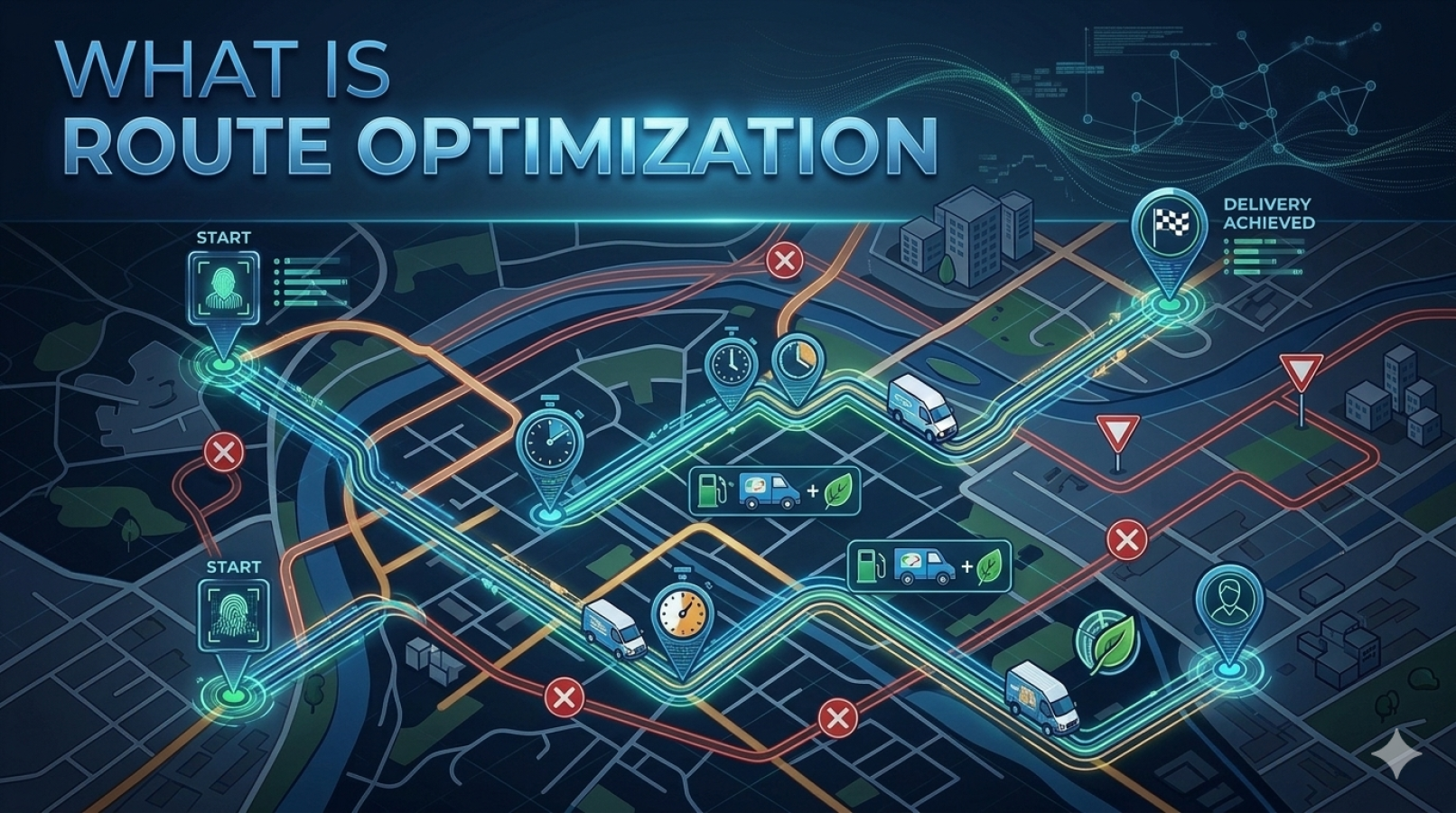
Every delivery driver, field service technician, sales representative, and ride-hailing vehicle moving through a city is solving a version of the same problem: given a list of places to visit and limited time, what is the best order and path for the journey? This problem, known as route optimization, sits at the centre of modern logistics economics. Solve it well and a fleet of 100 vehicles can do the work of 120. Solve it poorly and the same fleet wastes fuel, misses time windows, and disappoints customers. Understanding what route optimization is, how it works, and what it depends on is essential for anyone running operations that move through the physical world.
Defining Route Optimization
Route optimization is the process of determining the most efficient sequence and path for a vehicle or set of vehicles to follow when visiting multiple destinations. The objective is typically to minimize a cost function such as total time, distance, or fuel consumption, while respecting a wide range of operational constraints. Constraints can include vehicle capacity, driver shift hours, customer time windows, road restrictions, vehicle type compatibility with certain stops, and required service durations at each location.
According to research published by INFORMS, route optimization is a foundational problem in operations research and is studied under the broader category of vehicle routing problems, or VRP. What distinguishes practical route optimization from textbook VRP is the volume of real-world constraints and the need to produce solutions in seconds rather than hours.
The Core Algorithmic Challenge
The mathematical core of route optimization is computationally hard. The classical Travelling Salesman Problem, in which a single traveller must visit every city once and return home, becomes intractable by brute force once the number of cities grows beyond about 15. A delivery vehicle serving 80 stops faces a search space larger than the number of atoms in the observable universe.
As the Society for Industrial and Applied Mathematics has documented, modern route optimization relies on heuristic and metaheuristic algorithms that produce near-optimal solutions in practical time. Approaches such as simulated annealing, tabu search, genetic algorithms, and large-neighbourhood search are routinely combined with constraint programming to handle real fleet requirements. The output is rarely the mathematically optimal route, but it is consistently close enough that the savings dwarf the marginal benefit of further computation.
The Inputs That Determine Output Quality
A route optimization algorithm is only as good as the data flowing into it. The inputs typically include the list of stops with their coordinates, time windows, and service durations, the available vehicles with their capacities and shift schedules, the road network with current and predicted traffic, the depot locations, and operational rules unique to the business. If any input is wrong, the algorithm produces a route that looks optimal on paper but fails in execution.
The single most important input is the precise location of each stop. A street address alone is not enough. The algorithm needs a latitude and longitude corresponding to the actual point where the driver will stop. Imprecise coordinates send drivers to the wrong side of a divided road, the wrong end of a long building, or in extreme cases, an entirely different premises. Each such error introduces minutes of wasted time that cascade across the rest of the route.
Location Intelligence as the Foundation of Route Optimization
Because every routing decision is ultimately a location decision, route optimization depends on a high-quality location intelligence layer underneath it. The Maponomy Search and Place API and Maponomy Directions and Routes APIs together provide this foundation, combining geocoding, address parsing, reverse geocoding, point of interest search, turn-by-turn directions, and distance matrix computation into a single integrated stack that route optimization engines can consume directly.
The value of consolidating these capabilities is consistency. When the address of a stop is captured at order intake, geocoded at routing time, tracked during execution, and reverse-geocoded for customer notification, all four operations need to refer to the same underlying place. A fragmented stack, in which different APIs disagree about where a location is, produces inconsistencies no routing algorithm can fix downstream. The Maponomy Delivery Planner Suite avoids this fragmentation by pairing the location APIs with a built-in route planning engine, so that planning, optimization, dispatch, and tracking all draw from the same coherent dataset.
Address Quality Before the Route Is Built
The cheapest moment to catch a location error is before it enters the routing pipeline. If a customer enters a malformed address at checkout, every downstream system inherits that error. By the time the failure surfaces at the doorstep, the cost has already been spent.
The Maponomy Address Parsing API, part of the Search and Place suite, addresses this at the point of entry. It breaks raw address strings into structured components, standardizes them against authoritative reference data, and returns a clean, deliverable record that the routing engine can ingest with confidence. For applications ingesting addresses through other channels, such as bulk imports or partner integrations, the same API performs retrospective cleanup, parsing and standardizing addresses into a structured format before they enter the routing queue.
According to a study by the National Retail Federation, poor address data is one of the most common contributors to failed first-attempt deliveries. Address quality interventions at intake are therefore a direct route optimization input, not a peripheral data hygiene task.
Geocoding Precision and Route Construction
Once addresses are clean, the routing algorithm needs each one converted into coordinates with the precision required to support real-world navigation. The Maponomy Geocode API performs this conversion, returning coordinates that correspond to actual delivery points rather than approximated street centroids. This precision matters because route optimization uses the coordinates to calculate travel times between stops, and a coordinate placed even 100 metres away from the true delivery point can shift the calculated travel time by several minutes. Across an 80-stop route, the cumulative drift can render the entire schedule unreliable.
Once stops are precisely geocoded, the Maponomy Distance Matrix API computes the travel times and distances between every pair of stops, feeding the optimization engine the cost matrix it needs to evaluate route alternatives. This is the computational backbone that turns a list of geocoded stops into a sequenced, efficient route.
Real-Time Field Execution and Tracking
A planned route is a starting point, not a finished product. Once a driver departs, conditions change: traffic worsens, a stop takes longer than expected, a customer reschedules, a road closes. Effective route optimization is therefore not just a planning exercise but a continuous reoptimization process throughout the day.
The Maponomy Reverse Geocoding API supports this real-time layer by converting the continuous stream of GPS pings from driver devices into readable address updates that dispatchers and customers can interpret. When a vehicle is 200 metres from a stop, the dispatcher sees a specific street name rather than a raw coordinate. Trackonomy, the live tracking component of the Maponomy platform, brings this together with vehicle telematics, historical tracks, and notification triggers, giving the dispatch team a unified real-time view of fleet position and progress against planned routes. The Maponomy Courier Navigation app on the driver side closes the loop by delivering optimized turn-by-turn navigation, proof of delivery capture, and delivery sequencing directly to the field.
Visual Confirmation at the Final Few Metres
Even after a vehicle arrives at the correct coordinate, the driver still has to identify the exact storefront, gate, or entrance in front of them. In dense commercial streets or mixed-use buildings, this final visual identification is where many otherwise-perfect routes lose time. The Maponomy Dashcam and Streetview Navigation Interface closes this gap by combining real-time dashcam footage with interactive streetview imagery, giving drivers an on-the-ground visual reference for the destination before they leave the vehicle. The same interface supports dispatcher-side verification of delivery points and driver accountability, ensuring that field execution stays aligned with the optimized plan.
Together, these capabilities mean a route optimized on accurate coordinates is also delivered against accurate visual context, reducing the gap between the optimal route on paper and the realized route on the ground.
Conclusion
Route optimization is one of the most consequential and most data-dependent operations in modern logistics. The algorithms themselves are sophisticated, but their output quality is bounded almost entirely by the quality of the location data they consume. Imprecise addresses produce imprecise routes. Stale place records produce wasted driver time. Fragmented location stacks produce inconsistencies that no amount of algorithmic refinement can repair.
A unified platform such as Maponomy, which brings together the Search and Place API, the Directions and Routes APIs, the Delivery Planner Suite, and Trackonomy under one roof, provides the consistent, accurate, continuously refreshed foundation that route optimization engines need to operate at their full potential. From address parsing at intake through geocoding, distance matrix computation, sequenced route planning, live tracking, and visual confirmation in the field, the platform covers every stage of the routing lifecycle. Businesses investing in route optimization should think of the underlying location and routing layer not as a separate tooling choice but as the core determinant of how well their optimization will perform in the real world.