
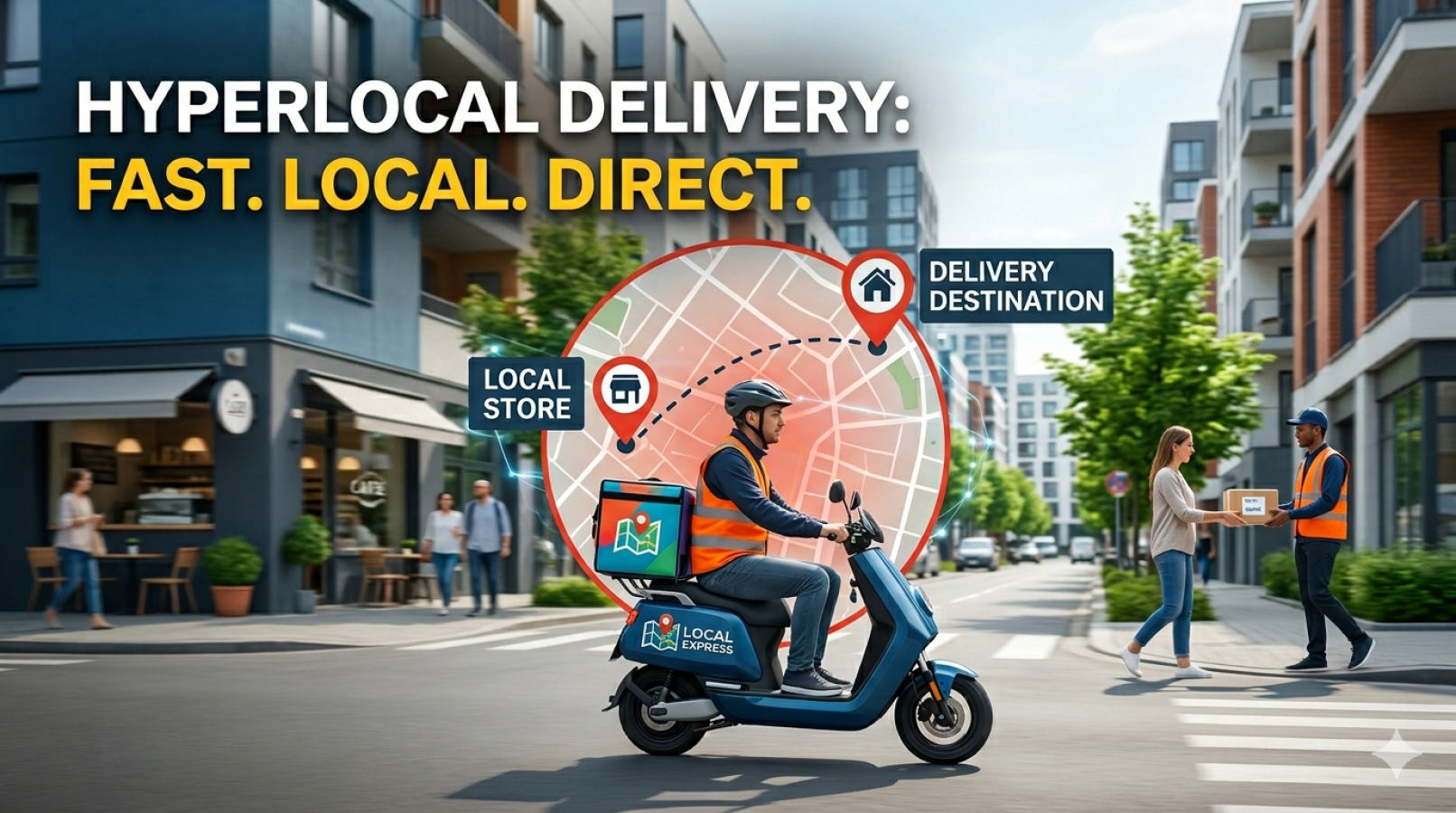
The expectation that a phone, a grocery order, or a household repair item will arrive within an hour or two of being ordered has moved, in just a few years, from a luxury offering in a handful of cities to a baseline expectation in many urban markets. This shift has given rise to an entirely new operational model in last mile logistics: hyperlocal delivery. Built around ultra-fast fulfillment within specific neighborhoods, and increasingly powered by partnerships that convert existing retail stores into localized shipping hubs, hyperlocal delivery is rewriting the playbook for how goods move the final few kilometres to a customer. Understanding what it is, why it has emerged, and what operational capabilities it depends on is essential for any business considering whether and how to participate.
What Is Hyperlocal Delivery
Hyperlocal delivery refers to a fulfillment model in which orders are picked, dispatched, and delivered within a tightly defined geographic area, typically a single neighborhood or a small cluster of adjacent neighborhoods, with a delivery promise measured in minutes or a few hours rather than days. Common applications include grocery delivery, restaurant orders, pharmacy fulfillment, convenience goods, and increasingly general retail items that customers expect to receive almost immediately.
What distinguishes hyperlocal delivery from traditional last mile logistics is the compression of every operational layer. The fulfillment location is close to the customer, often a few minutes away rather than hours. The picking process is fast, supported by simplified inventory management and short-shelf inventory selection. The dispatch decision happens in seconds rather than as part of an overnight planning cycle. The delivery itself is executed on bikes, scooters, or compact vehicles rather than vans or trucks, allowing easy navigation of dense urban streets. The result is an end-to-end flow that delivers within an hour or two of order placement, with some markets pushing the standard toward thirty minutes or less.
The Rise of Neighborhood-Scale Fulfillment
Several factors have converged to make hyperlocal delivery economically viable in ways it was not a decade ago. Smartphone penetration has put a frictionless ordering interface in the hands of nearly every urban consumer. Mobile payment infrastructure has eliminated checkout barriers. Mapping and location intelligence have advanced to the point where dispatching, routing, and tracking at small scale and high speed are technically achievable. And on the demand side, consumers have grown accustomed to the convenience of same-day and same-hour delivery in adjacent categories, lowering the psychological barrier to ordering anything from a screwdriver to a bottle of milk on demand.
According to research summarized by McKinsey and Company, quick commerce and hyperlocal models have grown faster than almost any other segment of retail in recent years, with consumers in major urban markets now expecting delivery windows that would have been considered impossible a decade ago. The growth has been particularly strong in densely populated cities where the operational economics of short-radius delivery work in favour of high order density and low travel times.
The Retail-as-Hub Model
One of the most consequential operational innovations enabling hyperlocal delivery is the conversion of existing retail stores into localized shipping hubs. Rather than building new dark stores or micro-fulfillment centres from scratch, logistics providers and platforms increasingly partner with neighbourhood retailers, pharmacies, supermarkets, and convenience stores to use their existing footprint as the staging point for hyperlocal orders.
The model is appealing for several reasons. The infrastructure already exists, eliminating the capital expenditure and lead time required to build dedicated fulfillment facilities. The inventory is already in place, often replenished daily through normal retail supply chains, which removes the additional inventory management overhead a separate fulfillment operation would require. The geographic distribution is already optimized for neighbourhood coverage, since retailers naturally locate where customer density justifies their presence. By tapping into this existing network, hyperlocal platforms can launch in new neighbourhoods quickly and at a fraction of the cost of building dedicated fulfillment infrastructure.
For retailers, the partnership opens an incremental sales channel without major operational disruption. Orders placed through the hyperlocal platform are picked from existing shelves by trained pickers, handed off to delivery couriers, and delivered to customers who would not otherwise have visited the store. The store earns margin on transactions it would not have captured, and the platform extends its footprint without infrastructure investment.
The Operational Challenge of Hyperlocal
The simplicity of the user-facing promise hides a substantial operational challenge. Hyperlocal delivery compresses every traditional logistics decision into seconds. Where a conventional last mile operation might plan routes overnight for next-day execution, a hyperlocal operation must decide, at the moment an order arrives, which store to fulfill from, which courier to dispatch, what route they should follow, and how that decision affects every other order currently in flight. Each of these decisions must be made in real time, often within milliseconds, and must remain coherent as new orders arrive every second.
The complexity scales nonlinearly. A platform handling 100 orders per hour across a city can manage with relatively simple dispatch logic. The same platform handling 1,000 orders per hour, or 10,000, faces a continuously shifting optimization problem in which courier positions, order priorities, store inventory levels, traffic conditions, and customer expectations all change minute by minute. Solving this problem reliably is the operational core of hyperlocal delivery, and it is the area where purpose-built location intelligence and routing technology delivers the most value.
Network Design and Dark Store Strategy
Before any single order is dispatched, the underlying network must be designed correctly. Which retail partners or dark stores should the platform onboard in each neighbourhood? Where are the gaps in coverage? Which areas have enough demand density to justify additional fulfillment nodes? These are network design questions that determine the long-term economics of a hyperlocal operation more than any single dispatching decision.
The Maponomy Network Optimiser, part of the Maponomy Delivery Planner Suite, supports this strategic layer by analyzing the geographic distribution of demand, the locations of candidate fulfillment partners, and the travel time characteristics of the local road and street network. By modelling different network configurations against expected order patterns, the platform identifies the placement of stores or hubs that maximizes coverage while minimizing the cost of delivery. As demand patterns shift, the Network Optimiser can rerun the analysis to inform decisions about adding new partners, retiring underperforming nodes, or restructuring service zones.
Real-Time Dispatch and Order Allocation
When an order is placed, the platform has seconds to make a series of interconnected decisions: which fulfillment partner can pick the order fastest, which courier is best positioned to deliver it, and how the assignment affects every other open order in the system. This is the heart of hyperlocal operations, and it requires a dispatching engine built specifically for high-throughput, real-time decision making.
The Maponomy Automated Dispatch Planner and the Maponomy Delivery Optimization Tool handle this layer. They consume live data on courier positions, order queues, store readiness, and travel times, and assign each new order to the fulfillment partner and courier combination that minimizes total system cost while respecting promised delivery windows. The dispatching engine continuously rebalances as conditions change, reassigning orders if a courier becomes available sooner than expected, or routing new orders to an alternative store if the closest one is temporarily overwhelmed.
This continuous, real-time optimization is what allows a hyperlocal platform to maintain ultra-fast delivery promises at scale. Without it, the system either over-promises and misses deadlines, or under-promises and surrenders the speed advantage that defines the category.
Route Planning at Hyperlocal Scale
Even though hyperlocal delivery involves shorter routes than conventional last mile operations, the routing layer remains critical. Couriers often carry multiple orders simultaneously, picking up from one or more stores and delivering to several customers in a single trip. Sequencing these stops optimally, while respecting order time windows and minimizing courier idle time, is a routing problem that occurs continuously throughout the day.
The Maponomy Route Planner and Maponomy Directions and Routes APIs provide the underlying routing intelligence. The Distance Matrix API computes the travel times between every relevant pickup and delivery point, and the Route Planner uses these as the cost input for sequencing each courier’s trip. Because the road network, traffic conditions, and order pool are constantly shifting, the routing layer is invoked many times per hour, producing fresh sequences that reflect current conditions rather than stale assumptions made hours earlier.
Live Tracking and Customer Experience
The customer experience in hyperlocal delivery is shaped almost entirely by the live tracking and notification layer. Because the delivery promise is so short, customers expect to see continuous progress updates from the moment they place the order to the moment the courier arrives at their door.
Trackonomy, the Maponomy live tracking suite, provides this visibility. The Live Tracking Dashboard gives dispatchers and operations teams a real-time view of every active courier, every pending order, and every potential delay, allowing intervention before a problem reaches the customer. On the customer side, real-time notifications deliver updates at each meaningful milestone: order accepted, picker assigned, courier en route, courier arriving. These notifications anchor the customer experience and reduce the friction that comes from uncertainty about when a delivery will actually arrive.
The combination of internal dispatch visibility and external customer communication, both drawing on the same live tracking infrastructure, ensures that the experience promised at order placement is the experience delivered at the doorstep.
The Courier Experience and Visual Confirmation
The courier is the final point of execution in hyperlocal delivery, and the tools available to them determine whether the optimized plans produced upstream actually translate into successful deliveries on the ground. The Maponomy Courier Navigation app delivers each courier their optimized sequence of pickups and deliveries, with turn-by-turn navigation tuned for the vehicle type, integrated proof of delivery capture, and direct communication with the dispatcher and customer.
In dense urban environments, even the final few metres of a delivery can be challenging. The Maponomy Dashcam and Streetview Navigation Interface provides couriers with visual context for each destination, helping them identify the correct entrance, gate, or storefront quickly. For dispatchers, the same interface supports verification of delivery points and accountability across the courier fleet, ensuring that every part of the operation operates on the same visual ground truth.
Conclusion
Hyperlocal delivery represents one of the most significant operational shifts in last mile logistics in recent memory. By compressing fulfillment radius to a single neighbourhood, leveraging existing retail infrastructure as localized shipping hubs, and rebuilding dispatch, routing, and tracking systems for real-time decision making, hyperlocal platforms are delivering speeds that would have been unimaginable a decade ago. The operational complexity behind the simple consumer promise is substantial, and it is met only by purpose-built location intelligence and routing technology. A unified platform such as Maponomy, spanning the Search and Place API, Directions and Routes APIs, Delivery Planner Suite, and Trackonomy live tracking, provides the integrated foundation hyperlocal operations require, from network design through real-time dispatch to courier execution and customer notification. For businesses entering or scaling in this category, choosing the right operational backbone is no longer a back-office decision. It is the difference between meeting the hyperlocal promise and breaking it.