
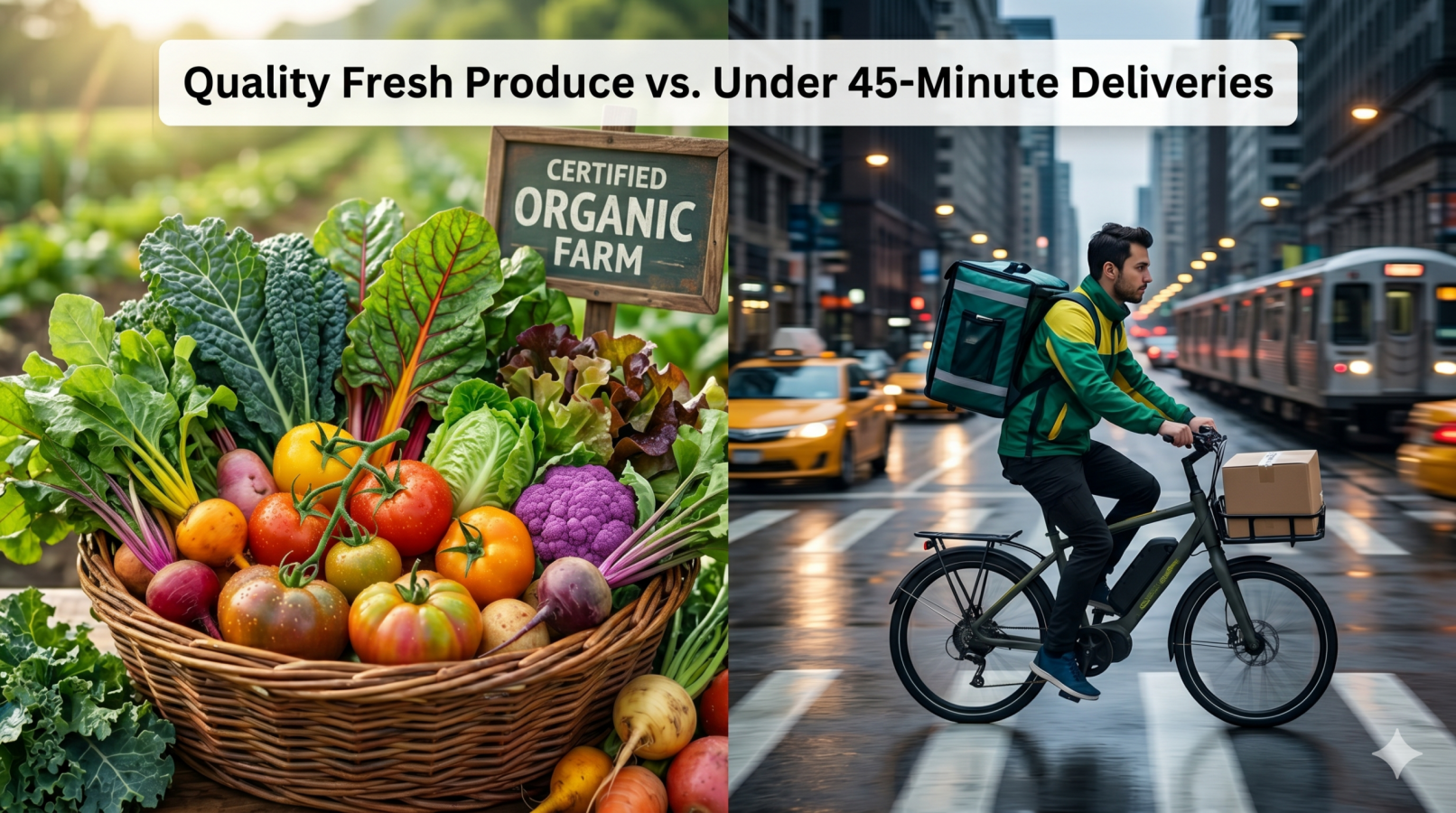
Industry research summarised by Statista forecasts the addressable market size of quick commerce in India to grow into the tens of billions of dollars over the coming years, with tens of millions of households actively transacting. The Indian online grocery market is similarly expected to expand at double-digit growth rates as more consumers shift weekly grocery and fresh produce purchases online. With fresh produce quick commerce gaining traction, food retail in India is set to undergo a substantial revolution.
This massive scope has fuelled the rise of sub-45 minute delivery businesses, some pushing the bar down to ten minutes for everyday groceries. Yet many consumers, particularly in Tier 2 and Tier 3 cities, still hesitate to buy fruits, vegetables, dairy, and meats online. Concerns about freshness, the inability to physically inspect produce before purchase, and the cultural value placed on traditional grocery shopping all contribute. To unlock mass adoption, quick commerce businesses must ensure that what arrives at the customer’s door is just as fresh as what they would have selected themselves. The quality of fresh produce, in other words, is the single most important brand differentiator in the category. This article examines the bottlenecks involved and shows how the location intelligence and delivery orchestration layer underneath modern quick commerce platforms tips the balance in favour of consistent quality.
The Time-Quality Equation in Fresh Produce
Quality in fresh produce is fundamentally a function of time. Every additional minute that a tomato spends outside cold storage, every additional minute that a litre of milk sits in an insulated bag during transit, every additional minute that a delivery rider takes to find the correct customer entrance, is a minute during which freshness is degrading. India’s range of climatic zones, from temperate northern hills to humid coastal plains to arid central plateaus, amplifies this effect. Fresh produce that might tolerate two hours in transit during a European winter has a far shorter window in an Indian summer.
This is why quick commerce, despite the operational complexity, is structurally the right model for fresh produce. The shorter the time from harvest to dark store to customer, the higher the quality on arrival. Every minute saved across the operational chain translates directly into measurable freshness at the doorstep. And while inventory management, cold storage, and sourcing innovations matter enormously, the largest controllable variable in a quick commerce delivery is the time spent in the last mile itself.
Bottlenecks in the Last Mile
Quick commerce platforms running sub-45 minute promises typically lose more time than they should at predictable points in the operational flow. Dark stores or partner retail outlets may be placed without enough density to cover the relevant demand area within the time budget. Customer addresses entered at checkout may be incomplete, ambiguous, or wrong, sending riders on detours. Routing engines may operate on imprecise coordinates that estimate travel times inaccurately and produce promises the operation cannot keep. Dispatch decisions may be made too slowly to match orders to the closest available rider in real time. Riders may struggle to identify the correct entrance among rows of similar storefronts or apartment blocks, losing minutes at the final leg of each delivery. Tracking and notification systems may rely on raw GPS data that customers cannot interpret, generating support calls that consume operational bandwidth.
Each of these bottlenecks adds time. Each minute of added time degrades the quality of the fresh produce in transit. And each unit of degraded quality erodes the customer trust that quick commerce operators are trying so hard to build.
Network Design: Placing Dark Stores Where They Matter
The first and most strategic place where location intelligence supports fresh produce quick commerce is in the design of the fulfillment network itself. A sub-45 minute promise is only achievable if the dark store, partner retail outlet, or micro-fulfillment hub is genuinely close enough to the customer to satisfy the time window after picking and dispatch are accounted for. Network design that places hubs in suboptimal locations imposes a permanent time penalty that no amount of routing or rider effort can recover.
The Maponomy Network Optimiser, part of the Maponomy Delivery Planner Suite, supports this strategic layer by analysing the geographic distribution of demand, the locations of candidate fulfillment partners, and the travel time characteristics of the local road and street network. Working alongside the Maponomy Search and Place API, planners can model different network configurations against expected order patterns to identify the placements that maximise coverage of high-frequency fresh produce buyers within the time budget that the category requires. As demand patterns evolve, the same toolkit supports the ongoing decisions about adding new hubs, retiring underused ones, and reshaping service zones to keep pace with the market.
Address Quality: Eliminating the Time Sinks Before They Start
Even with a well-designed fulfillment network, every individual delivery can still lose time to bad address data. A delivery rider sent to the wrong street, the wrong building, or the wrong gate may take ten or fifteen extra minutes to recover, which in a quick commerce context is enough to push a delivery past its quality window. According to industry analysis cited by Capgemini, poor address data remains one of the leading drivers of failed and delayed deliveries across the industry. For fresh produce, where delay translates directly into degraded quality, this is not a peripheral concern. It is a core operational risk.
The Maponomy Address Parsing API, part of the Search and Place API, addresses this challenge directly. It accepts raw address input, breaks it into structured components according to the conventions of the country it belongs to, standardises the formatting against authoritative reference data, and returns a clean, deliverable record. Whether addresses arrive through a customer-facing checkout, a bulk import from a partner, or a legacy migration, the parsing engine ensures that what enters the delivery pipeline is already validated rather than a guess that the system will have to correct later. Every address parsed and standardised at intake is a delivery that will not lose minutes to a rider correcting a wrong destination on the road.
Precise Geocoding and Real-Time Dispatch: Making the 45 Minute Promise Realistic
Address quality without geocoding precision is only half of the solution. The routing engine that orchestrates the quick commerce operation needs to know not just that an address is real but where exactly that address sits on the ground. A coordinate placed even 100 metres away from the actual delivery point can shift the calculated travel time by a minute or more, which is the kind of error that pushes a 43 minute delivery promise into a 46 minute reality.
The Maponomy Geocode API returns coordinates that correspond to the actual delivery point rather than approximated street centroids or block midpoints. The Maponomy Distance Matrix API then computes the travel times between every relevant origin and destination, feeding the routing layer the cost matrix it needs to sequence riders against realistic time budgets. The Maponomy Automated Dispatch Planner consumes this information continuously, assigning each new order to the rider and fulfillment node combination that minimises total time to the customer while respecting promised delivery windows. For quick commerce platforms running on tight time budgets, this combination of precise geocoding, accurate travel-time computation, and real-time dispatch optimisation is what makes the difference between routing promises the operation can actually meet and routing promises that look good in the planning console but fail in execution.
Real-Time Tracking: Closing the Loop With Customers
Quick commerce customers expect to see exactly where their order is at any moment from the time they place it to the time it arrives. A black box between order placement and doorstep, even one that resolves in under 30 minutes, generates support calls, customer anxiety, and lower repeat purchase rates. The live tracking layer is therefore not just an operational tool. It is a customer experience requirement.
The Maponomy Reverse Geocoding API converts the continuous stream of GPS pings from each rider’s device into readable address updates that populate the dispatcher’s console and the customer’s tracking screen. Trackonomy, the Maponomy live tracking suite, brings this together with vehicle telematics, historical tracks, and real-time customer notifications. The Live Tracking Dashboard gives dispatchers a unified view of every active rider and every potential delay, allowing intervention before a quality-affecting delay surfaces. On the customer side, the same infrastructure powers notifications like the rider being two streets away or approaching the building, anchoring the customer experience and reducing the support load that comes from delivery uncertainty. For fresh produce, where the time-quality relationship is direct, this kind of closed-loop visibility is what allows operators to manage exceptions before they become customer disappointments.
Visual Context: The Last Few Metres of a Delivery
Even after the rider arrives at the correct coordinate, the final identification of the right entrance, the right gate, or the right storefront can take longer than it should in dense urban environments, gated complexes, and mixed-use buildings. These final few metres are where many otherwise-perfect quick commerce deliveries lose precious minutes, and where the fresh produce inside the rider’s insulated bag continues to degrade while the rider walks the block trying to find the address.
The Maponomy Dashcam and Streetview Navigation Interface closes this last-metres gap by combining real-time dashcam footage with interactive streetview imagery, giving each rider an on-the-ground visual reference for the destination before they leave the vehicle. The Maponomy Courier Navigation app, part of the Delivery Planner Suite, delivers this visual context directly into the rider workflow alongside the optimised stop sequence, turn-by-turn navigation, integrated proof of delivery capture, and direct communication with the dispatcher. Together these capabilities mean that the rider arriving at a fresh produce delivery has a continuously refreshed visual reference for the destination, not a guess based on an outdated map snippet.
Bringing the Layers Together
Each of these capabilities improves time performance, and therefore quality outcomes, on its own. Their combined effect is far greater than the sum of the parts. A quick commerce platform that places its hubs optimally, parses addresses at intake, geocodes precisely, dispatches in real time, tracks live with reverse-geocoded updates, and supports riders with visual context at the destination is a fundamentally different operation from one that improvises each of those steps from incomplete data.
A unified platform such as Maponomy, combining the Search and Place API for address parsing, geocoding, and reverse geocoding, the Directions and Routes APIs for distance matrix and routing, the Delivery Planner Suite for network design, dispatch, and rider execution, and Trackonomy for live tracking and visual confirmation, provides this integrated foundation for fresh produce quick commerce operations. Because every layer draws from the same coordinated infrastructure, the entire pipeline operates on a consistent view of the world. Coordinates, addresses, dispatch decisions, and visual references all describe the same destinations and stay aligned as the operation unfolds.
Conclusion
The dilemma at the heart of fresh produce quick commerce, balancing quality against the demand for sub-45 minute deliveries, is fundamentally a time problem. The shorter the time from harvest to doorstep, the fresher the produce on arrival. The largest controllable contributor to that time is the last mile itself, and the largest contributor to last-mile time efficiency is the quality of the underlying location data and dispatch orchestration. Network design, address parsing, precise geocoding, automated dispatch, real-time tracking, and visual context together compress the time budget for every delivery, making sub-45 minute promises both realistic and consistent. Investing in a unified delivery and location intelligence platform such as the Maponomy suite is therefore not a peripheral technology decision for quick commerce operators. It is one of the highest-leverage investments available for protecting the fresh produce quality that ultimately determines whether customers come back and the category continues to grow.