
Have you tried every effort to reduce a high Return to Origin rate and still seen no real improvement? It is often the result of missed or late deliveries that trace back not to driver effort but to upstream data quality. In a market where customers can switch providers with a single tap, a business that cannot meet promised delivery windows, offer operational transparency, or actually reach its customers on the first attempt will lose them to a competitor who can.
The prime goal of every online business is to delight its customers by offering top quality products at the most competitive prices within the committed time. Falling short on any of these dimensions, particularly delivery, leads directly to customer dissatisfaction. And as customer expectations rise with each passing year, meeting same-day and next-day promises is no longer a differentiator. It is the baseline. With the right operational foundations, however, businesses can produce a meaningful and lasting increase in their delivery success rate. Before exploring the four most effective levers, it is worth pausing on the underlying question.
Why Does the Delivery Success Rate Matter
To shoot up conversion rate. As industry research from sources such as Capgemini consistently shows, poor delivery experiences are among the largest sources of frustration in online shopping. A majority of customers cite delivery problems as the single most negative aspect of their online purchases, and that perception translates directly into abandoned carts and lost sales.
To increase customer retention. Attracting new customers is expensive. Retaining existing ones is the more durable engine of growth. According to ongoing customer experience research summarized by firms like McKinsey and Company, a substantial share of customers will not return to a retailer after a single bad delivery experience. Every failed delivery, then, is not just the cost of one missed package. It is the loss of a future customer relationship.
To strengthen your brand reputation. Offering safe and timely deliveries alongside quality products contributes to a positive shopping experience and reinforces brand reputation. The reverse is equally true. A brand that becomes associated with delivery problems will struggle to convert even strong product marketing into sustained customer growth.
To achieve customer satisfaction. Even a minor delay in order delivery can affect customer experience and overall satisfaction. Good delivery is not only delivering orders within the committed window. It also incorporates clear and concise communication, multiple delivery options, and real-time delivery updates that keep the customer informed throughout the journey.
How to Shoot Up Your Delivery Success Rate
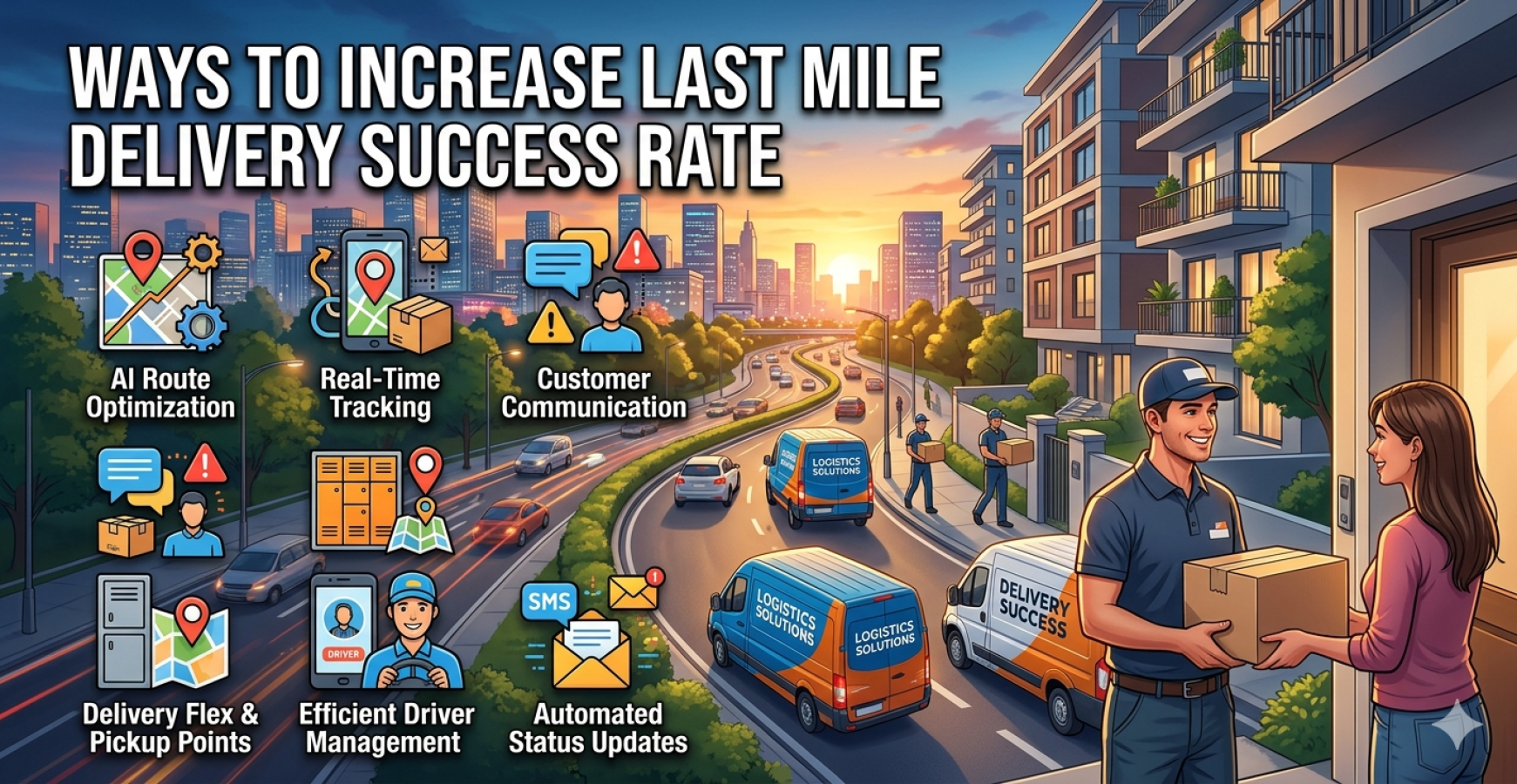
Delivery success is not the responsibility of delivery agents alone. It is the product of every operation that precedes the actual handoff at the doorstep. It is a domino effect: every upstream process affects the one after it, and the quality of the final delivery is determined long before the courier arrives. Most of these upstream processes depend, directly or indirectly, on the quality of the location data flowing through the operation. Here are four proven ways to lift your delivery success rate, with the location infrastructure that makes each of them work.
1. Get the Address Right at Order Intake
Most failed deliveries do not start at the doorstep. They start at the checkout form, when a customer enters an incomplete, malformed, or ambiguous address that no downstream system has the chance to correct. By the time the parcel is in the courier’s hand, the error is already baked into the route, the dispatch, and the promise to the customer. The most cost-effective intervention in delivery success is therefore the one furthest upstream: catching address problems before they enter the pipeline.
The Maponomy Address Parsing API, part of the broader Maponomy Search and Place API, addresses this challenge directly. It accepts raw address input, breaks it into structured components according to the conventions of the country it belongs to, standardizes the formatting against authoritative reference data, and returns a clean, deliverable record. Whether addresses arrive through a customer-facing checkout, a bulk import from a partner, or a legacy migration, the parsing engine ensures that what enters the delivery pipeline is already validated rather than a guess that the system will have to correct later.
This single intervention, parsing and standardizing every address at the point of entry, has an outsized effect on first-attempt delivery success because it removes the root cause of so many failures rather than treating their symptoms further downstream.
2. Geocode Precisely for Route Planning
Once the address is clean, the next step is converting it into a coordinate that the routing system can use. A street address is human-readable. A coordinate is machine-actionable. Route planning, distance matrix calculation, and arrival time estimation all operate on coordinates, and the precision of those coordinates determines how realistic the resulting plan is.
The Maponomy Geocode API converts each validated address into a precise coordinate that corresponds to the actual delivery point, not an approximated street centroid or block midpoint. The difference matters. A coordinate that is even 100 metres off can shift the calculated travel time by a minute or more, sending drivers to the wrong side of a divided road or the wrong end of a long building. Multiplied across the dozens of stops on a typical delivery route, these small errors accumulate into missed time windows and failed deliveries.
The Maponomy Distance Matrix API then takes these precisely geocoded stops and computes the pairwise travel times between them, feeding the routing engine the cost matrix it needs to sequence each driver’s day. Layered on top of this, the Maponomy Delivery Planner Suite turns the matrix into an actionable plan, assigning vehicles, sequencing stops, and dispatching couriers in a single coordinated workflow. The result is route planning that translates from a theoretical exercise into a realistic delivery schedule.
3. Facilitate Real-Time Location Visibility
Enable real-time delivery tracking for logistics managers as well as for end customers. With visibility on both sides, dispatchers can intervene proactively when a delay emerges, and customers can monitor progress without calling a support centre to ask where their order is. Real-time tracking also gives the operations team the information they need to redeploy resources in response to vehicle breakdowns, traffic events, or any other unforeseen circumstance.
Real-time tracking is, however, only as useful as the location data behind it. A vehicle position expressed as a raw latitude and longitude is not actionable to a dispatcher or a customer. It needs to be expressed as an address, a street, a neighbourhood, or a recognizable landmark. The Maponomy Reverse Geocoding API performs this conversion continuously, turning the stream of GPS pings from each courier into readable address updates that populate dashboards and customer-facing tracking pages.
Trackonomy, the Maponomy live tracking suite, brings this together with vehicle telematics, historical tracks, and real-time customer notifications. The Live Tracking Dashboard gives dispatchers a unified view of every active courier and every potential delay, allowing intervention before a problem reaches the customer. On the customer side, the same infrastructure powers notifications like “your driver is two streets away” rather than “your driver is at coordinates 28.6139, 77.2090”, anchoring the customer experience and reducing the support load that comes from delivery uncertainty.
4. Give Drivers Visual Context for the Final Few Metres
Maintain complete transparency with end customers as well as field staff. Even when the address is clean, the coordinate is precise, and the tracking is live, the final few metres of every delivery still come down to a person identifying a specific building, gate, or storefront in front of them. In dense urban areas with repetitive facades, ambiguous signage, or informal addressing conventions, this final visual identification is where many otherwise-perfect routes lose minutes. Multiplied across a day, these minutes turn into missed time windows. Multiplied across a year, they turn into a measurably lower delivery success rate.
The Maponomy Dashcam and Streetview Navigation Interface addresses this by combining real-time dashcam footage with interactive streetview imagery, giving each courier an on-the-ground visual reference for the destination before they leave the vehicle. Instead of stepping out to scan a block of similar storefronts, the driver confirms the right place against the visual reference and proceeds to the handoff.
The Maponomy Courier Navigation app, part of the Maponomy Delivery Planner Suite, delivers this visual context directly into the driver workflow alongside turn-by-turn navigation, proof of delivery capture, and integrated communication with the dispatcher. For operations leadership, the same visual layer supports verification of delivery points after the fact, providing the context needed to distinguish address errors from driver errors from genuine customer-side issues.
Bringing the Four Together
Each of these four levers improves delivery success rate on its own. Their combined effect is far greater than the sum of the parts. A delivery that begins with a parsed and validated address, is routed to a precisely geocoded coordinate, is tracked with reverse-geocoded location updates, and is completed with the help of streetview visual context is fundamentally a different operation from one that improvises each of those steps from incomplete data.
A unified platform such as Maponomy, combining the Search and Place API for address parsing, geocoding, and reverse geocoding, the Directions and Routes APIs for distance matrix and routing, the Delivery Planner Suite for plan generation and courier execution, and Trackonomy for live tracking and visual confirmation, provides this integrated foundation. Because every layer draws from the same coordinated infrastructure, the four levers operate on a consistent view of the world rather than on fragmented information sourced from different providers. Every coordinate, every address, every notification, and every visual reference describes the same delivery, and they remain consistent as the operation unfolds.
Conclusion
A high delivery success rate is not the product of harder-working couriers or tighter delivery promises. It is the product of better data and better coordination flowing through every stage of the delivery pipeline, from the moment a customer enters their address at checkout to the moment the parcel is handed over at the doorstep. Address parsing catches errors at intake. Precise geocoding turns clean addresses into actionable coordinates. Reverse geocoding and live tracking make progress meaningful for dispatchers and customers. Visual context through streetview and dashcam closes the final-few-metres gap that separates a near-perfect plan from a successful delivery. Investing in a unified delivery and location intelligence platform such as the Maponomy suite, spanning the Search and Place API, Directions and Routes APIs, Delivery Planner Suite, and Trackonomy, is one of the highest-leverage actions a delivery business can take to raise its success rate, reduce its Return to Origin volume, and improve the customer experience that ultimately determines whether the business grows or shrinks.